


What if getting a lower interest rate meant putting your home on the line?
Secured loans use collateral, a house or car, so rates often sit around 3%–10% and lenders will lend more.
Unsecured loans don’t ask for property; they rely on your credit and income and usually charge 6%–36%.
Which fits your finances? If you need a large loan or have weak credit but equity, consider secured.
If you can’t risk an asset and have solid credit, unsecured is probably better.
This post shows a simple decision rule to pick the right one.
Core Comparison of Secured and Unsecured Debt Consolidation Loans

A secured debt consolidation loan means you’re putting up collateral. Your home, your car, something valuable. If you can’t pay, the lender takes it. Simple as that. An unsecured loan doesn’t ask for collateral. The lender looks at your credit score, your income, how much debt you’re already carrying. They’re betting on your word.
That one difference changes everything else. How hard it is to get approved, what you’ll pay in interest, how much you can borrow, what happens when things go wrong. Secured loans usually run between 3% and 10% APR if your credit’s decent and you’ve got real equity in whatever you’re pledging. Unsecured rates? They’re all over the place. Anywhere from 6% to 36%, depending on how the lender sees your risk. Because a secured lender can take your house or car if you don’t pay, they’ll approve bigger amounts and sometimes let a weaker credit score slide. Unsecured lenders have nothing to fall back on except your promise, so they’re pickier about who they approve and they cap the loan lower.
Most lenders looking at consolidation want to see credit scores in the mid-600s or better, and a debt-to-income ratio at or below 36%. Hit those marks and you can choose between secured or unsecured. Fall short and a secured loan might be the only affordable option you’ve got. But you’re accepting the trade. Your property’s on the line.
| Feature | Secured Loan | Unsecured Loan | What This Means |
|---|---|---|---|
| Collateral requirement | Home, car, or other asset | None | Secured loans put your property at risk. Unsecured don’t. |
| Typical APR range | 3%–10% | 6%–36% | Secured usually costs less because collateral lowers the lender’s risk. |
| Approval difficulty | Easier with collateral | Stricter credit standards | Secured loans might approve lower scores. Unsecured need stronger profiles. |
| Loan amount limits | Up to $500,000+ (home equity) | Typically $1,000–$100,000 | Secured can handle bigger consolidations. Unsecured cap out lower. |
| Default consequence | Asset seizure (foreclosure/repossession) | Credit damage, collections, lawsuit | Secured loans risk losing your home or car. Unsecured wreck your credit and hit your finances, but they don’t take property. |
| Approval timeline | Slower (appraisal, underwriting) | Faster (same day to one week) | Secured need property valuation. Unsecured can fund fast. |
Understanding Debt Consolidation Loan Structures
A debt consolidation loan rolls two or more balances into one. One lender, one payment, one due date each month. The point is simplicity. No more juggling five different credit cards with five different rates and five different minimums. When your new loan rate’s lower than what you were paying before, or the term’s shorter, you can cut months or years off repayment and save hundreds or thousands in interest.
Most lenders don’t hand you the cash. They send the money straight to your creditors. That keeps you from accidentally spending it and makes sure the old debts actually get paid off. Some require a certain percentage go directly to creditors. Others verify your balances and handle payoffs themselves.
Consolidating works when it simplifies things, lowers your cost, or both. It doesn’t work if you rack up new balances on the cards you just paid off.
Five reasons people consolidate:
- One payment instead of five or ten makes monthly cash flow easier to track.
- Lower interest saves money if the new rate beats your current average.
- Shorter repayment compared to making minimums forever on credit cards.
- Credit score can improve as your credit utilization drops and you make on-time payments.
- Fewer chances to miss a payment and get hit with late fees.
Secured Debt Consolidation Loan Types and How They Work
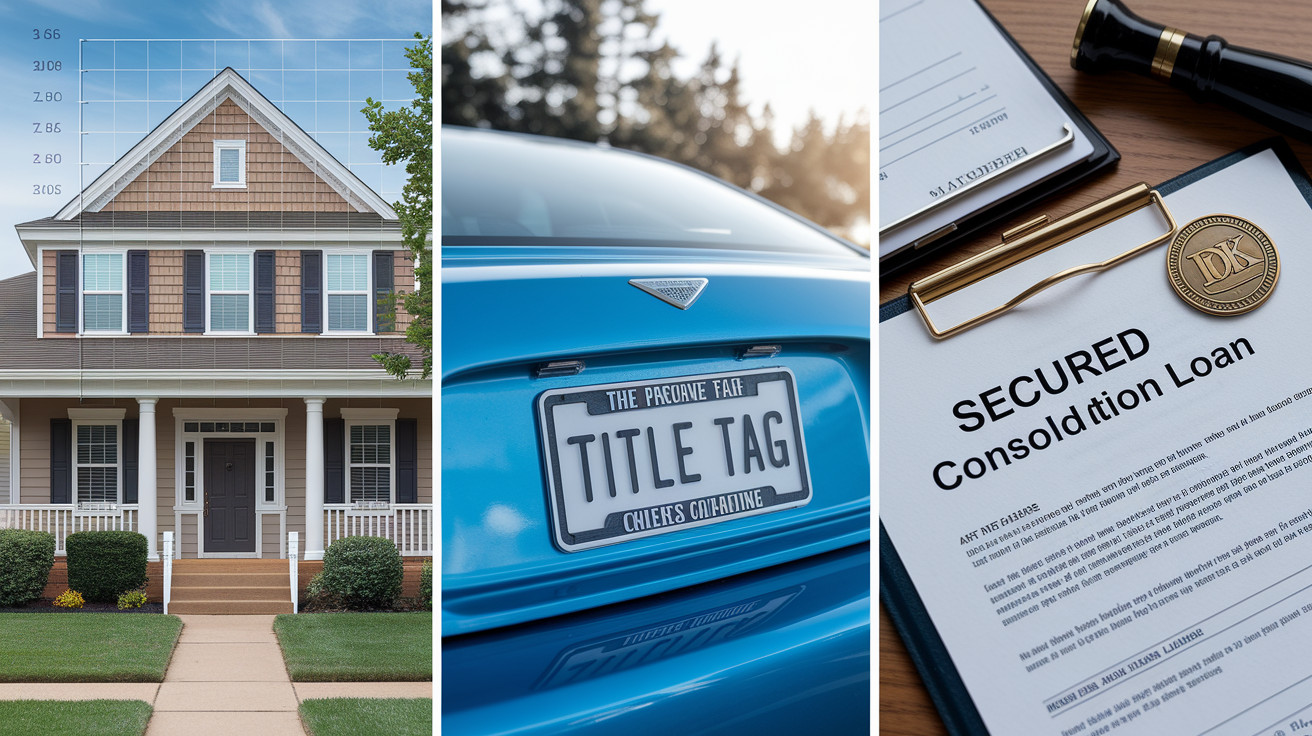
Secured loans come in a few versions. Each one’s backed by a different asset, and that asset determines how much you can borrow, what rate you’ll pay, and what you’ll lose if you default.
Home Equity Loan and Home Equity Line of Credit (HELOC)
A home equity loan lets you borrow against whatever equity you’ve built. Most lenders cap it around 80% to 90% of combined loan-to-value. So if your home’s worth $300,000 and you owe $200,000 on the mortgage, you’ve got roughly $100,000 in equity. A lender might approve $80,000 to $90,000, depending on their rules. Rates often track close to mortgage rates, somewhere between 3% and 10% if your credit’s good.
A HELOC works more like a credit card. You get a draw period, usually 5 to 10 years, where you can borrow and pay back over and over. After that ends, you enter repayment mode for 10 to 20 years, and you’re paying down whatever balance you’ve got left. HELOC rates are usually variable, tied to the prime rate. Your payment can move around.
Both options need a home appraisal. That’s $300 to $700 or more, plus closing costs that can hit 2% to 5% of the loan. Approval takes longer because of all the underwriting and property valuation.
Secured Personal Loan
Some banks and credit unions let you borrow against a savings account or CD you’ve got with them. You pledge the account, freeze access to the funds, and get a loan at a lower rate. Usually just a few points above what the account’s earning. Loan size depends on how much you’ve got in there. Less paperwork than home equity, but your money’s locked up until you pay it back.
Car Title Loan
Car title loans use your vehicle as collateral. Lenders typically offer 25% to 50% of what the car’s worth. Amounts range from $5,000 to $100,000 depending on the vehicle and the lender’s appetite. Rates vary wildly. Get one from a bank or credit union and you might see single digits. Go to a storefront title lender and you’re looking at rates that rival payday loans. Default and they repo the car.
Secured loans give you lower rates and bigger borrowing limits because the lender’s holding your stuff. But that same protection for them is risk for you. Miss payments and you could lose your house or your car. Even after they take it, you might still owe the difference if selling it doesn’t cover what’s left on the loan.
Unsecured Debt Consolidation Loan Types and How They Work
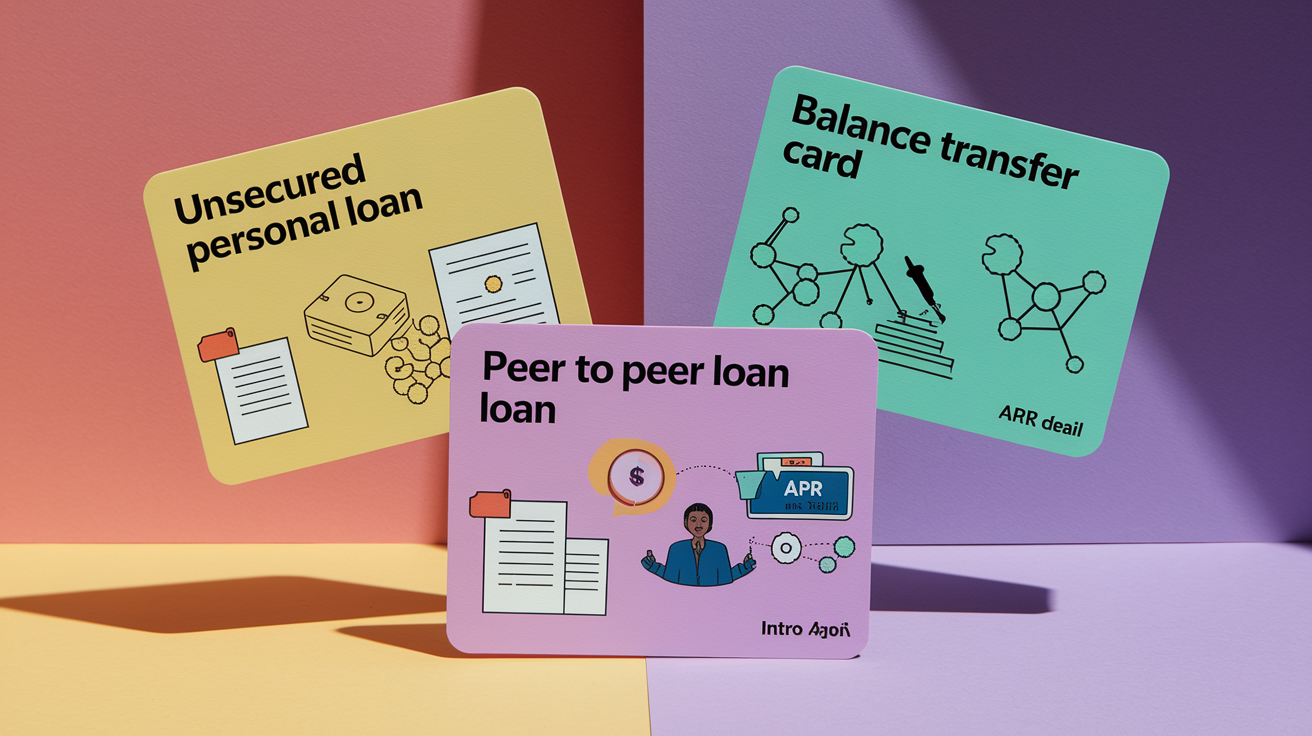
Unsecured loans run on creditworthiness, not collateral. Approval depends on your score, your income, your job history, your debt-to-income ratio. No asset for the lender to grab, so they charge more and get pickier about who qualifies.
Unsecured Personal Loans
These are the most common unsecured consolidation tool. Loan amounts usually run $1,000 to $100,000, though most lenders cap standard approvals somewhere around $35,000 to $50,000. Interest rates go from 6% to 36% depending on your credit. Score above 700 and you’ll probably land in the single digits or low double digits. Somewhere between 620 and 680, expect high teens or low twenties. Terms run 1 to 7 years. Funding’s fast. Often same day or within a few days after approval.
Peer-to-Peer Loans
Peer-to-peer platforms match individual investors with borrowers. You apply, the platform assigns you a risk grade, investors fund your loan in small chunks. Rates and terms look similar to bank personal loans. APRs between 7% and 36%, amounts usually $1,000 to $40,000. Approval and funding timelines are about the same as online lenders. Usually within a week.
Balance Transfer Credit Cards
Balance transfer cards let you move existing credit card debt onto a new card offering 0% APR for an intro period. Typically 12 to 18 months. Most charge a transfer fee, 3% to 5% of what you move. This works best for smaller balances you can kill within the promo window. Carry a balance past that and the standard APR kicks in, often 15% to 25% or higher. You need good to excellent credit to get approved.
| Unsecured Loan Type | APR Range | Typical Loan Limits | Best Use Case |
|---|---|---|---|
| Unsecured personal loan | 6%–36% | $1,000–$100,000 | Medium to large balances with a fixed repayment timeline |
| Peer-to-peer loan | 7%–36% | $1,000–$40,000 | Borrowers who like platform transparency and investor funding |
| Balance transfer card | 0% intro, then 15%–25%+ | Credit limit (often $5,000–$25,000) | Small balances you can wipe out within 12–18 months |
Interest Rates, Loan Terms, and Total Cost Differences
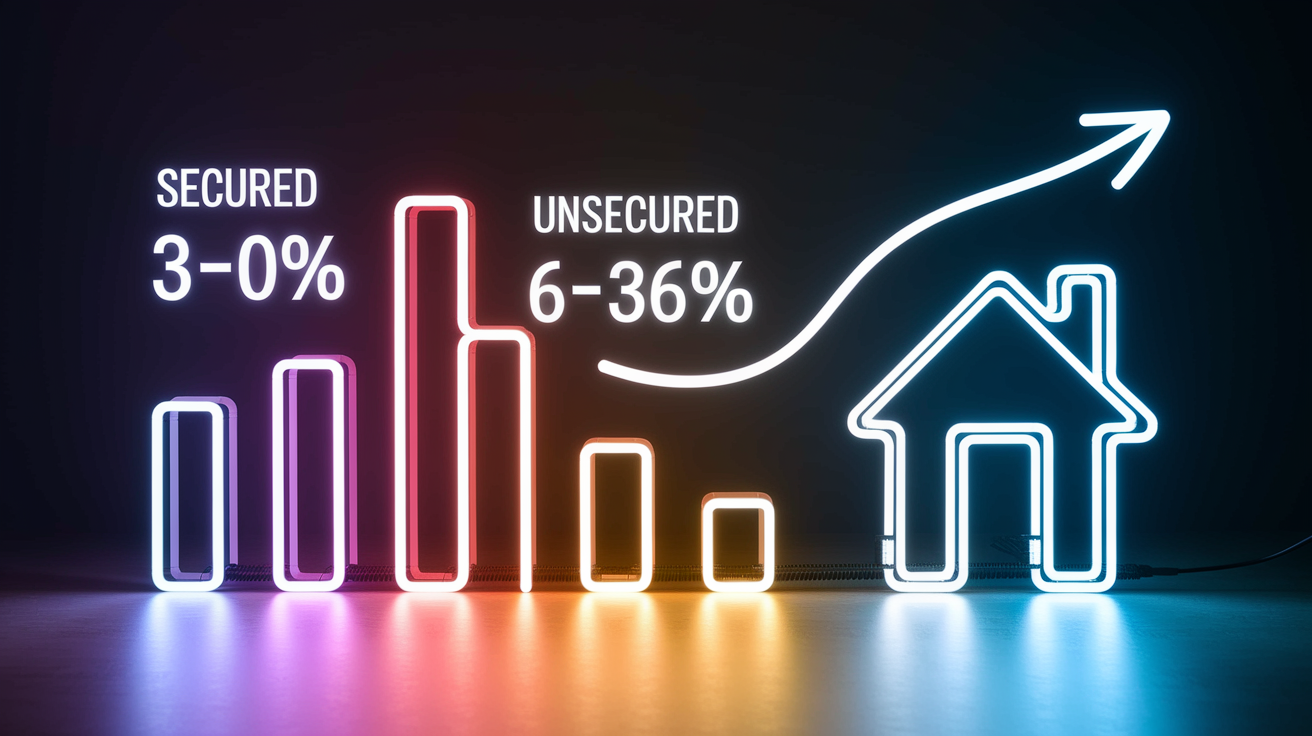
Secured loans usually run 3% to 10% APR for people with decent credit and enough collateral. Unsecured stretch from about 6% for excellent credit all the way to 36% for subprime borrowers. That gap exists because collateral cuts the lender’s risk. Pledge your home or car and the lender knows they can recover most of their money even if you stop paying. No collateral means they price in the chance they lose everything.
Terms differ too. Unsecured personal loans typically run 1 to 7 years. Most people pick 3 to 5 years to balance the monthly payment with total interest. Secured home equity loans and HELOCs stretch way longer. A HELOC might give you a 10-year draw period and then a 20-year repayment phase. Home equity loans can go 5 to 30 years. Longer terms shrink your monthly payment but jack up lifetime interest. A 10-year loan at 6% APR costs way more than a 3-year loan at the same rate, even though the monthly hit is lighter.
| Item | Secured Loan Typical Range | Unsecured Loan Typical Range | Impact on Borrower |
|---|---|---|---|
| APR | 3%–10% | 6%–36% | Lower secured rates cut your monthly payment and total interest. Higher unsecured rates increase cost. |
| Loan term | 5–30 years (home equity) | 1–7 years | Longer secured terms lower monthly cost but raise lifetime interest. Shorter unsecured terms limit total interest but need higher payments. |
| Origination fees | $500–$5,000 or 2%–5% closing costs | 0%–8%, commonly 1%–6% | Secured closing costs can eat into rate savings. Unsecured fees are usually lower but get added to what you finance. |
| Prepayment penalties | Rare but possible | Rare but check terms | Prepayment fees block early payoff savings. Always verify. |
Longer repayment feels easier month to month but quietly balloons what you pay over time. A 30-year home equity loan might cut your payment in half compared to a 5-year unsecured loan. But you’re paying interest for three decades. Run the full amortization before you sign anything.
Credit Requirements and Eligibility Criteria for Each Loan Type
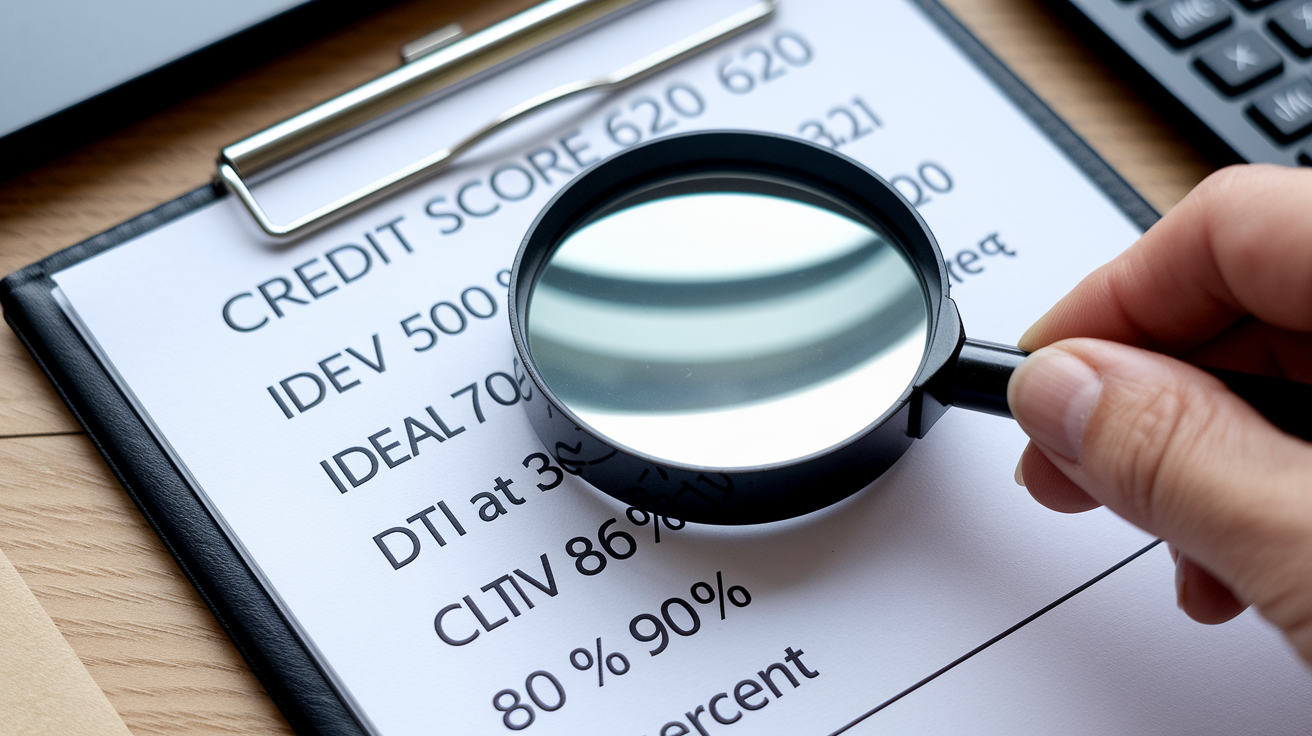
Most consolidation lenders want a credit score around 620 minimum. Below that, approvals dry up and rates spike. Unsecured lenders get even stricter. Competitive rates usually need scores around 700 to 740 or better. Borrowers in the 620 to 680 range can still get unsecured loans, but you’re looking at APRs in the high teens or twenties.
Secured loans care more about collateral value and equity than your credit score alone. If you’ve got serious home equity or a paid-off vehicle, some lenders will approve you with a score in the low-to-mid 600s. Your rate won’t be great, but the asset lowers the lender’s risk enough that they’ll overlook credit problems.
Debt-to-income ratio is the other major gate. Most lenders want DTI at or below 36%, though some go to 43%. DTI compares your monthly debt payments (including the new loan you’re applying for) to your gross monthly income. If you make $5,000 a month and your total monthly debt would be $2,000, your DTI’s 40%. Lenders worry that a high DTI leaves no cushion for emergencies. Secured loan underwriters also check combined loan-to-value for home equity products, usually capping CLTV around 80% to 90% of the home’s appraised value.
Documents lenders usually ask for:
- Recent pay stubs or proof of income (W-2s, tax returns if you’re self-employed)
- Bank statements from the past two or three months
- Proof you own the collateral (mortgage statement, vehicle title, account statements)
- List of current debts with balances, creditors, and monthly payments
- Government ID and Social Security number for the credit check
A lot of lenders offer pre-qualification or soft rate checks. These estimate your approval chances and likely APR without dinging your credit. Use those to compare offers before you formally apply and trigger a hard pull that can knock a few points off your score temporarily.
Pros and Cons of Secured vs Unsecured Consolidation Options
Secured loans deliver lower interest because the lender’s holding your property. That collateral also makes approval easier for people with fair credit or higher debt loads. Loan limits climb higher, sometimes into six figures for home equity, so you can consolidate big balances under one roof. Monthly payments often drop thanks to the lower rate and longer terms you can get.
But secured loans carry serious risk. You’re putting a valuable asset on the table. Default on a home equity loan and the lender forecloses. Default on a car title loan and they repo your vehicle. Even after they take the asset, you might still owe money if selling it doesn’t cover what’s left. Secured loans also take longer to close because of appraisals and title work, and you’ll pay upfront costs like appraisal fees ($300 to $700 or more) plus closing costs that can hit several thousand dollars.
Secured loan pros:
- Lower APR compared to unsecured
- Higher loan amounts (up to $500,000 or more with home equity)
- Easier approval for lower credit scores or higher DTI
- Longer repayment terms, which shrink the monthly payment
- Can boost your credit score over time through on-time payments and lower credit utilization
Secured loan cons:
- Risk losing your home, car, or other asset if you default
- Longer approval because of appraisal and underwriting
- Upfront costs (appraisals, closing fees) can run thousands
- Longer terms mean more lifetime interest
Unsecured loans protect your assets. No collateral means no foreclosure or repo risk if you fall behind. Approval and funding happen fast, often within days, and you skip appraisal fees and closing costs. Shorter loan terms limit total interest paid, and fixed-rate structures give you predictable monthly payments.
The downsides are higher rates and tougher qualification standards. If your credit score’s below 700, expect double-digit APRs that might rival or beat your current credit card rates. Loan amounts cap lower, and lenders scrutinize income and DTI harder. Fair credit and sketchy income documentation can shut you out of unsecured approval entirely.
Unsecured loan pros:
- No collateral needed. Assets stay safe even if you default.
- Fast approval and funding, often same day or within a week
- Lower upfront costs (no appraisal or closing fees)
- Shorter repayment terms cut lifetime interest
Unsecured loan cons:
- Higher APR, especially if your score’s below 700
- Stricter credit and income requirements
- Lower loan limits, often capping around $50,000
- Default still trashes your credit and can lead to collections or lawsuits
Real-World Examples Comparing Secured and Unsecured Costs

Numbers tell the real story. Say you need to consolidate $30,000 of credit card debt currently running 20% APR. You get approved for a secured home equity loan at 5% APR or an unsecured personal loan at 15% APR. Both 60-month terms.
The secured loan at 5% gives you a monthly payment around $566. Over five years, you’ll pay about $33,960 total. Roughly $3,960 in interest. The unsecured loan at 15% pushes your monthly to around $714. Total paid climbs to about $42,857, with around $12,857 in interest. That’s a $148 monthly difference and nearly $8,900 more in interest over the life of the loan.
| Scenario | APR | Monthly Payment | Total Interest Paid |
|---|---|---|---|
| $30,000 secured loan, 60 months | 5% | ≈ $566 | ≈ $3,960 |
| $30,000 unsecured loan, 60 months | 15% | ≈ $714 | ≈ $12,857 |
| $10,000 secured loan, 36 months | 8% | ≈ $314 | ≈ $1,300 |
| $10,000 unsecured loan, 36 months | 18% | ≈ $361 | ≈ $3,014 |
For a smaller balance, say $10,000 over 36 months, the gap narrows but it’s still real. A secured loan at 8% APR runs about $314 a month with roughly $1,300 in interest. An unsecured loan at 18% APR costs around $361 a month with about $3,014 in interest. That’s a $47 monthly difference and roughly $1,700 over three years.
Savings from a secured loan grow as the balance and term increase. But remember what you’re trading. Those savings come from pledging your home or car. If your income gets shaky or an emergency drains your savings, a missed payment on a secured loan puts your property at risk. The lower rate only matters if you can reliably make every payment.
Choosing the Right Loan Based on Your Financial Situation
Start by checking your credit score and calculating your debt-to-income ratio. If your score’s above 700 and your DTI’s under 36%, you’ll probably qualify for competitive unsecured rates in the single digits to low teens. If the rate difference between secured and unsecured is only a few points and your balance is moderate (under $30,000, say), an unsecured loan protects your assets without a massive cost penalty.
If your credit score’s below 680 or your DTI’s pushing 40%, secured loans might be the only affordable path. A 10-point spread in APR (7% secured versus 17% unsecured, for example) makes a secured loan way cheaper over time, even after you account for closing costs. But only go that route if you’ve got stable income and confidence you can meet every payment. One layoff or medical bill shouldn’t put your home on the line.
Six steps to figure out which loan fits:
- Pull your credit report and check your score. Above 700 unlocks better unsecured rates. Below 640, secured might be your only reasonable shot.
- Calculate your debt-to-income ratio. Divide total monthly debt payments (including the new loan estimate) by gross monthly income. Keep it at or below 36% for best approval odds.
- Inventory your collateral. Do you own a home with at least 20% equity? A paid-off car worth $10,000 or more? If not, secured loans aren’t on the table.
- Compare APR offers from at least three lenders, both secured and unsecured. Use pre-qualification tools to avoid hard credit pulls until you’re ready to apply.
- Estimate total cost for each option. Multiply the monthly payment by the number of months, then add any origination fees or closing costs. Compare the all-in numbers, not just the monthly payment.
- Weigh risk. If losing your home or car would be catastrophic, choose unsecured even if it costs more. If you’re confident in your income and the secured APR’s 5+ points lower, the savings usually justify the collateral risk for large balances.
Asset protection matters. A few thousand dollars in extra interest is a small price compared to foreclosure or repossession. But if you’re consolidating $50,000 or more and you can cut your rate from 18% to 6%, the secured option could save you tens of thousands over the loan term.
Alternatives to Secured and Unsecured Consolidation Loans
Consolidation loans aren’t the only way to handle multiple debts. If you’re unsure about taking on a new loan, or if your credit and income don’t qualify you for decent terms, here are other options.
Debt management plans from nonprofit credit counseling agencies can eliminate debt in 3 to 5 years through one monthly payment. The agency negotiates with your creditors to cut interest rates and waive fees, then you pay the agency and they distribute funds to creditors. Your accounts close during the plan and you can’t take on new credit, but there’s no loan and no collateral risk. Credit counseling agencies offer free consultations to review your finances, build a budget, and figure out whether a debt management plan fits.
Balance transfer credit cards work for smaller balances if your credit’s good. Move existing credit card debt onto a card offering 0% APR for 12 to 18 months. Pay down the balance hard during the promo period to dodge interest. Watch for balance transfer fees (usually 3% to 5%) and make sure you can pay off the balance before the standard APR kicks in.
Six alternatives to consolidation loans:
- DIY debt payoff plans using the avalanche method (highest interest first) or snowball method (smallest balance first)
- Credit counseling and debt management plans through nonprofit agencies
- Balance transfer credit cards with 0% intro APR periods
- Negotiating directly with creditors for lower rates or hardship programs
- Debt settlement programs (watch out for for-profit companies. Serious credit damage and tax consequences.)
- Bankruptcy as a legal option for overwhelming debt (Chapter 7 or Chapter 13)
You can get your free credit report from all three bureaus once a year at https://www.annualcreditreport.com. Review it before you apply for any loan or debt relief program to confirm it’s accurate and see where you stand. On-time payments and cutting your debt-to-income ratio improve your credit score over time, opening up better loan options down the road even if you don’t qualify for the lowest rates today.
Final Words
We jumped straight into the differences: secured loans use collateral so they often bring lower APRs and higher limits but carry asset risk, while unsecured loans rely on credit and usually mean higher rates. You also saw common loan types, rate ranges, qualifying rules, pros and cons, and real cost examples.
If you have large balances or weaker credit, secured loans can cost less. If you want speed and no lien on your things, unsecured may be better. Next step: get prequalification quotes for both and compare APR, fees, and monthly payment.
Use the secured vs unsecured debt consolidation loans comparison to pick the option that fits your budget and comfort with risk, and you’ve got a clear path forward.
FAQ
Q: What is the difference between a secured and unsecured debt consolidation loan?
A: The difference is secured loans use collateral (home or car) so they usually have lower APRs (≈3–10%) and bigger limits; unsecured loans need no collateral but carry higher APRs (≈6–36%) and stricter credit.
Q: How much is the payment on a $50,000 consolidation loan?
A: The payment on a $50,000 consolidation loan depends on rate and term; for example, 60 months at 5% ≈ $944/month, at 10% ≈ $1,062/month — use a loan calculator for exact figures.
Q: Is a secured loan a good idea for debt consolidation?
A: A secured loan can be a good idea when lower APRs and bigger limits cut enough interest to justify risking collateral; choose it for large balances or weaker credit, but weigh foreclosure or repossession risk.
Q: How to pay off $30,000 in debt in 1 year?
A: To pay off $30,000 in one year you need about $2,500 a month plus interest; cut expenses, boost income, use low-rate consolidation or attack highest-rate debts and apply every extra dollar.