


Think rolling all your cards into one loan will always save you money? Think again.
A debt consolidation loan calculator gives the answer in clear numbers.
It takes each balance, APR (annual percentage rate), and monthly payment, then shows a single loan’s monthly payment, total interest, and payoff date for whatever APR and term you choose.
This post shows how the calculator works, what to plug in, and how to run quick scenarios so you can see real savings (or costs) and pick the plan that fits your budget.
First step: grab your latest statements.
Core Functionality of a Debt Consolidation Loan Calculator

A debt consolidation loan calculator takes your existing debts and shows what one replacement loan would look like. You enter each debt separately, then play with consolidation terms to see if you’re actually saving money, dropping your monthly payment, or getting out of debt faster.
The calculator figures out the weighted average of your current interest rates, adds up your monthly payments, and shows how long you’ll be stuck in debt at your current pace. Then it runs the same numbers for a consolidation loan at whatever APR and term you pick. You get the new monthly payment, total interest cost, and payoff date. The side by side comparison shows the difference: less each month, interest saved over time, and whether you’re free sooner or later.
These results tell you if consolidation actually helps. If the new loan’s total interest is lower and the monthly payment works for your budget, consolidation might be worth it. If the numbers show higher total interest or barely any monthly relief, you can test different terms or decide it’s not the right move yet.
What you need to enter:
- Balance for each debt
- APR for each debt
- Current monthly payment for each debt
- Your credit score range (Fair 630–689, Good 670–739, whatever fits)
- What APR you think you’ll get on the consolidation loan
- Loan term in years
How to Use a Debt Consolidation Calculator Step by Step

Grab your most recent statements for every unsecured debt you want to roll into one. Credit cards, personal loans, payday loans, medical bills. All fair game. Leave out secured debts like car loans, mortgages, and low rate federal student loans. Those rarely make sense in an unsecured consolidation.
Enter each debt as its own line. Type the current balance, the APR from your statement, and the monthly payment you’re making right now. If your payment bounces around, use the minimum or the average you’ve been paying. Add rows until every debt’s accounted for.
Now pick your credit score range from the dropdown and adjust the consolidation loan sliders. Set the APR you expect based on your credit, and pick a term between one and seven years. Not sure what rate you’ll qualify for? Use the midpoint of your credit band’s typical range, then run a few scenarios. “If I get 12 percent for five years, what happens? What if I stretch to seven at the same rate?”
Hit Calculate. The tool instantly shows your current total balance, combined weighted interest rate, current monthly payment, and how long you’ll be paying at this pace. Below that, the new loan’s monthly payment, total interest, interest saved, and new payoff date. Differences are highlighted so you can see the trade offs fast.
Understanding Your Consolidation Loan Payment and Savings Estimates

The calculator’s output splits into two columns: what you’re doing now and what a consolidation loan would do. The current debts column adds your balances, figures a combined weighted APR (accounting for each debt’s rate and size), totals your monthly payments, and estimates when you’ll be debt free if you keep going. The consolidated loan column uses your entered rate and term to show a new fixed monthly payment, total interest over the loan’s life, and the payoff date.
Interest savings is the number that matters most. It’s the difference between total interest on your current plan and total interest on the new loan. Big positive savings? Consolidation’s working. Small or negative? The new loan isn’t cutting costs, just shuffling payments around. You’ll also see if your monthly payment goes up or down, and whether you’re debt free sooner or later.
Use the side by side view to test changes. Shorten the term to see how much your payment jumps and how much more interest you save. Stretch the term to see if the lower monthly payment’s worth the extra interest. Run scenarios until you find something that fits your budget and cuts total interest.
| Metric | Current Debts | Consolidated Loan |
|---|---|---|
| Total Balance | $20,000 | $20,000 |
| Weighted APR / Loan APR | 23% | 16% |
| Monthly Payment | $500 | $485 |
| Payoff Timeline | 6.4 years | 5 years |
Example Scenario Using a Debt Consolidation Loan Calculator

Say you’ve got four credit cards, each carrying a $5,000 balance. APRs range from 20 to 26 percent. You’re paying $125 per card every month, $500 total. You enter all four into the calculator. It shows a combined weighted APR of 23 percent and estimates 6.4 years to freedom at your current pace.
Now test a five year consolidation loan at 16 percent. The calculator spits out a new monthly payment around $485, about $15 less than your current total. Better yet, it shows total interest savings of $9,318 over the life of the loan and a payoff that’s 1.5 years shorter. Your monthly payment drops and total interest drops. This consolidation makes sense.
What changed in this example:
- Monthly payment falls from $500 to $485 (saves $15/month)
- Total interest paid drops by $9,318
- Payoff timeline shortens by 1.5 years
- Combined APR improves from 23% to 16%
- Single payment replaces four separate card payments
Debt Consolidation Loan Options Compared Within the Calculator
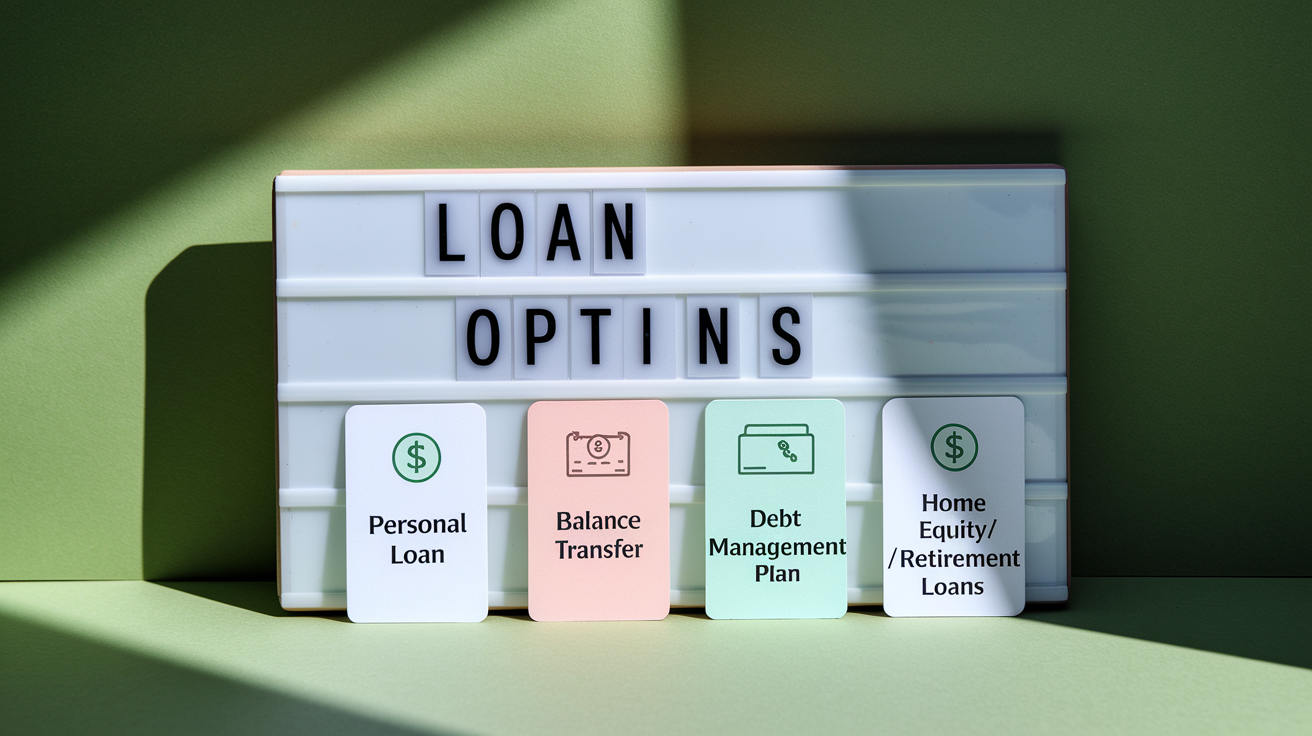
Personal Consolidation Loans
Personal consolidation loans are unsecured installment loans with fixed monthly payments and terms usually between one and seven years. You get a lump sum, pay off your existing debts, then make equal monthly payments to the new lender until it’s done. These work well in a calculator because the rate and term are fixed. Math’s straightforward. Max loan amounts for bad credit often hit $50,000, and some lenders take credit scores as low as 550 to 600.
Balance Transfer Cards
A balance transfer card gives you a promotional 0 percent APR window, usually 15 to 21 months. You move existing card balances to the new card and pay no interest during the promo. The calculator models this by setting consolidation APR to zero for the promo period, then switching to the card’s standard variable rate if you don’t clear the balance in time. Watch for balance transfer fees (typically 3 to 5 percent of what you move) and the risk that your credit limit might not cover all your debts. You won’t know your exact limit or APR until after approval, so calculator results are estimates.
Debt Management Plans
Debt management plans are structured repayment programs run by nonprofit credit counseling agencies certified by the National Foundation for Credit Counseling, the Financial Counseling Association of America, or the Council on Accreditation. The agency negotiates lower rates with your creditors. You close your accounts and make one monthly payment to the agency, which spreads it to each creditor. Typical timeline’s three to five years. Some agencies charge startup or monthly fees. Others offer low cost or no cost plans. Because rates vary and accounts close, a calculator can only estimate savings if you know the negotiated rates beforehand.
Home Equity and Retirement Loans
Home equity loans and HELOCs let you borrow against your house. A home equity loan gives you a lump sum at a fixed rate. A HELOC’s a variable rate line of credit you tap as needed. Both put your home on the line. Can’t make payments? You could lose the house. Retirement account loans, like 401(k) loans, offer lower rates but strict repayment rules. Leave your job? Full loan balance might come due immediately. Fail to repay and you’re under 59.5? You’ll owe a 10 percent penalty plus income tax on the unpaid amount. Roth IRA withdrawals of contributions skip penalties, but you lose the compound growth those dollars would’ve earned.
Calculators can model home equity and retirement loan scenarios by letting you plug in the lower rates these options often carry. Numbers might look tempting, but the calculator can’t measure foreclosure risk or the retirement savings you’re giving up. Weigh those separately.
Eligibility Criteria That Affect Calculator Results

The APR you plug into a debt consolidation calculator depends heavily on your credit score. Lenders save their lowest rates, often 6 to 12 percent, for borrowers with good to excellent credit. FICO scores between 690 and 850. If your score’s in the fair range (around 630 to 689) or lower, expect higher APRs. Sometimes mid 20s or low 30s. Some lenders work with bad credit applicants with scores as low as 550 to 600, but rates and fees will be higher.
Credit unions often offer more flexibility and lower rates than banks or online lenders. If you’re a member, check theirs first. Every application triggers a hard credit inquiry, which can ding your score a few points temporarily. Applying to multiple lenders in a short window (usually 14 to 45 days) typically counts as one inquiry for scoring, so shop around without worrying about excessive damage.
Your debt to income ratio, employment history, and monthly income also shape approval and the rate you’re offered. Lenders want total monthly debt payments, including the new consolidation loan, to stay below a certain percentage of your gross monthly income. Commonly around 40 to 50 percent. The calculator won’t know these details. It’s on you to test realistic APR ranges based on your credit profile and financial situation.
What lenders typically look at:
- FICO or VantageScore
- Debt to income ratio (total monthly debts divided by gross monthly income)
- Employment status and income stability
- Recent credit inquiries and new accounts
Pros and Cons Shown Through a Debt Consolidation Calculator

A debt consolidation calculator makes the financial benefits obvious. You can see exactly how much your monthly payment drops, how much interest you save, and how many months or years you cut off your payoff timeline. If the new loan’s APR is meaningfully lower than your current weighted average and the monthly payment fits your budget, consolidation simplifies things and reduces total cost. One payment to one lender each month beats juggling multiple due dates and balances.
But the calculator also shows the downsides. Stretch the loan term to lower your monthly payment? You might end up paying more total interest even if the APR’s lower, because you’re borrowing longer. Origination fees and balance transfer fees add to your cost and shrink your savings. The calculator won’t stop you from consolidating at a higher rate than you’re paying now. Always compare total interest paid, not just the monthly payment. And consolidation doesn’t erase the debt or fix spending habits. Leave credit card accounts open after consolidating? You risk running up new balances and ending up deeper in debt.
Pros:
- Lower monthly payment if your new rate’s better
- Simpler finances with one payment instead of many
- Clear interest savings and faster payoff if terms work out
- Fixed payment schedule with a known end date
Cons:
- Longer terms can jack up total interest paid
- Origination fees and balance transfer fees cut net savings
- Qualifying might need good credit. Bad credit rates can be brutal
- Risk of re borrowing on cards if accounts stay open and spending discipline’s weak
Credit Score Effects Modeled by a Consolidation Calculator
Applying for a consolidation loan triggers a hard inquiry. Your score might drop a few points. Usually temporary. Get approved and take the loan? Your credit mix and total available credit change, which can affect your score short term. Paying off card balances with the consolidation loan might improve your credit utilization ratio (the percentage of total credit limits you’re using). That’s a big factor in your score.
Making on time payments on the new loan gradually rebuilds and improves your credit. Payment history’s a huge chunk of your score. Consistent, timely payments over months and years will outweigh the initial hard pull dip. Close the old card accounts after consolidating? Your total available credit shrinks and your average account age might drop. Both can hurt your score temporarily.
The calculator won’t predict your exact credit score change, but it helps you see if the financial savings justify short term score effects. If consolidation cuts your monthly payment and total interest significantly, a few points off your score for a few months is usually worth it.
Comparing Consolidation vs Refinancing and Other Payoff Strategies

Consolidation and refinancing sound alike but aren’t. Consolidation combines multiple debts into one new loan. Refinancing replaces a single existing loan with a new loan at a different rate or term, but the debt type and number of loans stay the same. A debt consolidation calculator can model refinancing by treating your one existing loan as the “current debts” input and testing a new loan with better terms.
The calculator can also help you compare consolidation to DIY payoff strategies like debt snowball or debt avalanche. Snowball method? Pay minimums on everything except the smallest debt, which you attack with every extra dollar until it’s gone. Then roll that payment into the next smallest. Avalanche method? Target the highest interest debt first. Saves more on interest over time. Enter your debts into the calculator, note the total interest and payoff timeline, then manually simulate snowball or avalanche by tweaking payment amounts and timelines to see which saves the most or feels most motivating.
| Method | Typical Use Case | What Calculator Reveals |
|---|---|---|
| Consolidation | Multiple unsecured debts at varying rates | New single payment, total interest saved, payoff timeline |
| Refinancing | One existing loan with high rate or bad term | New rate/term impact on monthly payment and total cost |
| Snowball / Avalanche | DIY payoff with extra payments directed strategically | Baseline comparison, manual simulation of accelerated payoff |
Choosing a Lender After Using a Debt Consolidation Calculator

Once the calculator shows consolidation would save you money, next step’s gathering real loan quotes from multiple lenders. Personal loan APRs range wide, from around 6 percent for excellent credit borrowers to mid 30s for poor or limited credit. The rate you saw in the calculator’s an estimate. Actual offers depend on your credit report, income verification, debt to income ratio, and each lender’s underwriting.
Start with your credit union if you’re a member. Credit unions often offer lower rates and more flexibility than banks or online lenders. Then request prequalification quotes from at least two or three online lenders or banks. Prequalification uses a soft credit pull. Won’t hurt your score. Gives you a rate range before you formally apply. Compare the APR, term, origination fee (if any), and total amount you’ll repay over the loan’s life.
Use the calculator to test each real quote. Plug in the lender’s exact APR, term, and any fees to see the true monthly payment and total interest. Sometimes a loan with a slightly higher APR but no origination fee costs less overall than a lower APR loan with a 5 percent upfront fee. Don’t rush. The calculator helps you evaluate offers side by side so you pick the one that saves you the most and fits your monthly budget.
Lender comparison checklist:
- APR and whether it’s fixed or variable
- Loan term options (shorter term means higher payment, lower total interest)
- Origination fee, prepayment penalties, other charges
- Monthly payment amount and total repayment over the loan’s life
Final Words
Start by entering each debt’s balance, APR, and monthly payment. Then adjust the proposed APR and loan term to see the new monthly payment, total interest, and estimated savings.
This post covered what the calculator does, a step-by-step how-to, how to read payment and savings estimates, a real example, option comparisons, eligibility factors, pros and cons, and picking a lender.
If the numbers show lower monthly cost and total interest, get rate quotes and test them in the debt consolidation loan calculator. Small next move: gather your balances and hit Calculate. You’ve got this.
FAQ
Q: How much is the payment on a $50,000 consolidation loan?
A: The payment on a $50,000 consolidation loan depends on APR and term. For example, at 7% for 5 years it’s about $990/month; at 10% for 10 years it’s about $660/month.
Q: How much would a $30,000 personal loan cost per month?
A: The cost of a $30,000 personal loan per month depends on APR and term. For example, at 6% for 5 years it’s about $582/month; at 12% for 5 years it’s about $668/month.
Q: Do consolidation loans hurt your credit score?
A: Consolidation loans can hurt your credit score short-term from a hard pull, but on-time payments and lower credit utilization often improve scores over time. Avoid closing old accounts without checking impact.
Q: Is it possible to get a $20,000 loan for debt consolidation?
A: It is possible to get a $20,000 loan for debt consolidation. Many lenders offer that amount; approval depends on credit, income, and debt-to-income ratio. Shop rates and consider credit unions for lower APRs.