

Want your money to grow while you sleep?
Compound interest is exactly that — interest earning interest, and it turns small balances into noticeably bigger ones over time.
The bank adds interest to whatever’s in your account, then future interest is calculated on that larger total.
This post will explain, in plain terms, how rate, compounding frequency, APY (actual yearly return), and time change your results, and it will give one clear first step: compare APY and set an automatic transfer so your savings start compounding sooner.
Core Explanation of Compound Interest in Savings Accounts

Compound interest means you’re earning interest on your original deposit plus all the interest that’s piled up in your account already. Your balance grows each time the bank calculates and adds interest, creating this cycle that feeds itself. Banks compound interest on savings accounts daily, monthly, quarterly, or annually. The compounding period (how often the bank adds interest to your balance) decides when your new balance starts earning even more.
Here’s the deal: When your bank calculates interest, it looks at whatever’s sitting in your account right then, not just what you put in originally. Say you drop $1,000 into a savings account paying 5% interest with annual compounding. After the first year you’ve got $1,050. In year two, the bank calculates 5% on that full $1,050, which comes out to $52.50, not just the original $50. Leave that same $1,000 alone for 10 years at 5% annual compounding and you’ll end up with about $1,628.89, even if you never add another cent.
The interest gets added back to your account automatically at each compounding interval. Your next interest payment gets calculated on a slightly bigger amount than before. This snowball effect means your money grows faster as time passes. Growth starts slow but picks up speed, especially over longer stretches, because you’re earning interest on a total that keeps getting larger.
Four things control how much compound interest you earn:
Principal amount: the money you start with or deposit
Interest rate: the annual percentage the bank pays
Compounding frequency: how often the bank adds interest to your balance
Time horizon: how long you leave the money sitting there
Comparing Simple Interest and Compound Interest for Savings Growth

Simple interest only pays you based on what you originally put in. Drop $1,000 into an account at 5% simple interest and you earn exactly $50 every single year, doesn’t matter how long it sits. After 10 years you’ve earned $500 in total interest, bringing your balance to $1,500. The interest never changes because it’s always calculated on that initial $1,000, not on what’s actually in there.
Compound interest works differently because it builds on itself. Same $1,000 at 5% but with annual compounding means you earn $50 in year one, then $52.50 in year two (5% of $1,050 is $52.50), then $55.13 in year three, and it keeps going. After those same 10 years your balance hits approximately $1,628.89. That’s an extra $128.89 compared to simple interest, purely because the interest itself started earning interest.
| Type of Interest | How It Grows | 10-Year Outcome |
|---|---|---|
| Simple Interest | Earns $50 every year on the $1,000 principal | $1,500 total |
| Compound Interest | Earns interest on principal plus accrued interest each year | $1,628.89 total |
Understanding Compounding Frequency and Its Impact on Savings Accounts
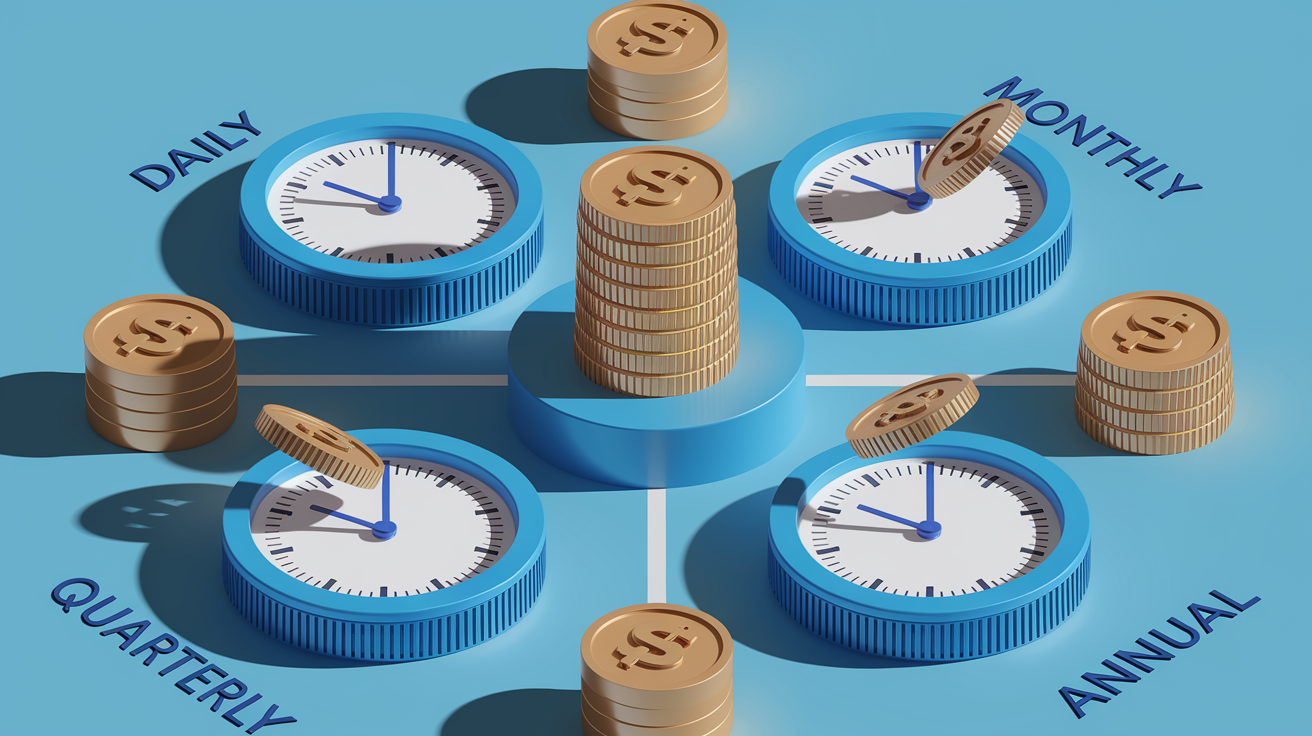
Compounding frequency is how often your bank calculates interest and adds it to what you’ve got. Daily compounding means the bank runs the calculation every single day and adds that tiny amount to your balance. Monthly compounding happens once per month, quarterly every three months, annual just once per year. The more frequently your bank compounds interest, the faster your money grows, because that newly added interest starts earning its own interest sooner.
When you compare compounding frequencies on the same rate, the differences look small at first but they add up. Put $1,000 into an account with a 5% annual rate that compounds monthly instead of annually and your balance after 10 years grows to around $1,647 instead of $1,628.89. That’s about $18 more just from changing the compounding schedule, even though the stated rate stayed the same. Daily compounding pushes the total slightly higher again, though the gains between daily and monthly are usually smaller than the jump from annual to monthly.
This is why banks advertise the APY (annual percentage yield) alongside the nominal rate. The APY tells you the actual annual return after accounting for compounding frequency. A 5% rate compounded monthly has an APY slightly higher than 5%, while that same rate compounded annually has an APY of exactly 5%. When you’re comparing savings accounts, always look at the APY, not just the base rate, because it shows the true growth you’ll see over a year.
Common compounding practices:
Most online high-yield savings accounts compound daily
Traditional brick and mortar banks often compound monthly or quarterly
Some credit unions compound quarterly or monthly depending on the account type
CDs (certificates of deposit) frequently compound monthly or at maturity
The APY requirement means banks must disclose the effective rate including compounding frequency
How to Calculate Compound Interest in a Savings Account
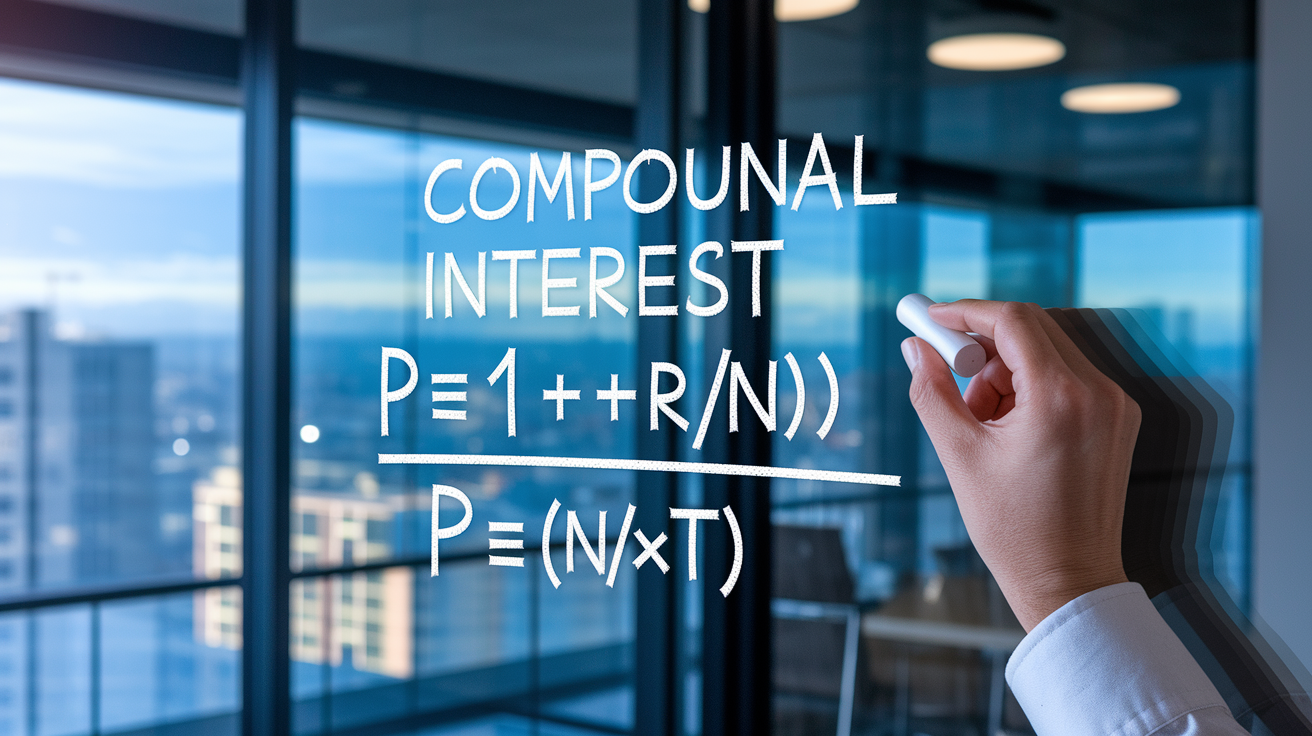
Calculating compound interest lets you predict how much your savings will grow before you even open an account. The formula uses four variables: P is the principal (what you start with), r is the annual interest rate written as a decimal (so 5% becomes 0.05), n is how many times per year the bank compounds interest, and t is the number of years you leave the money alone. Plugging these numbers into the formula gives you A, the final balance after interest.
The Compound Interest Formula
The compound interest formula is A = P(1 + r/n)^(nt).
You divide the annual rate by the compounding frequency to find the rate per period (r/n), then add 1 to that result. Next you raise that sum to the power of the total number of compounding periods (n times t). Finally, multiply that result by your principal to get the ending balance. Banks use this exact calculation to determine how much interest to add to your account at every compounding interval.
Step-By-Step Example
Let’s walk through a full calculation using $1,000 at 5% annual interest, compounded annually for 10 years.
-
Write out your values: P = $1,000, r = 0.05, n = 1 (annual compounding), t = 10.
-
Calculate the rate per compounding period: r/n = 0.05/1 = 0.05. Add 1: (1 + 0.05) = 1.05.
-
Raise 1.05 to the power of (n × t): 1.05^(1 × 10) = 1.05^10 ≈ 1.62889.
-
Multiply by the principal: $1,000 × 1.62889 = $1,628.89.
Your $1,000 deposit grows to $1,628.89 after 10 years with annual compounding at 5%. If you changed n to 12 for monthly compounding, you’d use 1.05/12 per month and raise it to the 120th power (12 months × 10 years), which would give you around $1,647 instead.
Real Examples of Compound Interest Growth Over Time
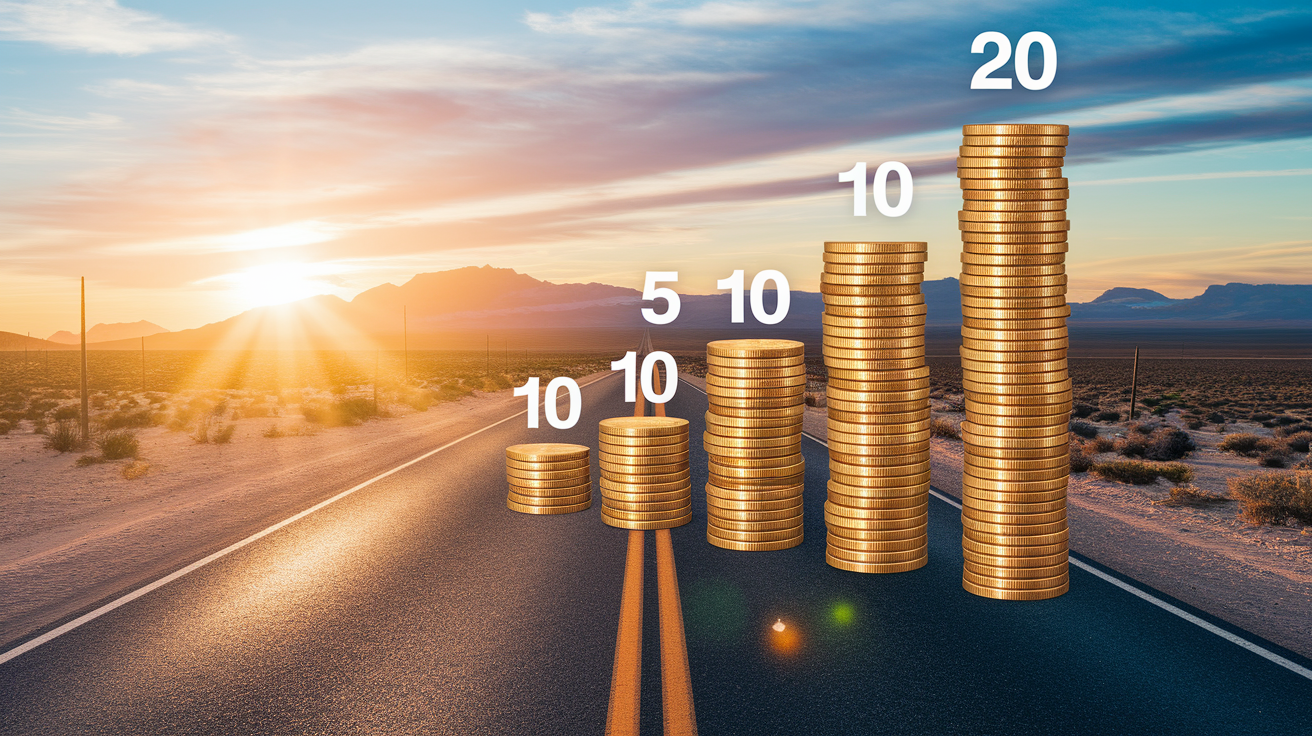
Time makes a massive difference in how compound interest builds your savings. A $1,000 deposit at 5% annual compounding grows to about $1,276 after 5 years, but after 10 years that same deposit reaches $1,628.89. The extra 5 years added roughly $353 to your balance, while the first 5 years only added $276. The longer you leave the money untouched, the faster it grows, because the accumulated interest keeps stacking on top of itself. Monthly compounding at that same 5% rate pushes the 10 year total to approximately $1,647, showing how compounding frequency adds a small boost on top of the time effect.
Adding regular monthly deposits on top of compound interest accelerates growth big time. Start with $1,000 and add $100 every month into an account earning 5% compounded monthly and you’re not just earning interest on the original $1,000. Every single $100 deposit starts compounding immediately, and deposits made early in the timeline benefit from years of compound growth. After 10 years, the combination of your initial deposit, your monthly contributions, and compounding can push your balance past $16,000, way beyond what the initial $1,000 alone would’ve achieved.
Short term vs long term compounding effects:
First 5 years show steady but modest growth as compounding builds momentum
Years 6 through 10 accelerate faster because interest compounds on a larger balance
The second decade of compounding typically adds more dollars than the first decade, even with no new deposits
| Time Period | Annual Compounding | Monthly Compounding |
|---|---|---|
| 5 years | $1,276 | $1,283 |
| 10 years | $1,628.89 | $1,647 |
| 20 years | $2,653 | $2,712 |
Strategies to Maximize Compound Interest in Savings Accounts
Choosing a high yield savings account with a strong APY gives you a head start because even a 1% difference in rate compounds into hundreds or thousands of dollars over time. Online banks typically offer APYs between 4% and 5%, while traditional banks often pay closer to 0.5% or less. The higher your APY and the more frequently the bank compounds interest (ideally daily), the faster your balance grows. Rate shopping takes an hour but can add years’ worth of extra interest to your account.
Making consistent contributions, even small ones, multiplies the power of compounding. Setting up automatic transfers from your checking account ensures you add money regularly without having to remember. Each deposit you make starts compounding immediately, and deposits made early benefit from years of growth. If you can deposit $50, $100, or $200 every month, those contributions will grow way beyond their face value over time because they’re all earning interest on top of interest.
Fees and withdrawals destroy compounding by pulling money out of the cycle. A $10 monthly maintenance fee costs you $120 per year, but it also costs you all the compound interest that $120 would’ve earned over the next 10 or 20 years. Avoid accounts with monthly fees by meeting minimum balance requirements or choosing fee free options. Don’t pull money out for non emergencies, because every withdrawal resets your compounding progress on that portion of your savings.
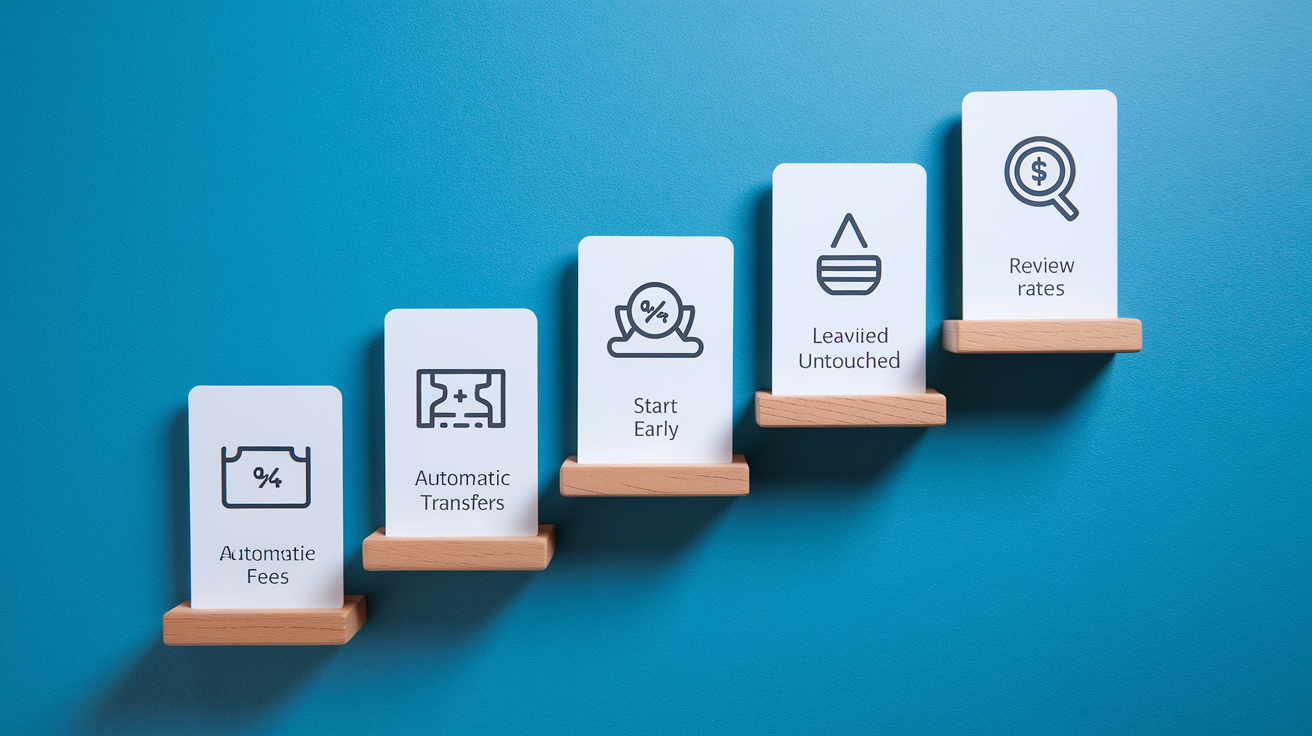
Six steps to maximize your compound interest returns:
-
Open a high yield savings account with an APY above 4% and daily compounding
-
Set up automatic monthly transfers on payday so contributions happen consistently
-
Start as early as possible, even if you can only deposit $25 or $50 at first
-
Avoid accounts with monthly maintenance fees or meet the requirements to waive them
-
Leave the money untouched except for true emergencies so compounding never stops
-
Review rates annually and switch banks if a competitor offers a significantly higher APY
How Account Types and Bank Policies Influence Compounding Results
Online savings accounts usually offer higher APYs and more frequent compounding than traditional brick and mortar banks because they’ve got lower overhead costs. Credit unions sometimes match or beat online banks on rates, though their compounding schedules vary by institution. Both types of accounts are insured up to $250,000 per depositor. FDIC insurance covers banks, while NCUA insurance covers credit unions, so your money’s safe either way. The key difference is that online accounts often compound daily and pay 3% to 5% APY, while traditional banks may compound monthly and pay under 1%.
Minimum balance requirements and withdrawal limitations can limit how well you use compound interest. Some high yield accounts require you to maintain a $500 or $1,000 minimum balance to earn the advertised APY, which means your first goal is hitting that threshold. Federal regulations used to limit savings account withdrawals to six per month (Regulation D), and while that rule was relaxed in 2020, some banks still enforce similar limits or charge fees for excess withdrawals. Frequent withdrawals not only interrupt compounding but can also trigger penalties that eat into your returns.
Typical bank requirements or fees that affect compounding:
Monthly maintenance fees of $5 to $15 unless you meet a minimum balance or direct deposit requirement
Minimum opening deposits ranging from $0 to $100 depending on the institution
Withdrawal limits or excess transaction fees that discourage pulling money out frequently
Inflation, Taxes, and Real Returns on Compound Interest

Compound interest grows your account balance, but inflation reduces what that money can actually buy. If your savings account earns 4% APY but inflation runs at 3% annually, your real return is only about 1% after accounting for the loss in purchasing power. A $10,000 balance that grows to $10,400 after a year looks like progress, but if everything you want to buy costs 3% more, you’ve only gained $100 in real terms. This is why chasing the highest possible APY matters, especially during periods of higher inflation, because you need your rate to outpace rising costs.
Interest earned in savings accounts is taxable income. Banks report your interest earnings to the IRS on a 1099-INT form if you earn more than $10 in a year, and you’ll owe federal income tax on that amount at your ordinary rate. Some states also tax interest income. If you’re in the 22% federal tax bracket and earn $500 in interest, you’ll owe about $110 in federal taxes, reducing your effective gain to $390. Your money still compounds on the full balance in your account, but the after tax return is what actually matters for your financial planning. Tax advantaged accounts like Roth IRAs can shelter compound interest from taxes, but those come with contribution limits and different rules than regular savings accounts.
Final Words
We showed how compound interest turns interest into more interest, how compounding frequency and APY affect returns, and how to use the formula and examples to see real growth.
We compared simple and compound interest, explained daily and monthly compounding, and offered steps and strategies: pick a high APY account, automate deposits, and avoid fees.
If you want one clear next move, open a high-yield savings account and set automatic transfers. This puts how does compound interest work in savings accounts into action. Small, steady steps add up.
FAQ
Q: What is the 7 3 2 rule of compounding?
A: The 7 3 2 rule of compounding isn’t a standard finance rule; you’re likely thinking of the Rule of 72 (a quick way to estimate years to double at a given rate) or similar approximations.
Q: How much interest will $100,000 make in a savings account?
A: The interest $100,000 will make in a savings account depends on the APY and compounding frequency. For example, at 1% APY you’d earn about $1,000 yearly; at 4% about $4,000 yearly.
Q: What is 5% APY on $1000 monthly?
A: Five percent APY on $1,000 monthly means about $4.17 interest for one month (0.05/12 × $1,000). If you deposit $1,000 each month, compounding increases the total over time.
Q: How much will $50,000 be worth in 20 years?
A: The value of $50,000 in 20 years depends on the annual rate and compounding. Examples: at 3% ≈ $90,300; 5% ≈ $132,700; 7% ≈ $193,500.