


Think a credit score and a FICO score are the same? Think again.
They sound the same, but there’s a big practical difference: FICO is a branded scoring model used by roughly 90% of U.S. lenders.
Every FICO Score is a credit score, but not every credit score is a FICO Score.
That matters when you apply for a mortgage, car loan, or credit card because the lender’s chosen model can change approval and the interest rate.
This post explains the key differences, why your numbers can vary by bureau and app, and the one thing to check before you apply.
Understanding the Core Difference Between FICO Scores and Credit Scores

A credit score is any number a lender, bureau, or scoring company uses to estimate how likely you are to fall behind on payments. The predictive goal is usually the same: What’s the chance this borrower will become 90 days delinquent in the next 24 months? That’s it. Credit scores aren’t magic. They’re just numerical predictions built from patterns in your credit report (payment history, account balances, length of credit, types of accounts, and how often you’ve applied for credit).
FICO Score is a branded credit scoring product created by the Fair Isaac Corporation and first released in 1989. When someone says “my FICO Score is 740,” they’re referring to one of several models that follow the FICO approach. Most FICO Scores use a 300 to 850 range, and each score version (like FICO Score 8, FICO Score 9, or FICO Score 10 T) applies slightly different rules to the same underlying report data. FICO isn’t the only credit score, and it doesn’t define the entire category. But it is by far the most widely used brand in U.S. lending.
Here’s the key distinction: every FICO Score is a credit score, but not every credit score is a FICO Score. Roughly 90% of lenders rely on FICO scores for underwriting mortgages, auto loans, credit cards, and personal loans. That leaves about 10% who use VantageScore models, proprietary in-house scoring systems, or industry specific scores. Whichever model a lender pulls is the one that determines whether you’re approved and at what rate.
FICO scores and other credit scores often differ because different scoring models apply different formulas to your credit report. FICO and VantageScore weigh factors differently. Each credit bureau (Equifax, Experian, TransUnion) stores slightly different account data. Not every creditor reports to all three. Model versions evolve. FICO 8 treats paid collections one way, FICO 9 another, and FICO 10 T adds trended data. Scores update at different times. Your balances or payment status may have changed since the last calculation. Some lenders use proprietary or industry specific scores. Auto lenders may use FICO Auto Score, card issuers may use internal risk models.
What a FICO Score Measures and How It’s Calculated

Every FICO Score answers one forward looking question: Based on your credit behavior so far, what’s the likelihood you’ll fall 90 days delinquent within the next 24 months? Higher scores signal lower odds of that happening. FICO doesn’t give you a precise percentage (it’s comparative, not predictive probability), but it’s enough for a lender to slot you into risk tiers and interest rate bands.
FICO breaks your credit profile into five weighted categories. Payment history is the heavyweight at 35%, so one 30 day late payment will hurt more than a small increase in your credit card balance. Credit utilization (how much you owe relative to your total available limits) is second at 30%. If you have $5,000 in balances spread across accounts with a combined $20,000 limit, your utilization is 25%. The higher that percentage, the more risk the model sees. And the more your score drops.
The other three categories carry smaller but still meaningful weight. Length of credit history (15%) rewards stability. Older accounts help. Credit mix (10%) looks at whether you manage different account types (revolving credit like cards, installment loans like auto or mortgage). New credit and inquiries (10%) penalize rapid application sprees because rapid credit seeking can flag cash flow stress. Keep your applications clustered when rate shopping, and this factor should stay manageable.
FICO releases updated score versions every few years. FICO Score 8 (circa 2009) is still common in credit card underwriting. FICO 9 (circa 2014) ignores paid collection accounts and treats medical debt more leniently. FICO 10 and FICO 10 T (circa 2020) add trended data (your balance trajectory over time), and FICO Score 10 BNPL integrates buy now pay later account behavior. Lenders can adopt whichever version fits their risk appetite and systems, which means the score they pull may not match the one you see from your credit card issuer.
| Factor | Weight (%) |
|---|---|
| Payment history | 35 |
| Credit utilization (amounts owed) | 30 |
| Length of credit history | 15 |
| New credit and inquiries | 10 |
| Credit mix | 10 |
What a Generic Credit Score Considers (Including VantageScore)
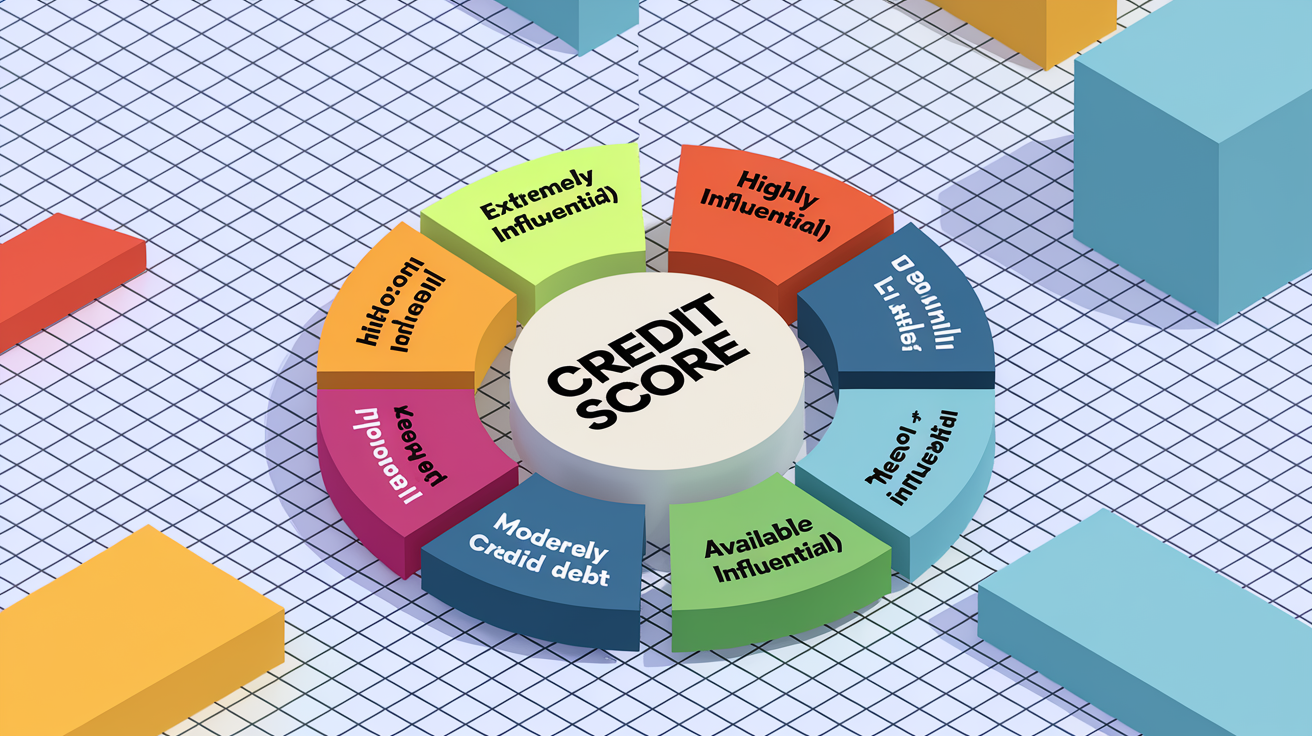
All credit scores share the same fundamental job: rank order borrowers by their likelihood of missing payments. Whether it’s FICO, VantageScore, or a lender’s internal model, each score pulls from credit report data and applies statistical weights. The difference lies in how those weights are assigned, which data points are emphasized, and whether alternative data (like bank account activity or utility payments) gets included.
VantageScore is the second most common consumer credit score, developed by the three major bureaus in 2006. VantageScore versions 3.0 (2013) and 4.0 (2017) both use the same 300 to 850 scale as FICO, but they organize and weigh data differently. Instead of five fixed percentage categories, VantageScore divides your credit profile into six factor groups, each labeled with relative influence (extremely influential, highly influential, moderately influential, or less influential). That means the exact contribution of each factor can shift depending on your unique profile. Two people with identical utilization may see different score impacts if their payment histories or credit age differ substantially.
The six VantageScore factors and their relative influence:
Payment history: Extremely influential. Missed payments, late payments, and derogatory marks carry the heaviest penalty.
Credit utilization: Highly influential. The ratio of balances to total available credit matters across all models.
Length of credit history and type of credit: Highly influential. Older accounts and a balanced mix of revolving and installment credit help.
Total balances and debt: Moderately influential. How much you owe across all accounts signals repayment capacity.
Recent credit behavior and inquiries: Less influential. New applications and account openings add risk, but not as much as missed payments.
Available credit: Less influential. Your total unused credit plays a smaller role than utilization or history.
Why FICO Scores and Other Credit Scores Often Don’t Match

When you check your credit score from one source and see a different number from another source, that’s not a data error. It’s how the system works. Each credit bureau (Equifax, Experian, TransUnion) maintains its own file on you, and not every creditor reports to all three. If your auto lender only reports to Experian and your newest credit card only reports to TransUnion, your Equifax report is missing both accounts. Score one bureau, and the model has incomplete information.
Model version and type create another layer of variation. Your credit card issuer might show you a free FICO Score 8 pulled from TransUnion. A mortgage lender might pull FICO 5 from Equifax, FICO 4 from TransUnion, and FICO 2 from Experian, then use the middle score. An auto lender might use FICO Auto Score 10, which weights auto loan history more heavily. Meanwhile, your bank’s mobile app might display VantageScore 3.0 from Experian. Same you, same day, four different scores. All technically accurate.
Timing matters, too. Credit scores recalculate whenever the bureau receives updated account data. If you pay down a credit card balance today, that update might hit one bureau tonight and another bureau five days from now. Check your score in the middle of that window and you’ll see different numbers from different bureaus, even though you’re the same borrower. One more important detail: when you check your own score through your credit card portal, bank app, or a credit monitoring service, that’s a soft inquiry and it never lowers your score.
Four reasons your scores don’t match:
Bureau data differences. Not every creditor reports to all three bureaus, so your Equifax, Experian, and TransUnion files hold different account histories.
Model version differences. FICO 8, FICO 9, FICO 10 T, and VantageScore 4.0 all use different rules and weights.
Update timing. Bureaus receive account data on different schedules, and scores recalculate as soon as fresh data arrives.
Model type differences. Comparing a base FICO Score to an auto industry score or VantageScore yields natural variation because each model optimizes for different risk predictions.
Which Score Lenders Actually Use in Real Decisions

The score that matters for your loan approval is whichever score and bureau your specific lender pulls during underwriting. That single number drives the decision, not the score you see on your credit card app or the one from a free monitoring site. Lenders choose the bureau and model version that best fits their risk tolerance, investor requirements, and systems. You can have a 780 FICO Score 8 on your app and a 745 FICO 5 in your mortgage file, and the lender only cares about the 745.
Mortgage lenders almost always rely on FICO scores, especially for conforming loans backed by Fannie Mae or Freddie Mac. The standard practice is to pull one FICO score from each of the three bureaus (often FICO 2, FICO 4, and FICO 5) and use the middle score for a single borrower. If you’re applying with a co-borrower, the lender typically uses the lower middle score between the two of you. Some portfolio lenders or alternative mortgage products may use newer FICO versions or different models, but FICO is still the industry standard for home loans.
Auto lenders use a mix. Many rely on FICO Auto Score versions (like FICO Auto Score 8 or FICO Auto Score 10), which weight your auto loan payment history more heavily than your credit card behavior. Some captive finance arms (the lending division of a car manufacturer) use proprietary internal models. Others stick with base FICO scores. The variation is wide enough that shopping your loan across three lenders can surface three different score pulls and three different interest rate offers, even when your credit report hasn’t changed.
| Credit Product | Common Score Used | Notes |
|---|---|---|
| Mortgage (conforming) | FICO 2, 4, 5 (middle score) | Fannie Mae and Freddie Mac require FICO; some lenders may use FICO 10 T for portfolio loans. |
| Auto loan | FICO Auto Score 8 or 10 | Some lenders use base FICO or internal models; captive finance companies often have proprietary scores. |
| Credit cards / personal loans | FICO 8, FICO 9, or VantageScore | Card issuers vary; some use VantageScore, others use newer FICO versions or custom internal scores. |
How Negative Items Affect FICO and Other Credit Scores

Late payments, collections, charge offs, public records, and bankruptcy all hurt your score. They hurt across almost every model because they all pull from the same underlying credit report data. A 30 day late payment on your auto loan shows up on your Equifax, Experian, and TransUnion reports, and every FICO version and VantageScore version will penalize it. The size of the penalty varies by model, but the direction is always the same: down.
The specifics matter, though. FICO Score 8 still counts unpaid collection accounts but ignores collections under $100. FICO 9 disregards paid collections entirely and treats medical collections more leniently. VantageScore 4.0 also downweights medical debt and paid collections. If you’ve settled an old medical bill and it now shows “paid” on your report, your FICO 9 or VantageScore 4.0 may recover faster than your FICO 8, which still factors that collection into the calculation even though it’s closed.
Bankruptcies and charge offs are universal score killers. Chapter 7 or Chapter 13 bankruptcy can drop a score by 100 to 200 points or more, and the filing stays on your report for seven to ten years. Charge offs (when a creditor writes off your debt as a loss) remain for seven years from the original delinquency date and continue to drag scores down until they age off. The good news is that the impact fades over time. Recent negatives hurt more than old ones, so consistent on-time payments and low balances after a negative event will start rebuilding your score within months to a year.
Common negative items and general score impact:
30 day late payment: Moderate to significant drop, worse if recent. Stays on report for seven years.
60 or 90 day late payment: Larger drop, signals higher delinquency risk.
Collection account (unpaid): Penalized by all models. FICO 9 and VantageScore 4.0 may ignore if paid.
Charge off: Severe penalty, treated similarly to a serious delinquency. Remains seven years.
Bankruptcy (Chapter 7 or 13): Largest single event penalty. Remains seven to ten years. Score can recover with time and positive behavior.
How to Check and Monitor Your FICO Score Before Applying
Many credit card issuers, banks, and credit unions now offer free FICO Score access as a cardholder or account benefit. Log into your card’s mobile app or online portal and look for a “Credit Score” or “FICO Score” feature. Most providers show FICO Score 8 from one bureau (often Experian or TransUnion) and update it monthly. That score is real, and checking it won’t hurt your credit because it’s a soft inquiry.
Before you apply for a mortgage, auto loan, or new credit card, confirm which score model and bureau the lender uses. Call the lender’s customer service line or check their website FAQs. If the lender pulls FICO 5 from Experian for mortgages, try to access your Experian FICO 5 score (or at least your Experian FICO Score 8) so you have a baseline close to what they’ll see. Some credit monitoring services and paid bureau subscriptions let you view multiple FICO versions and all three bureau reports, which is useful when you’re comparing offers or preparing for a major loan.
When you pull your score, review the score factors or “key factors affecting your score.” These short explanations tell you what’s helping or hurting (high utilization, too many recent inquiries, a missed payment, or short credit history). Use that feedback to prioritize fixes before you apply. If utilization is your biggest drag, pay down balances and wait for the next statement cycle to close before submitting your application, so the lower balance gets reported.
Four steps to monitor your FICO Score effectively:
Confirm which model and bureau your target lender uses. Ask directly or check the lender’s underwriting guidelines.
Access your score from a free source (credit card, bank, or bureau portal). Verify the FICO version and bureau shown.
Review the score factors and identify your top one or two negatives. Address the highest impact items first (utilization, late payments, or recent inquiries).
Monitor regularly (at least monthly) and before major credit applications. Scores shift as balances and payment history update, so check often enough to spot changes.
Practical Tips to Improve FICO Scores and Other Credit Scores

The biggest driver is payment history, which accounts for 35% of your FICO Score. Pay every bill on time, every month. Set up autopay for at least the minimum payment on all credit cards and loans, and if you can afford more, pay the statement balance in full to avoid interest. One 30 day late payment can drop your score by 60 to 110 points depending on your starting profile, and it stays on your report for seven years (though its impact fades after the first year or two).
Credit utilization is the second largest factor at 30%. Target keeping your total balances below 30% of your combined credit limits. If you want a top tier score (above 800), aim for under 10%. Utilization is calculated per card and across all cards, so spreading $3,000 in balances across three cards with $10,000 limits each (10% each, 10% overall) is better than carrying $3,000 on one card with a $5,000 limit (60% on that card). Pay down high balance cards first, and if possible, make a mid cycle payment before your statement closes so the lower balance gets reported to the bureaus.
Length of credit history (15% of FICO) rewards stability. Keep your oldest accounts open, even if you rarely use them, because closing an old card shortens your average account age. New credit and inquiries (10%) penalize application sprees, but rate shopping for a mortgage or auto loan within a short window (typically 14 to 45 days depending on the FICO version) counts as a single inquiry. If you’re shopping for the best loan rate, do it fast and your score takes one small hit instead of several. Credit mix (10%) benefits from having both revolving (credit cards) and installment (auto, mortgage, personal loan) accounts, but don’t open a loan just to diversify if you don’t need it.
Six actions to improve both FICO and other credit scores:
Lower your credit utilization below 30%, ideally below 10%. Pay down balances or request credit limit increases to reduce the ratio.
Pay every bill on time, every month. Automate minimum payments to avoid missed due dates.
Preserve the age of your oldest accounts. Keep old cards open and use them once or twice a year to prevent closure.
Limit hard inquiries and cluster rate shopping within 14 to 45 days. Apply for new credit only when you need it.
Diversify your credit mix over time. A healthy profile includes revolving and installment accounts, but don’t force it.
Review all three credit reports annually and dispute errors. Incorrect late payments or fraudulent accounts can be removed, which immediately helps your score.
Final Words
Focus on the score that matters for the loan or card you want: FICO is one type of credit score and about 90% of lenders use it, while others use VantageScore or proprietary models. Small differences between scores are normal.
Do this next: ask the lender which model they’ll pull, check that FICO version through your card or bank, and work to keep credit utilization under 30% while paying on time.
If you’re comparing fico score vs credit score, remember there’s no single “perfect” number. Keep monitoring, make steady changes, and you’ll improve.
FAQ
Q: What’s a good FICO score?
A: A good FICO score is generally 670 or higher on the 300–850 scale. Aim for 740+ to get the best loan rates; keep utilization under 30% and pay on time.
Q: What credit score does Hyundai Finance use?
A: Hyundai Finance typically uses FICO Auto Score variants for auto loans. Lenders usually pull one bureau and one model, so check your FICO before applying or call Hyundai to confirm.
Q: What credit score do you need for a $400,000 house?
A: For a $400,000 house, the needed score varies by loan: about 620+ for conventional loans, 580+ for FHA, and 700+ for the best rates; down payment and income also matter.
Q: Should I go by my FICO score or Credit Karma?
A: You should prioritize the FICO score lenders actually pull, while Credit Karma (VantageScore) is useful for tracking trends. If you’re applying, check a lender-relevant FICO beforehand.