


Think paying down your biggest debt first will fix your credit? That move often wastes months.
Errors, duplicates, and wrong balances can inflate what you owe and drag your score down.
Start by pulling your three credit reports and disputing inaccuracies.
Then bring current accounts up to date, cut credit card balances toward about 30 percent of each limit, and handle collections last.
Do the steps in that order and you’ll see faster, more reliable score improvement without throwing money at problems that aren’t real.
Core Priority Framework for Sequencing Credit Repair Steps
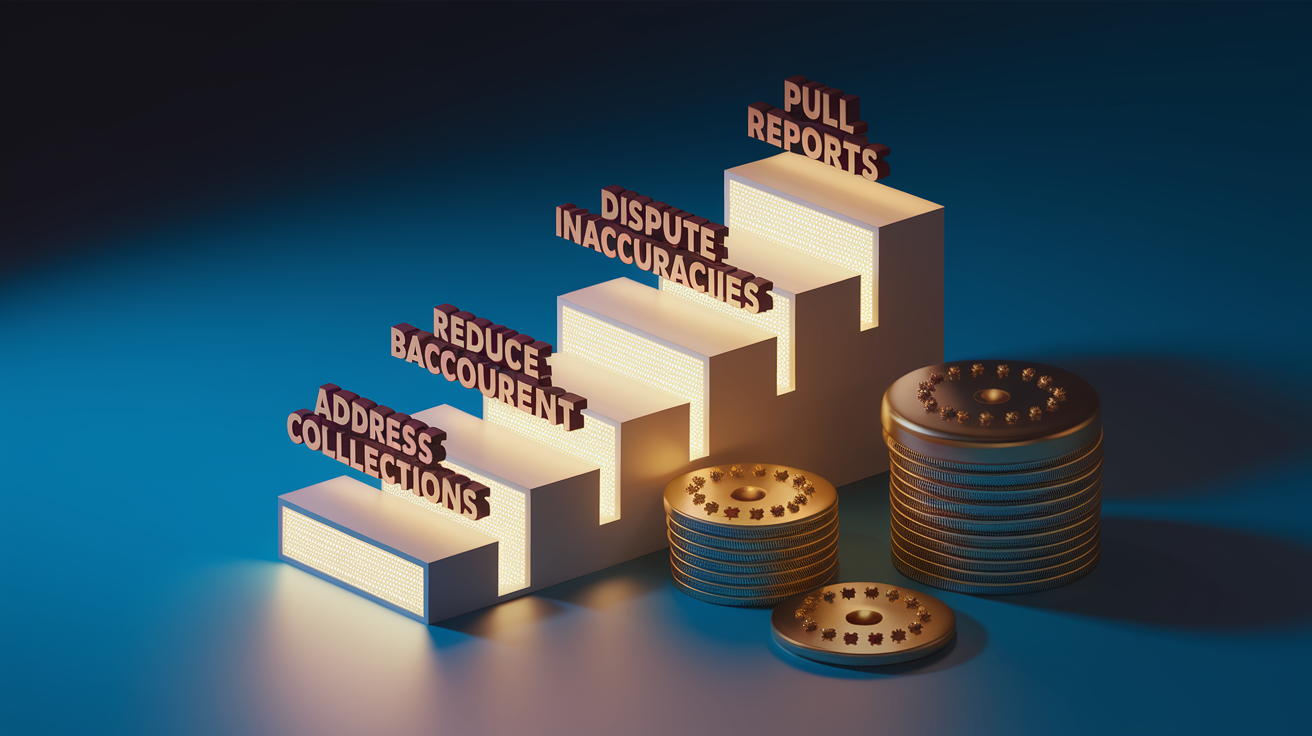
The order you tackle credit issues determines how fast you’ll see results. A lot of people jump straight into paying down their biggest debts or applying for new credit, but those moves can waste months if errors are inflating your balances or tanking your score unfairly.
The correct sequence is pretty straightforward: pull your reports, fix what’s wrong, stabilize what’s falling behind, reduce what you owe on revolving accounts, and then tackle older debts strategically. Each step builds on the last. Disputing errors first means you’re not throwing money or effort at balances that shouldn’t even exist. Stabilizing payment history next prevents new damage while you work on utilization and collections.
Here’s the framework that delivers the fastest, most reliable improvement:
5 Highest-Impact Credit Repair Priorities (in order)
- Pull and review your credit reports from Equifax, Experian, and TransUnion. Free once per year from each bureau.
- Dispute all inaccuracies immediately. Wrong balances, duplicate accounts, outdated items, fraudulent activity. Bureaus typically investigate within 30 to 45 days.
- Bring all current accounts current and stop new late payments. Payment history accounts for roughly 35 percent of your credit score, so this is the highest-weighted factor.
- Reduce credit card balances below 30 to 33 percent of each card’s limit. Utilization makes up about 30 percent of your score and can improve within one billing cycle.
- Address collections and charge-offs strategically. Verify debts, negotiate settlements on small balances first, and avoid resetting statute-of-limitations clocks in your state.
Errors must come first because they can artificially inflate your debt load or report accounts that aren’t yours. If you dispute and remove a $2,000 fraudulent balance before making payments, you’ve just saved months of unnecessary effort. The 30 to 45 day dispute window means you can often clear these issues before your next billing cycle, giving you a cleaner baseline to work from.
Proper sequencing accelerates improvement because each completed step makes the next one easier. Removing errors reduces your total debt picture. Stopping late payments protects the 35 percent weight of payment history. Lowering utilization delivers a quick score boost. Then you can focus energy on older or more complex debts without new problems piling up behind you.
Reviewing and Disputing Credit Report Errors (Step 1)
Reviewing your reports and disputing errors are paired as the first priority because they cost nothing, require no debt payoff, and can deliver the fastest score improvements if issues exist. You can’t build an accurate repair plan until you know which debts and accounts are real and which are mistakes.
Start by requesting your free annual reports from Equifax, Experian, and TransUnion. Compare them line by line, because each bureau may list different information. Look for anything that seems off, outdated, or unfamiliar.
How to Review Your Credit Reports
- Wrong account balances or credit limits. A $5,000 card showing a $10,000 balance inflates your utilization and damages your score unfairly.
- Duplicate accounts. The same debt listed twice (once from the original creditor and once from a collection agency) makes your debt load look larger than it is.
- Accounts that don’t belong to you. Similar names or identity theft can cause someone else’s debt to appear on your report.
- Closed accounts reported as open. This can affect your utilization calculation and available credit totals.
- Late payment marks on accounts you paid on time. If you have proof of on-time payment, this error can be removed.
- Outdated information that should have aged off. Most negative items should drop after seven years. Bankruptcies after ten.
Submitting Effective Credit Disputes
- Gather documentation. Bank statements, canceled checks, payment confirmations, or account closure letters that prove the error.
- Write a clear dispute letter. State the specific item (account number, date, creditor name), explain why it’s incorrect, and reference your attached proof.
- Submit through the bureau’s online portal or via certified mail. Online is faster, but certified mail gives you a paper trail and delivery confirmation.
- Keep copies of everything. Your letter, attachments, submission confirmation, and any responses from the bureau.
- Follow up after 30 days if you don’t receive a response. Bureaus are required to investigate, usually within 30 to 45 days, but delays happen.
Bureaus must investigate disputes within roughly 30 days under the Fair Credit Reporting Act. If they verify the information is correct, they’ll leave it. If they can’t verify it or the creditor doesn’t respond, they must remove it. This is why disputes come first. Clearing inaccurate items before you start paying debts prevents you from wasting money or effort on balances that shouldn’t exist. Once disputes are resolved, you’ll have a clean, accurate starting point for the rest of your repair steps.
Structuring Debt Payments Based on Credit Impact Priority

Not all debts affect your credit score equally, and not all payment strategies deliver the same results. Payment history accounts for roughly 35 percent of your score, so bringing delinquent accounts current and stopping new late payments is the highest-impact move you can make. High APR accounts cost more in monthly interest, which slows your overall payoff, but the interest rate matters less than whether the account is current or past due.
Collections remain on your credit report for years, but a fresh late payment on an active account damages your score more immediately. The correct order is to stabilize what’s falling behind now, then reduce revolving debt that’s driving up your utilization, and finally address older collections or charge-offs that are already aging off your report.
Here’s the order of accounts to prioritize:
Order of Accounts to Prioritize
- Accounts that are 30, 60, or 90 days past due. Bring these current immediately, even if it means paying only the minimum. Each additional late payment adds another negative mark and increases the damage.
- Current accounts with high utilization. Once nothing is past due, focus extra payments on credit cards with balances above 30 to 33 percent of the limit. High utilization pulls down your score even if you’re never late.
- High APR accounts. If two cards have similar balances and utilization, pay down the one with the higher interest rate first. You’ll save monthly interest charges that can be redirected to other debts.
- Small collections or charge-offs. After current accounts are stable and utilization is under control, tackle the smallest collection balances first. Settling or paying these off can remove negative items faster than trying to chip away at one large debt.
- Large, older charge-offs with approaching drop-off dates. If a charge-off is six years old and will age off your report in one year, it may make sense to let it fall off naturally rather than restarting the clock by making a payment. Check your state’s statute of limitations before deciding.
Curing delinquencies outranks large-balance paydowns because a single current $500 card that goes 30 days late will hurt your score more than a $5,000 card you’re steadily paying down on time. High APR matters for your wallet, but payment status matters more for your credit score. Once accounts are current and utilization is managed, you can focus on eliminating collections without new problems piling up behind you.
Handling Collections, Charge-Offs, and Delinquencies in Correct Order
Collections and charge-offs are handled after you’ve stabilized current accounts and lowered utilization. Trying to settle collections while new accounts slide into delinquency doesn’t improve your score, it just shifts the damage around. Once nothing is falling behind and your revolving balances are under control, you can focus energy on older debts strategically.
Small collections can often be negotiated and resolved quickly, giving you a psychological win and removing a negative item from your report. Larger charge-offs may require payment plans or settlements that take 30 to 90 days to finalize. Before you pay or negotiate anything, verify the debt is legitimate. Send a debt verification letter to the collector and wait for documentation proving you owe the debt, the amount is correct, and they have the legal right to collect it.
Some states reset the statute of limitations on debt if you make a payment or acknowledge the debt in writing. If a debt is old and close to the statute expiring, paying it could restart the clock and extend how long a creditor can sue you. Research your state’s rules or consult a nonprofit credit counselor before negotiating on debts that are several years old.
| Collection Type | Priority Order | Risk Notes |
|---|---|---|
| Small balances under $500 | High priority after current accounts are stable | Easiest to settle; quick removal possible with pay-for-delete negotiation |
| Large balances over $2,000 | Medium priority; negotiate payment plan | May take 30 to 90 days to finalize; confirm written agreement before paying |
| Collections near statute of limitations | Low priority; consider letting it age off | Payment may reset the clock in some states; verify state law first |
| Disputed or unverified debts | Dispute first, pay only if verified | If collector can’t verify, bureau must remove; don’t pay unverified debts |
Always get settlement agreements in writing before you send money. If a collector agrees to remove the item from your report (a “pay-for-delete”), make sure that’s documented in the agreement. If they only agree to mark it “paid,” you’ll still have the negative item on your report for up to seven years, even though you paid it off. Verified debts that can’t be settled should be addressed in order of impact: small balances first for quick wins, then larger balances with negotiated payment plans that fit your budget.
Reducing Credit Utilization in Priority Order

Credit utilization makes up roughly 30 percent of your credit score, and it’s one of the fastest factors to improve. Utilization is the percentage of each card’s limit that you’re currently using. If you have a $5,000 limit and a $4,000 balance, you’re at 80 percent utilization, well above the 30 to 33 percent target that protects your score.
Paying down balances before your statement closes ensures the lower balance gets reported to the bureaus. If you make a payment after the statement date, your high balance may still appear on your credit report for that billing cycle, which means your score won’t reflect the improvement until the next month. Timing matters as much as the total amount you pay.
High-Impact Utilization Moves
- Target each card below 30 percent individually. If you have three cards with different limits, focus extra payments on the one with the highest utilization percentage, not necessarily the highest dollar balance. A $1,500 balance on a $2,000 limit (75 percent) hurts more than a $3,000 balance on a $10,000 limit (30 percent).
- Pay before the statement date, not just the due date. Call your issuer or check your online account to find out when your statement closes each month, then make your payment a few days before that date. The lower balance will be reported to the bureaus.
- Request credit limit increases on cards you’ve paid on time. If your limit goes from $5,000 to $7,000 and your balance stays at $1,500, your utilization drops from 30 percent to about 21 percent instantly. Only request increases if you won’t be tempted to add new charges.
- Freeze cards you’re paying down. If you’re actively reducing a balance, stop using that card until it’s below 30 percent. Adding new charges while you’re trying to lower utilization just extends the timeline.
Example: you have a card with a $3,000 limit and a $2,700 balance. That’s 90 percent utilization. If you pay the balance down to $900, you’re at 30 percent, and your score can improve within one billing cycle once that lower balance is reported. If you can’t pay it all at once, get it under $1,000 first, then continue paying it down over the following months. Every percentage point you drop below 30 helps, and the change can show up on your credit report within 30 days.
Adding Positive Tradelines in the Right Sequence

Adding positive tradelines (authorized user accounts, credit-builder loans, rent reporting, or utility payment history) should happen after you’ve stabilized payment history and lowered utilization. Opening new accounts or adding tradelines too early can trigger hard inquiries or complicate your repair plan while errors and delinquencies are still unresolved.
Once your current accounts are reporting on time and your utilization is under control, adding positive data can accelerate score growth. Authorized-user accounts can appear on your credit report within one billing cycle if the card issuer reports to all three bureaus. Rent reporting services add past and ongoing rental history, which can boost thin credit files or add consistent on-time payments that weren’t previously counted. Credit-builder loans let you make small monthly payments into a savings account, and the loan is reported as an installment tradeline, which diversifies your credit mix.
Don’t apply for multiple new credit sources at once. Each application triggers a hard inquiry, and several inquiries in a short period can lower your score temporarily and signal risk to lenders. If you’re going to add tradelines, choose one or two methods that fit your situation, space them out by at least a few months, and make sure they won’t interfere with your existing payment or utilization strategy.
Best Timing for New Tradelines
- After bringing all accounts current and lowering utilization below 30 percent. Positive tradelines won’t help if late payments or high utilization are still actively damaging your score each month.
- When you can sustain on-time payments on the new tradeline. Adding a credit-builder loan or becoming an authorized user is pointless if you can’t keep up with the payments or if the primary cardholder starts missing payments.
- Spacing out applications by at least 60 to 90 days. This minimizes the impact of hard inquiries and gives each new tradeline time to report and show positive history before you add another.
Authorized-user boosts work best when the primary cardholder has excellent payment history, low utilization, and an account that’s been open for several years. Confirm the issuer reports authorized users to all three bureaus before asking to be added. Rent reporting is ideal if you’ve been paying rent on time but have a thin credit file with few other tradelines. Credit-builder loans are useful if you need an installment tradeline to diversify your credit mix, but only take one if the monthly payment fits comfortably in your budget.
Budgeting and Cash Allocation to Support Prioritized Credit Repair Steps

Credit repair only works if you can consistently fund the plan. Bringing accounts current, paying down utilization, and settling collections all require cash, and most people don’t have extra money sitting around. The solution is reallocating what you’re already spending. Even small cuts free up dollars that can be redirected to high-impact payments.
Eliminating one $15 streaming subscription frees $180 per year. Skipping a daily $8 coffee four days a week saves roughly $128 per month, enough to bring a past-due account current or make an extra payment that drops your utilization below 30 percent. The goal isn’t to cut every expense. It’s to identify spending that doesn’t match your current priorities and redirect that money toward accounts that affect your credit score.
Budget Adjustments That Accelerate Credit Repair
- Cancel or pause one subscription service. If you have three streaming services, drop one for six months and put that $15 to $20 per month toward your highest-utilization card.
- Reduce discretionary food spending. Cooking at home three extra nights per week or cutting back on takeout by half can free $200 to $400 per month, depending on your current habits.
- Switch to a no-fee bank account. If you’re paying $12 per month in maintenance or overdraft fees, that’s $144 per year that could go toward debt reduction instead.
- Negotiate or eliminate one recurring bill. Call your phone or internet provider and ask for a lower rate, or switch to a cheaper plan. Even saving $30 per month adds up to $360 per year.
- Redirect windfalls immediately. Tax refunds, bonuses, or side income should go straight to your highest-priority debt or collection, not into discretionary spending.
Once you’ve identified where to cut, automate the reallocation. Set up an automatic transfer from checking to savings or directly to the account you’re prioritizing. If the money moves automatically, you won’t be tempted to spend it elsewhere. Budgeting supports sequencing because it ensures you have the cash to execute each step in order. Disputes cost nothing, but bringing accounts current, lowering utilization, and settling collections all require consistent payments over weeks or months.
Monitoring and Adjusting Your Credit Repair Priorities Over Time

Credit repair isn’t a one-time project. It’s an ongoing process that requires monthly check-ins and adjustments as issues resolve. Your priorities will shift as disputes close, accounts come current, utilization drops, and collections are settled. What mattered most in month one may not be the top priority in month three.
Set a monthly review date to pull updated credit reports, check for score changes, and confirm that disputed items were investigated and updated. If a dispute was supposed to resolve in 30 days but the item is still showing, follow up with the bureau and escalate if necessary. If you’ve brought an account current and lowered utilization, your score should improve within one to two billing cycles. If it hasn’t, review your reports to see if another issue is holding you back.
Long-term improvements take months to years depending on the size of your debts and the severity of negative marks. A few small errors might clear in 30 to 60 days, but rebuilding payment history after multiple late payments or recovering from a charge-off can take 12 months or longer. Monitoring helps you see progress even when it’s slow, and it keeps you from wasting effort on steps that aren’t delivering results.
Monthly Repair Review Checklist
- Pull updated credit reports or use a free monitoring tool. Check for changes to disputed items, new late payments, updated balances, and score changes. Many credit card issuers and monitoring services provide free monthly updates.
- Confirm disputed items were investigated and updated. If the bureau hasn’t responded or the item is still showing after 30 days, send a follow-up letter or escalate the dispute through the bureau’s portal.
- Review payment history and utilization percentages. Make sure on-time payments are being reported correctly and that utilization is reflecting your recent paydowns. If a payment was made but not reported, contact the creditor.
- Adjust your budget and payment priorities based on what’s resolved. If a small collection was paid off and removed, redirect that monthly payment to your next-highest-priority account. If a dispute failed, decide whether to escalate or move on to other steps.
Tracking dispute responses and outcomes is critical because bureaus don’t always follow up proactively. If an item is removed, you’ll see it disappear from your report, but if it’s verified as accurate, you need to know so you can stop disputing and focus on other repair steps. Expected timelines vary: score changes from utilization and payment corrections can show up within 30 days, but recovering from serious derogatory marks may take years of consistent on-time payments and low balances. Monitoring keeps you on track and prevents backsliding from new late payments or rising utilization while you’re working on older issues.
Final Words
In the action, you have a simple roadmap: pull free reports from Equifax, Experian, and TransUnion; dispute inaccuracies first; get payments current; lower utilization below about 33%; then tackle collections and add positive tradelines.
That order matters, disputes take roughly 30-45 days, and fixing errors first avoids wasted effort and speeds score gains.
If you only do one thing this week, pull your reports and start disputes. That one step is the core of how to prioritize credit repair steps, and it moves progress forward; small wins add up.
FAQ
Q: What’s the first step to repairing your credit?
A: The first step to repairing your credit is to pull your free reports from Equifax, Experian, and TransUnion, then review and dispute inaccuracies before paying or negotiating accounts.
Q: What is the 609 loophole?
A: The 609 loophole is a misunderstood tactic invoking Section 609 of the FCRA to demand removals; it’s mostly a myth, and bureaus remove items only with valid documentation or legal errors.
Q: What is the biggest killer of credit scores?
A: The biggest killer of credit scores is missed or late payments, since payment history makes up about 35% of your score and recent delinquencies cause the largest drops.
Q: What is the 15-3 rule?
A: The 15-3 rule is a credit-utilization guideline suggesting lower-per-card and lower-overall targets (often 15% per card and around 30% overall); treat it as a helpful goal, not a guarantee.