


Think debt consolidation erases your debt?
It doesn’t, but it can make paying it simpler and cheaper if you pick the right path.
This post explains what debt consolidation means, shows real-world before-and-after examples, and walks you through the trade-offs.
If you have multiple high-interest cards, consolidating into one loan or a balance transfer card often cuts interest and frees up mental space.
If you tend to run up new balances, consolidation alone won’t fix the problem — and you’ll learn what to do next.
Clear Explanation of Debt Consolidation Meaning With One Simple Example

Debt consolidation means rolling multiple debts into one new loan or credit account. You’re trying to simplify things by swapping several monthly payments for a single one, hopefully at a lower rate or with terms that don’t make you feel like you’re drowning.
Here’s what actually happens: you borrow money to pay off what you already owe. The new lender either sends payments straight to your creditors or gives you the cash to close those accounts yourself. After that, you’ve got one payment to track instead of five different due dates.
Let’s say you’re carrying three credit cards. One’s at $2,000, another at $3,000, and the last at $1,500. All of them are charging around 20% APR. You take out a personal loan for $6,500 at 10% and wipe out all three balances. Now you owe $6,500 to one lender at half the interest rate, and you only have to remember one payment date each month.
How Debt Consolidation Works as a Debt Management Strategy

You start by applying for a new loan or credit line. You’ll need to show income verification, employment records, and a breakdown of what you currently owe. Lenders dig into your credit score, your debt compared to your income, and whether you’ve been paying bills on time. That’s how they decide if you’re approved and what rate you’re getting.
Once you’re approved, the lender either pays your creditors directly or hands you a lump sum to take care of it yourself. After those balances are zeroed out, you can close the old accounts or leave them open depending on what makes sense for your situation. From there, you make regular payments on the new loan according to whatever schedule you agreed to.
Consolidation loans come in two flavors: fixed rate and variable rate. Fixed means your rate doesn’t budge, so your monthly payment stays the same and budgeting gets easier. Variable rates shift with the market, which can bump your payment up later.
Opening a new account triggers a hard inquiry on your credit report, which dings your score temporarily. But if you use a personal loan to pay off credit cards and keep those cards open with zero balances, your credit utilization drops to nothing. That can actually help your score over time.
Main Debt Consolidation Options and Their Practical Uses
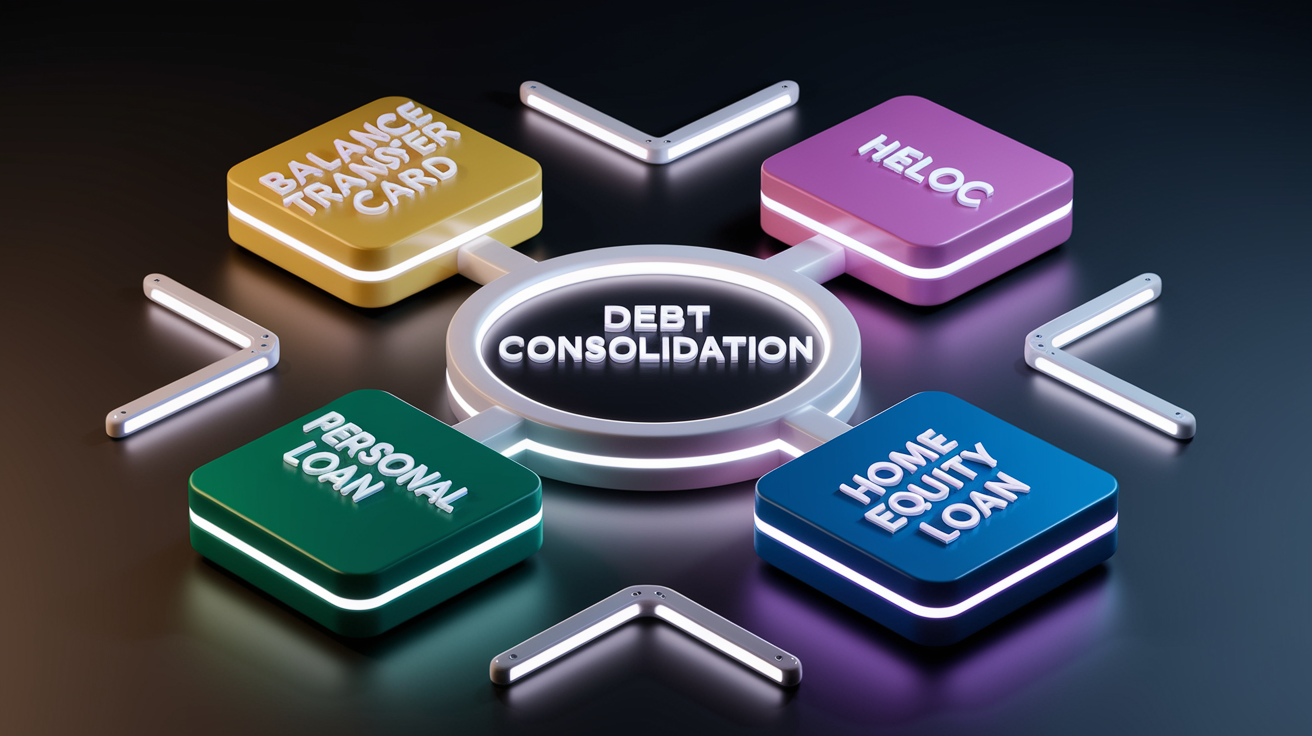
Balance Transfer Cards
Balance transfer cards let you move high interest credit card debt onto a new card with a promotional 0% or low APR, usually for 12 to 21 months. You’ll pay a transfer fee, typically 3% to 5% of whatever you move.
You eat that fee upfront, but you dodge interest charges during the promo window. Miss a payment by more than 60 days, though, and the promotional rate can vanish. Interest might apply to your entire balance at that point.
Best for people who can knock out the transferred balance before the promo period ends and want to skip ongoing interest.
Personal Loans
Personal loans give you a lump sum that you pay back in fixed monthly chunks over one to seven years. Amounts range from $1,000 to $250,000, with APRs between 6.7% and 35.99% depending on your credit.
Origination fees can run anywhere from 1% to 12% of the loan, but if your credit is good or excellent, you might dodge them completely. Fixed rates keep your monthly payment steady, which makes planning a lot simpler.
Good for rolling up different types of debt like credit cards, medical bills, and small personal loans into one predictable payment.
Home Equity Loans
Home equity loans let you borrow a lump sum backed by the equity in your home. You get fixed interest rates and repayment terms that can stretch up to 30 years. Closing costs usually hit 2% to 5% of the loan amount.
Because your home is collateral, rates are often lower than unsecured options like personal loans. But if you miss payments, you could lose your house. And if home values drop, you might owe more than your place is worth.
Best for borrowers with serious equity who need a big chunk of cash and can handle the risk of putting their home on the line.
HELOCs
A home equity line of credit works like a revolving credit line tied to your home. You can pull funds as you need them during a 10 year draw period, then pay it back over up to 20 years. Closing costs are around 2% to 5% of your credit limit.
Rates can be variable or fixed, and your monthly payment shifts based on how much you draw and what rates are doing. You only pay interest on what you actually borrow, which gives you flexibility if your needs change.
Best for people who want ongoing access to funds and can manage payments that move around. But you’re still risking foreclosure, same as with a home equity loan.
Debt Consolidation Examples With Before and After Comparisons
These scenarios show how consolidation changes both your monthly payment and what you’ll pay in total interest. Each example uses a different method, and the trade offs vary.
The thing to watch is total cost. A lower monthly payment sounds great, but if you stretch repayment over more years, you can end up paying more interest overall even if your APR drops.
| Scenario | Before APR / Payment | After APR / Payment | Key Trade Off |
|---|---|---|---|
| $6,000 credit card balance | ~20% APR, $200/month across 3 cards | 0% for 12 months (3% transfer fee), $500/month | Pay $6,180 total; avoid interest if paid in 12 months |
| $20,000 mixed unsecured debt | ~18% APR, $450/month | 6% fixed, $387/month for 5 years | Home secured; total interest ~$3,220; foreclosure risk |
| $12,000 credit cards and small loans | ~22% APR, $350/month | 10% fixed, $388/month for 3 years | Lower total interest; monthly payment slightly higher but term is shorter |
Pros and Cons of Debt Consolidation for Everyday Borrowers

Consolidation can make your debt easier to handle, but it’s not magic. It won’t fix overspending habits or erase what you owe. You need to understand both sides before you decide if it fits your situation.
Think of it as reorganizing your debt, not getting rid of it. If you consolidate and then run up new balances on the cards you just paid off, you’ll be in worse shape than when you started.
Simplifies repayment by turning multiple due dates and amounts into one monthly payment. Can lower your interest rate, especially if you’re consolidating high interest credit card debt. Drops your credit card utilization to 0% if you use a loan to pay off cards, which can bump your score up.
But it might increase total interest paid if you extend the repayment term just to lower your monthly payment. Requires a hard inquiry and opening a new account, which dings your credit score temporarily. And if you use a home equity loan or HELOC and can’t make payments later, you’re putting your house at risk.
Credit Score Requirements and Financial Qualifications for Consolidation

Most lenders want to see a credit score of at least 670 before they’ll approve a consolidation loan with decent terms. If your score is in the 700s or higher, you’ve got a better shot at low APRs and skipping high origination fees.
Lenders also check your debt to income ratio, which compares your monthly debt payments to your gross monthly income. If your DTI is too high (usually above 43%), approval gets harder even if your credit score looks solid. You’ll need proof of income, employment verification, and details about your current debts when you apply.
Each application triggers a hard inquiry on your credit report, which can knock your score down a few points for a bit. If you’re shopping around, try to submit all your applications within a short window so credit bureaus count them as one inquiry. Prequalification tools let you check rates with a soft inquiry that doesn’t touch your score, which is smarter than applying everywhere at once.
Risks, Red Flags, and When Debt Consolidation May Not Be the Right Choice

Consolidation works when you’ve got high interest debt and a real plan to avoid racking up new balances. If you’re struggling with overspending or your debt load is too much even at a lower rate, consolidation alone won’t fix the real problem.
Debt settlement is not the same thing as consolidation. Settlement means negotiating with creditors to pay less than you owe, which tanks your credit and might leave you with taxable income on forgiven balances. Consolidation pays off debts in full and does less damage if you qualify.
Companies that ask for upfront fees before doing anything are often scams. Promises that sound too good, like “erase your debt for pennies on the dollar,” should set off alarms immediately.
If consolidating would raise your interest rate or monthly payment compared to what you’re paying now, it doesn’t make sense. Low interest debt like federal student loans, mortgages, or car loans usually shouldn’t be consolidated because you’d lose favorable terms or protections.
And if you can’t stop adding new balances to credit cards, consolidation will leave you with both a new loan and growing card debt.
Steps to Take Before Starting a Debt Consolidation Plan

Before you apply for any consolidation product, get a full picture of your debts and whether you can actually handle the new payment. Skipping this step can lead to picking the wrong loan or missing better options.
Check your credit score and review your credit report for errors that could hurt your approval odds or rate. List every debt you want to consolidate: current balance, interest rate, monthly payment, and how much time is left on the term.
Compare lenders and prequalify with at least three to see rate ranges, fees, and terms before you commit to a hard inquiry. Calculate total cost by multiplying the new monthly payment by the number of months in the term, then tack on any fees like origination, transfer, or closing costs.
Make sure the new loan actually lowers your total cost or simplifies things enough to justify the fees. And confirm you can afford the monthly payment without adding new debt.
Final Words
You now know what debt consolidation is, how it works, the main options, sample scenarios, and the risks to watch for.
If you’re deciding, use this rule: list all balances, estimate total interest and fees, then compare that to any consolidation offer. If the new loan lowers your total cost and you won’t run up new debt, it’s worth considering.
Start by listing debts and checking prequalification offers. These small steps turn the idea of debt consolidation meaning and examples into a plan you can act on. You’ve got this.
FAQ
Q: Is it a good idea to consolidate debt?
A: Consolidating debt is a good idea when it lowers your interest or simplifies payments; if it cuts total cost or prevents missed payments, go for it, otherwise consider other options.
Q: How much is the payment on a $50,000 consolidation loan?
A: The payment on a $50,000 consolidation loan depends on APR and term. Example monthly payments: 5 years at 6% ≈ $970; 7 years at 10% ≈ $830; 10 years at 15% ≈ $805.
Q: How to pay off $30,000 in debt in 1 year?
A: Paying off $30,000 in one year needs about $2,500 monthly plus interest. Cut expenses, add income (side work), consider a lower-rate consolidation loan only if it lowers total cost, and automate payments.
Q: What is the downside of consolidation?
A: The downside of consolidation is longer repayment that can raise total interest, lost promotional terms, origination or transfer fees, and possible risk to collateral (like home equity); it doesn’t erase principal.