


Think rolling all your credit cards into one loan is always the smart move? Not true.
Picking the best consolidation method depends on three things: your credit score, how much you owe, and how fast you can realistically pay it off.
If your score is 670 or higher and you can finish inside a 0% intro period, a balance transfer usually costs the least.
Need more time? A fixed-rate personal loan often wins.
Bad credit or overwhelming balances? A nonprofit debt management plan can be the safer choice.
Choosing the Most Effective Debt Consolidation Method for Multiple Credit Cards

The best debt consolidation method for multiple credit cards depends on your credit score, how much you owe, and how fast you can pay it back. Good to excellent credit (670 or higher) and you can clear balances in under two years? A balance transfer card with a 0% intro period usually delivers the lowest total cost. Borrowers who need more time (three to seven years) often do better with a fixed-rate personal loan. Predictable payments. No risk of a promotional APR expiring. If your credit’s weak or you’re overwhelmed, a debt management plan through a nonprofit counselor can cut your interest rates and consolidate payments without requiring a new loan or high credit score.
Your credit tier narrows the field fast. Balance transfer cards typically require a FICO around 670 or above, and you’ll need enough available credit on the new card to move your balances. Home equity loans and HELOCs often accept scores as low as 620, but you’re putting that home on the line. Personal loans are available across the credit spectrum, though borrowers below 670 will see higher APRs. Sometimes high enough that consolidation saves very little. DMPs work regardless of your score because the credit counseling agency negotiates directly with your card issuers.
Here’s why the numbers matter. Suppose you carry $10,000 in credit card debt at an average APR of 23%. Paying only the minimums could take over four years and cost you around $6,200 in interest. Consolidate that same $10,000 with a 15% personal loan and you’ll save roughly $2,800 in interest while paying off the balance about six months sooner. The right method cuts both time and cost, but only if it fits your credit and repayment capacity.
Balance transfer credit card: Best for borrowers with credit scores ≥ 670 who can pay off debt during a 0% intro period (typically 6 to 21 months).
Personal consolidation loan: Best for borrowers who need a fixed payment over two to seven years and want to avoid revolving credit risk.
Home equity loan or HELOC: Best for homeowners with equity who can accept foreclosure risk in exchange for the lowest available interest rate.
Debt management plan (DMP): Best for borrowers with low credit scores or large balances who can commit to a structured 3 to 5 year repayment plan.
401(k) loan: Best used only as a last resort when other options aren’t available and you fully understand the retirement and job-change risks.
Comparing Key Credit Card Debt Consolidation Options
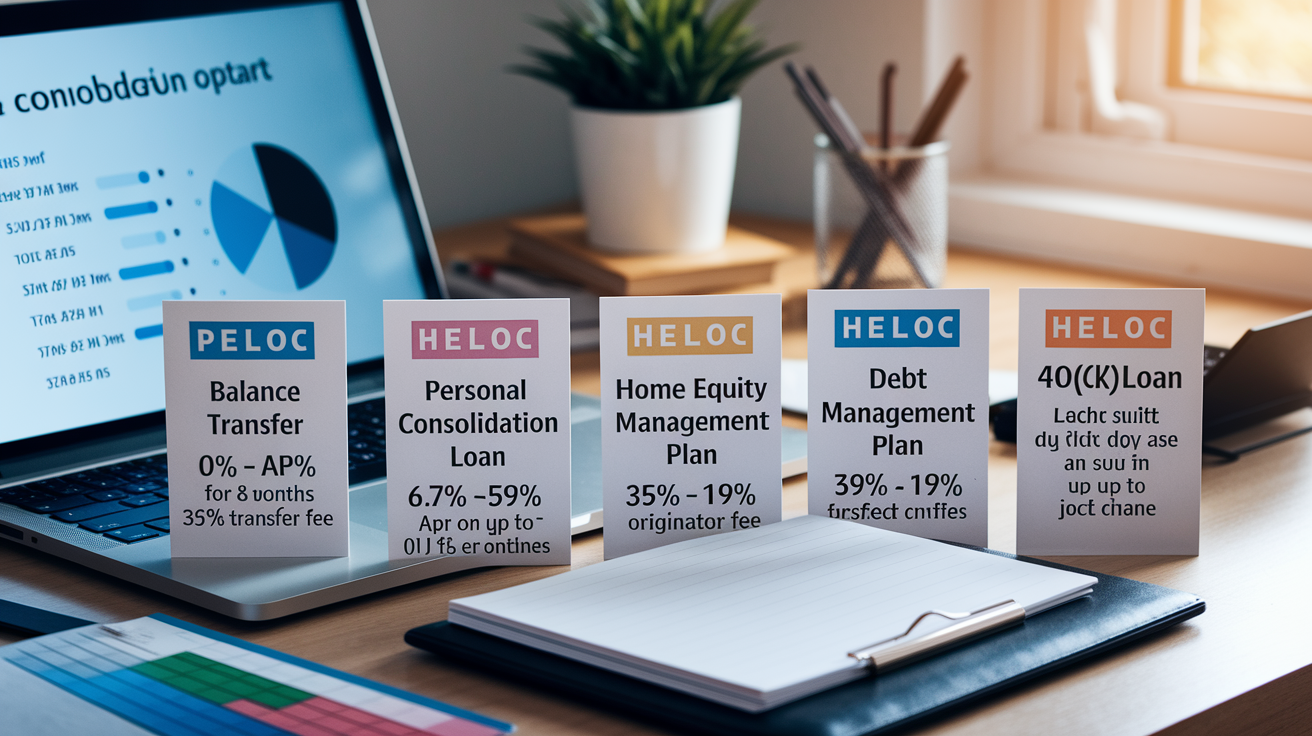
Each consolidation method handles interest, fees, and repayment structure differently. Those differences determine the real cost. Balance transfer cards offer a 0% intro APR for 6 to 21 months but charge a transfer fee of 3% to 5%, so you pay that fee upfront and then race the clock to finish before the promotional rate expires. Personal loans come with fixed APRs ranging from about 6.7% to 35.99%, terms between 12 and 120 months, and origination fees that can be anywhere from 1% to 12% of the loan amount. Those fees get rolled into your balance or deducted from your proceeds, raising the effective cost. Home equity products (loans or HELOCs) typically carry lower rates because your home secures the debt, but closing costs can run up to 5% and you risk foreclosure if you miss payments.
Debt management plans don’t charge interest in the traditional sense. Instead, a credit counseling agency negotiates with your card issuers to cut your APRs, sometimes by half, and may waive late fees. You’ll pay the agency a modest setup fee and a monthly administrative fee, usually in the range of $20 to $75. The plan typically runs three to five years. A 401(k) loan lets you borrow up to half your vested balance (maximum $50,000) at a relatively low rate, and the interest you pay goes back into your own account. But if you lose or leave your job the full loan balance is due immediately, often by the tax filing deadline of the following year, or it’s treated as an early withdrawal with taxes and penalties.
| Method | Typical APR/Cost | Best For |
|---|---|---|
| Balance transfer card | 0% intro for 6–21 months; 3%–5% transfer fee; then 15%–25% variable | Good to excellent credit (≥670); can pay off within promo period |
| Personal consolidation loan | 6.7%–35.99% APR; 1%–12% origination fee; 12–120 month terms | Borrowers who need fixed payments over 2–7 years |
| Home equity loan / HELOC | ~3%–8% APR; up to 5% closing costs; draw period often ~10 years | Homeowners with equity willing to secure debt with their home |
| Debt management plan | Negotiated APR cuts (often to 10%–15%); setup + $20–$75/month fee; 3–5 year plan | Low credit or large balances; can commit to structured multi-year plan |
| 401(k) loan | Low single-digit rate; max 50% vested balance or $50,000; due on job change | Last resort when other options unavailable; stable employment required |
Final Words
in the action: the right path comes down to three things — credit score, total debt, and how fast you can pay it off. If you have excellent credit and a short payoff window, balance transfers often win. Bigger balances or longer timelines usually point to personal loans or home equity. Low scores may mean a debt management plan is the realistic start.
Quick eligibility note: balance transfer cards usually need about 670+, home equity options around 620+. Those tiers narrow your real choices.
A $10,000 balance at 23% versus a 15% consolidated rate can save roughly $2,800. Choose the best debt consolidation method for multiple credit cards that fits your score and timeline, and you’ll cut interest and make steady progress.
FAQ
Q: What’s the best way to pay off credit card debt on multiple cards, and can I consolidate them into one?
A: Paying off multiple cards and consolidating them into one is possible; the best option depends on your credit, debt size, and timeline. If you can repay within 6–21 months, a 0% balance-transfer card often works best.
Q: What is the 2 3 4 rule for credit cards?
A: The 2 3 4 rule for credit cards isn’t a single official rule; it’s a shorthand some advisers use. Definitions vary, so check the source—focus instead on low utilization, on-time payments, and account age.
Q: Why does Dave Ramsey say not to consolidate debt?
A: Dave Ramsey says not to consolidate debt because it can stretch payments, hide the problem, and increase total cost; he prefers the debt snowball to build quick wins and stop further borrowing.