


Thinking about rolling all your debts into one payment?
It can be a smart move, or it can make things worse.
This post breaks down the main pros and cons so you can decide.
If you can secure a meaningfully lower APR (interest rate) and commit to not recharging those cards, consolidation often saves money and stress.
If you can’t, fees or longer terms can cost you more.
I’ll show when each method, like balance transfers, personal loans, or debt management plans, makes sense and the exact mistakes that turn a good plan into a worse one.
Key Advantages and Disadvantages of Debt Consolidation Programs

Debt consolidation takes all your separate debts and rolls them into one account. You’re replacing a bunch of monthly payments with a single one. The idea is to make your life simpler, drop your interest rate, and pay everything off faster. But it only works if you actually qualify for better terms than what you’ve got now and you don’t miss payments.
You save real money when your new APR comes in lower than the blended rate you’re paying across all your current debts. And the monthly payment has to fit your budget for the entire term. If you can’t lock in a good rate, or the fees and stretched out timeline eat up your interest savings, consolidation might cost you more than just sticking with what you have.
The biggest danger isn’t even financial. It’s you. Consolidation doesn’t fix whatever got you into debt in the first place. When you use a loan to pay off your credit cards, those cards suddenly have zero balances again. If you start using them without controlling your spending, you’ll end up with more debt than before.
Core Advantages:
- Lower interest rate if your credit’s decent, which cuts down total interest over time.
- One monthly payment instead of juggling five different due dates.
- Your credit score can improve if you make consistent payments and drop your utilization.
Core Drawbacks:
- Upfront fees like origination charges and balance transfer costs that can wipe out your savings.
- Hard to qualify if your credit’s weak, and you might end up with rates just as bad as what you’re paying now.
- Temptation to rack up new debt on those cleared credit lines if you don’t change your habits.
Consolidation delivers when you lock in a meaningfully lower APR, stick to your payment plan, and commit to not touching those cards while you’re paying down the consolidated balance.
Understanding How Debt Consolidation Programs Work

Debt consolidation moves balances from a bunch of accounts into one new place. That new account could be a personal loan with a fixed term and predictable monthly payment, a balance transfer credit card with a promotional interest rate, or a debt management plan run by a nonprofit counselor.
How these different methods actually work matters a lot. A personal loan is an installment account. You know when it ends and what you owe every month. A balance transfer card is revolving credit, which gives you flexibility but the terms get messy after the promo period runs out. Debt management plans usually negotiate your interest down with creditors, but you might have to close accounts and go through counseling.
| Method | Typical APR/Promo | Key Benefit | Key Limitation |
|---|---|---|---|
| Personal Loan | 6.7% to 35.99% | Fixed term and payment | Origination fees (1–6%) |
| Balance Transfer Card | 0% for 12–21 months | Interest‑free promo period | 3–5% transfer fee; requires good credit |
| Debt Management Plan | Negotiated rates vary | Works for weaker credit | May require closing accounts |
| Home Equity Loan | Often lower fixed rate | Secured by property; larger limits | Risk of foreclosure if you default |
What happens depends heavily on your credit when you apply and whether you can make every payment for the full term. A hard credit inquiry when you apply might knock your score down temporarily by fewer than five points.
Main Pros of Debt Consolidation Programs

The big win with consolidation is cutting your interest costs when you secure a lower APR. Your credit determines which rate tier you’ll land in. If your score’s in the mid 600s, you’re probably looking at rates in the high teens or twenties. Excellent credit can get you single digits or even promotional 0% offers. The gap between what you’re paying now and what you’ll pay after consolidating is where your savings live.
How the loan is structured also affects how fast you pay it off. A 24 month loan at a lower rate forces you to knock down principal faster than minimum payments spread across multiple cards. Say you’re consolidating $9,000 at 25% APR with a $500 monthly payment. That costs about $2,500 in interest over roughly two years. Refinance to 17% APR over the same period and your payment drops to around $445, saving you about $820 in interest. Before consolidating $12,000 in credit card debt, Jake was paying $380 a month and barely touching principal. After refinancing to a 14% loan, his $380 payment cleared the balance in 36 months instead of seven years.
Streamlining payments reduces headaches down the road. One due date means fewer calendar reminders, fewer autopay setups, and less chance of accidentally missing a payment and getting hit with fees or credit damage. Whether it helps your credit depends on how your utilization changes and what kind of account you’re moving to. Paying off revolving accounts drops your overall utilization ratio, which is huge for your score. If you turn that debt into an installment loan, your credit mix might improve too.
Five Key Benefits:
- You can eliminate interest completely during 0% promo windows that last up to 21 months.
- Brings past due accounts current and stops collection activity.
- Predictable monthly payment and payoff date with fixed rate installment loans.
- Better credit utilization if you pay off revolving balances and don’t use them again.
- Easier record keeping and less admin work across accounts.
Main Cons and Risks of Debt Consolidation Programs
Origination fees on personal loans usually run 1% to 6% of what you’re borrowing, and balance transfer fees hit 3% to 5% of the amount you move. On a $10,000 consolidation loan with a 5% origination fee, you’re paying $500 upfront before your first payment. If your total interest savings over the life of the loan are less than $500, you just lost money on the deal.
Getting approved for good APRs is harder than the ads make it sound. Those low rates you see advertised? They’re usually only for people with excellent credit and low debt to income ratios. If your credit’s in the fair range, you might get an APR that’s barely lower than what you’re paying now. Or even higher. Missing payments on the new consolidation account triggers late fees, potential APR increases after promo periods end, and negative marks on your credit report that stick around for seven years.
Stretching out your repayment term drops your monthly payment but jacks up your total interest. A $15,000 balance at 12% APR paid over three years costs about $2,900 in interest. Stretch that to six years and total interest climbs to about $5,900. The lower monthly payment feels easier, sure. But you’re paying double the interest.
Hidden Costs and Behavioral Pitfalls
Beyond the upfront fees, some lenders charge prepayment penalties if you pay the loan off early. Others tack annual fees onto balance transfer cards. Read the full disclosure before you sign anything. Long repayment periods also carry opportunity cost. Money tied up in debt payments can’t be saved or invested.
The most dangerous risk is what happens to those credit lines once you pay them off. When you use a consolidation loan to clear your credit cards, those cards now have zero balances and full available credit. If you don’t close the accounts or control your spending, it’s ridiculously easy to run up new balances. You end up with the original consolidation loan plus new credit card debt. Worse than where you started. When Sarah paid off $8,000 in cards with a personal loan, she felt relieved. Six months later, she’d charged $3,000 back onto the cards and now owed $11,000 total instead of $8,000.
Whether consolidation works or fails comes down to behavioral discipline. Consolidation doesn’t address root overspending issues. If you haven’t changed the habits that created the debt, you’re just postponing the problem.
Comparing Types of Debt Consolidation Programs
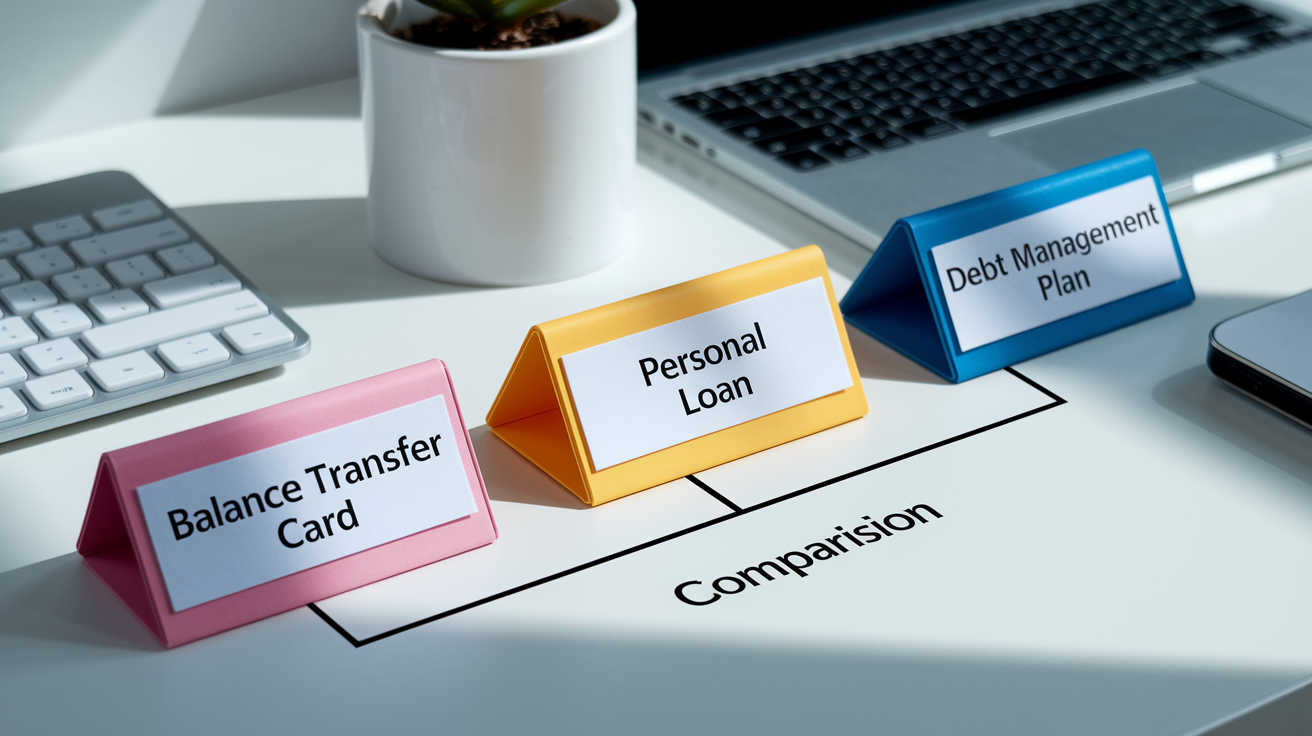
Each consolidation method fits a different profile and financial situation. Pick the wrong type and you’ll lock yourself into bad terms or set yourself up to fail the payoff plan.
Balance Transfer Credit Cards
Balance transfer cards offer 0% APR promo periods, usually 12 to 21 months. Transfer a $5,000 balance and pay it off within the promo window? You pay zero interest. Just the 3% to 5% transfer fee. These cards need good to excellent credit, typically mid 600s or higher. Approval also depends on income and existing credit lines. If your credit limit comes in lower than your total debt, you can’t move everything onto one card. After the promo period ends, whatever balance is left reverts to standard APRs, often 18% to 25%.
Best use case: you’ve got only credit card debt, qualifying credit, and a realistic plan to pay it off before the promo expires.
Personal Debt Consolidation Loans
Personal loans give you fixed monthly payments and a defined payoff date. No risk of revolving debt creep. APRs range from about 6.7% for excellent credit to 35.99% for weaker profiles. Origination fees vary by lender. Some charge nothing, others charge up to 6%. Loan terms can run from 12 to 120 months. Shorter terms mean higher monthly payments but lower total interest. Longer terms reduce monthly cost but increase total interest paid.
Best use case: you’ve got mixed debt types (cards, medical bills, personal loans), you prefer a fixed payment structure, or you prequalify for a loan APR lower than your current blended rate with manageable fees.
Debt Management Plans
Nonprofit credit counseling agencies negotiate directly with your creditors to reduce interest rates and create a single monthly payment. You pay the agency, which then distributes funds to creditors. These plans often require closing credit accounts and completing financial counseling. Fees are usually low or based on what you can afford. Debt management plans work for borrowers with weaker credit who can’t qualify for better loans or balance transfers.
Best use case: you can’t qualify for lower rate products, you need creditor negotiation support, or you want structured guidance and accountability.
| Program Type | Best For | Key Drawback |
|---|---|---|
| Balance Transfer Card | Good credit, card‑only debt, fast payoff plan | Promo expires; remaining balance reverts to high APR |
| Personal Loan | Fixed payment preference, mixed debt, moderate credit | Origination fees and APR depend heavily on credit profile |
| Debt Management Plan | Weak credit, need creditor negotiation, prefer counseling | May require closing accounts; affects credit access |
Eligibility Requirements for Debt Consolidation Programs

Lenders check your credit score, income, debt to income ratio, and payment history to decide approval and terms. Balance transfer cards typically want credit scores in the mid 600s or higher. Personal loans might approve borrowers with scores in the low 600s but at higher APRs. Past due accounts or recent collections can disqualify you from the best offers.
Prequalification tools use soft credit pulls that don’t affect your score. You can compare potential offers before you formally apply. Once you submit a full application, lenders do a hard inquiry that might drop your score temporarily by fewer than five points. Multiple applications in a short window can compound the effect and make you look risky to future lenders.
Core Qualification Requirements:
- Minimum credit score thresholds (mid 600s for balance transfers, low 600s for many personal loans, debt management plans might have no minimum).
- Verifiable income enough to cover the new monthly payment alongside what you already owe.
- Debt to income ratio usually below 40% to 50%, depends on the lender.
- Active bank account for loan disbursement and autopay setup.
- Documentation like recent pay stubs, tax returns, or bank statements to confirm income and employment.
Cost Factors and Fee Structures in Debt Consolidation Programs
Total borrowing cost is more than the APR. You’ve got to account for all fees, the length of the repayment period, and any penalties for early payoff or missed payments. APR represents the annualized cost of borrowing, including interest and certain fees. It’s the best single number for comparing offers across lenders.
Balance transfer fees run 3% to 5% of what you’re moving. A $10,000 transfer at 4% costs $400 upfront. Origination fees on personal loans range from 1% to 6%. A $15,000 loan with a 5% fee costs $750, usually deducted from what you receive. So you get $14,250 but owe $15,000. Some lenders also charge late fees, returned payment fees, or prepayment penalties.
How long you take to repay changes total cost dramatically. A $10,000 loan at 12% APR paid over two years costs about $1,270 in interest. Stretch that to five years and interest jumps to about $3,350. Lower monthly payments feel more manageable but cost significantly more over time.
Major Cost Categories:
- Upfront fees: Balance transfer fees, origination fees, application fees (rare but possible).
- Ongoing interest: Calculated daily and compounded, determined by APR and what’s left on principal.
- Penalty fees: Late payment fees, returned payment fees, prepayment penalties (less common but worth checking).
- Opportunity cost: Total interest paid over extended terms that could’ve been saved or invested elsewhere.
Credit Score Effects of Debt Consolidation Programs
Applying for a consolidation loan or balance transfer card triggers a hard credit inquiry. Usually drops your score by fewer than five points and stays on your report for two years. Multiple inquiries within a short period (usually 14 to 45 days, depending on the scoring model) might get treated as a single inquiry if you’re rate shopping for the same type of loan.
On time payments on the new consolidated account build positive payment history. That’s the single largest factor in most credit scoring models. Paying off revolving credit card balances lowers your overall credit utilization ratio, which can boost your score. But if you consolidate multiple small balances onto one card and max out that card’s limit, utilization on that single account spikes and might temporarily lower your score. Some scoring models exclude paid collections from calculations, so bringing past due accounts current through consolidation can improve your score over time.
Three Key Credit Score Dynamics:
- Hard inquiry impact: Short term dip of fewer than five points. Effect fades within months and disappears from scoring after one year, though the inquiry stays on your report for two years.
- Utilization redistribution: Paying off cards lowers overall utilization (good), but closing accounts or stacking balances on one card can raise utilization on that account (temporarily negative).
- Payment history weight: Consistent on time payments on the consolidation account build long term positive history. A single missed payment can drop your score by 50 to 100 points and linger for seven years.
When Debt Consolidation Programs Make Sense (Decision Checklist)

Consolidation works when the new terms give you real savings, the monthly payment fits your budget for the full term, and you’re committed to not piling on new debt while paying down the consolidated balance. If any of those things aren’t true, consolidation can make your situation worse.
Run the numbers before you apply. Calculate your current blended APR, total monthly payments, and projected payoff timeline. Compare those to the new loan’s APR, fees, monthly payment, and term. If total cost (principal plus all interest and fees) is lower with consolidation and the payment’s affordable, it might make sense. If fees and longer terms wipe out savings, or the payment strains your budget, look for something else.
Seven Item Decision Checklist:
- Will the new APR (after accounting for all fees) be meaningfully lower than your current blended rate?
- Can you afford the new monthly payment every month for the full loan term without cutting essential expenses?
- If you’re using a 0% balance transfer offer, can you realistically pay off the balance before the promo ends?
- Have you prequalified to confirm likely approval and terms without triggering a hard inquiry?
- Are you confident you won’t use those freed credit lines and pile on new balances?
- Have you compared the total cost of consolidation (principal plus interest plus fees) to what you’re on track to pay now?
- If your credit’s weak and offers exceed 36% APR, have you checked nonprofit debt management plans or other options?
Alternatives to Debt Consolidation Programs

If you can’t qualify for a lower APR, or fees and terms make consolidation unattractive, other debt payoff strategies might work better. The debt avalanche method focuses on paying off the highest interest debt first while making minimum payments on everything else. Cuts total interest to the bone. The debt snowball method targets the smallest balance first to build momentum and get psychological wins, even if it costs slightly more in interest.
Nonprofit credit counseling gives you free or low cost guidance and might include debt management plans that negotiate lower rates without requiring a new loan. If your income’s unstable or your debt feels overwhelming, counseling can help you figure out whether consolidation, bankruptcy, or another path makes the most sense. Do it yourself payoff strategies work when you’ve got the discipline to stick to a plan and redirect any extra income toward debt.
Behavioral factors matter more than the math in a lot of cases. Some people crush it with the avalanche method’s logic. Others need the snowball method’s quick wins to stay motivated. Pick the approach that matches your personality and circumstances, not the one that looks best on a spreadsheet.
| Alternative | Best For | Key Benefit |
|---|---|---|
| Debt Avalanche | Disciplined budgeters focused on minimizing interest | Lowest total cost; pays off high‑rate debt fastest |
| Debt Snowball | Those needing quick wins and visible progress | Builds momentum; clears accounts faster psychologically |
| Nonprofit Counseling | Borrowers unsure of best path or needing negotiation support | Free guidance; may negotiate lower rates without new credit |
| Do‑It‑Yourself Payoff | Stable income, moderate debt, strong self‑discipline | No fees, no new credit; full control over strategy |
Final Words
In the action, consolidation can lower interest and simplify payments, but it only helps if you secure a meaningfully lower rate and make on-time payments.
This post covered how consolidation works, the main advantages and risks, program types, fees and credit effects, who typically qualifies, a decision checklist, and alternatives.
Weigh the pros and cons of debt consolidation programs against your budget and spending habits. When the math and discipline line up, consolidation can speed payoff and cut stress. Pick one small next step and move forward.
FAQ
Q: Is there a downside to consolidating debt?
A: The downside to consolidating debt is it can add fees, increase total interest if you extend terms, hurt credit with missed payments, and won’t fix overspending; compare rates and budget first.
Q: How much is the payment on a $50,000 consolidation loan?
A: The payment on a $50,000 consolidation loan depends on APR and term. For example, at 8% APR over 5 years the monthly payment is about $1,015; longer terms lower monthly payments but increase total interest.
Q: How to pay off $30,000 in debt in 1 year?
A: To pay off $30,000 in debt in 1 year you need roughly $2,500 a month plus interest; cut expenses, boost income, negotiate rates, and focus payments on highest-rate balances.
Q: Why does Dave Ramsey not recommend debt consolidation?
A: Dave Ramsey does not recommend debt consolidation because he favors the debt-snowball method, prioritizes behavior change over refinancing, and worries consolidation can extend repayment or tempt people to rack up new balances.