


Think consolidating your debt will fix everything?
It can tidy multiple bills into one payment, but only if the new loan lowers your interest and you don’t run up new balances.
Consolidation often helps when you have several high-interest debts, steady income, and you can qualify for a loan with a lower APR (annual percentage rate) than you’re paying now.
If those things line up, consolidation can simplify payments and cut total interest.
Simple rule: if your weighted average rate is above 15% and you can get at least 5 percentage points lower, consider it.
Deciding If Debt Consolidation Fits Your Financial Situation

Debt consolidation makes sense when you’re carrying multiple high-interest debts, you’ve got steady income, and you can qualify for a loan with a meaningfully lower APR than what you’re paying right now. The strategy works best if you’re juggling credit card balances, medical bills, store installment plans, or payday loans. Debts that charge 15% to 29% interest or more. If your current debts feel scattered and unmanageable, and you can commit to a disciplined repayment plan without opening new credit lines, consolidation can restore order and reduce what you pay over time.
Watch your debt to income ratio closely. If your monthly debt payments (not counting mortgage or rent) eat up more than 40% of your gross income, consolidation may provide breathing room. You’re replacing those payments with one smaller, fixed obligation. That single payment should be affordable within your monthly cash flow, leaving enough left over for essentials, savings, and emergencies.
Consolidation only helps if you stop the behaviors that led to debt in the first place. If spending habits don’t change, you risk paying off old cards only to run them back up again. Leaving you with both the new loan and fresh balances.
Six signs that consolidation may make sense:
- You’re making only minimum payments on credit cards month after month, with balances barely shrinking.
- You struggle to track multiple due dates and have missed payments or paid late fees.
- You’re borrowing from one account to cover payments on another, a cycle that raises total interest costs.
- Your debt to income ratio exceeds 40% of your gross monthly income, not counting your mortgage.
- You have no emergency fund or retirement contributions because debt payments consume available cash.
- You feel constantly stressed or overwhelmed by the volume of accounts and payment obligations.
Understanding Debt Consolidation and How It Works

Debt consolidation means taking out a single new loan and using the proceeds to pay off multiple existing debts. You’re left with one monthly payment at a fixed interest rate. The goal is to secure a lower rate than the weighted average of what you’re currently paying, which reduces both your monthly burden and the total interest you’ll owe by the time everything’s paid off. Lenders evaluate your credit score, income stability, and the size of the loan to set your APR. Many charge an origination fee, typically 1% to 5% of the loan amount, that may be deducted up front or rolled into the balance.
Typical repayment terms range from 24 to 60 months for moderate balances, though larger debts can carry terms stretching to 10 years or more. A longer term lowers your monthly payment but increases the total interest you’ll pay over the life of the loan. Balancing affordability with cost efficiency matters. Fixed monthly payments make budgeting simpler and remove the guesswork of variable minimums or revolving balances.
| Step | What Happens | Why It Matters |
|---|---|---|
| 1. Apply and qualify | Lender reviews credit, income, and DTI; approves loan amount and rate | Your credit profile determines the APR you receive; a lower rate is essential for savings |
| 2. Receive funds | Loan proceeds are deposited or sent directly to creditors | Immediate payoff of old accounts stops interest from accruing on those balances |
| 3. Make fixed payments | You pay the lender one predictable amount each month for the loan term | Consistency improves payment history and simplifies tracking |
| 4. Complete payoff | Loan is fully repaid at the end of the term | You’re debt-free if you avoided accumulating new balances during the loan period |
Pros of Consolidating Debt and How They Improve Your Financial Stability

Consolidation delivers its biggest advantage when it replaces multiple high-interest payments with one lower monthly obligation. Freeing up cash you can redirect toward savings, retirement, or simply covering everyday expenses without stress. When your new loan rate sits well below the 18% to 25% you might be paying across several credit cards, the interest savings add up quickly. The fixed payoff timeline gives you a clear finish line instead of the endless treadmill of minimum payments.
Your credit score can benefit over time, too. Paying off revolving credit card balances drops your credit utilization ratio, how much of your available credit you’re using, which is a major factor in credit scoring models. Consistent on time payments on the new loan build positive payment history. Within a few months you may see your score climb as those improvements are reported.
Five key benefits of debt consolidation:
- Simplified payments: One due date, one amount, one account to monitor each month.
- Lower monthly payment: Consolidation often reduces what you owe each month compared to the sum of your old minimums.
- Interest savings: A lower APR means more of each payment goes to principal, shrinking the balance faster.
- Credit utilization improvement: Paying off credit cards lowers your utilization percentage, which can boost your score.
- Predictable payoff schedule: Fixed terms give you a concrete end date, making long term planning easier.
Cons and Risks of Debt Consolidation You Should Evaluate First

Extending your repayment term is one of the most common pitfalls. A 10 year loan may feel manageable month to month, but you’ll pay significantly more in total interest than if you had tackled the same debt over three or four years. When you stretch payments thin to lower the monthly number, you’re betting that your income and discipline will hold steady for the entire decade. Any stumble can leave you worse off than when you started.
Fees can quietly erode your savings. Loan origination fees typically run 1% to 5% of the borrowed amount, meaning a $20,000 consolidation loan might cost you $200 to $1,000 right out of the gate. Balance transfer credit cards often charge 3% to 5% of the transferred amount. Home equity products carry closing costs that can reach several thousand dollars. If the fee consumes most of your projected interest savings, consolidation becomes a wash or even a net loss.
The behavioral risk is real. Consolidation clears your credit card balances, which can feel like a financial reset. But if you treat those zero balances as permission to spend, you’ll quickly rebuild the debt while still owing the consolidation loan. That double burden is how people end up deeper in the hole than before they consolidated. Secured consolidation options, like home equity loans or lines of credit, add another layer of danger. You’re pledging your house as collateral, so a missed payment can eventually put your home at risk of foreclosure.
Comparing Debt Consolidation Methods and When Each Makes Sense
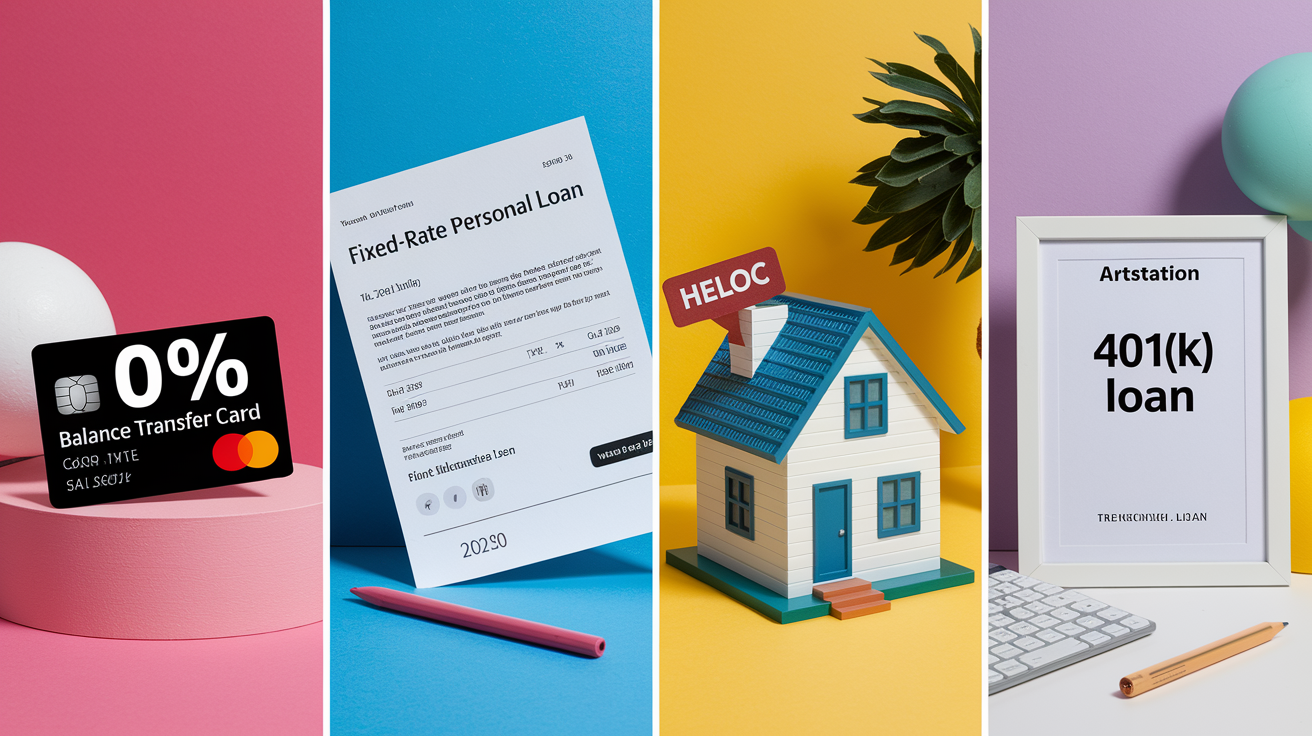
Balance Transfer Credit Cards
A balance transfer card offers a promotional 0% APR period, typically 12 to 21 months, during which you pay no interest on transferred balances. The catch is that you must pay off the entire balance before the promo window closes. Or the remaining amount reverts to the card’s standard purchase APR, often 18% or higher. Most issuers charge a balance transfer fee of 3% to 5% of the amount moved, so a $10,000 transfer costs $300 to $500 up front. This method works best when you have a clear plan to eliminate the debt within the promotional period and can avoid using the card for new purchases. If you transfer $8,000 and can commit to paying roughly $670 per month for 12 months, you’ll clear the balance interest free and save hundreds compared to a standard card rate.
Personal Loans for Consolidation
Fixed rate personal loans are the most common consolidation vehicle. You borrow a lump sum, receive funds to pay off your existing accounts, and then repay the lender over a set term with predictable monthly payments. Rates depend heavily on your credit score. Borrowers with good to excellent credit may qualify for rates in the 6% to 12% range, while those with fair credit might see 15% to 20%. Loan amounts can reach up to $100,000 with repayment terms typically capped at 60 months, though some lenders offer longer windows for larger debts. Personal loans work well when you need simplicity, want to avoid pledging collateral, and qualify for a rate that beats your current weighted average.
Home Equity Options
Home equity loans and home equity lines of credit (HELOCs) let you borrow against the equity you’ve built in your home, often at lower rates than unsecured personal loans because your house serves as collateral. The trade off is serious. If you can’t make the payments, the lender can foreclose. Closing costs (appraisals, title searches, and origination fees) can run into the thousands, so this route makes sense only for large consolidations where the savings justify the expense and risk. Use home equity cautiously, and only if your income is stable and you’re confident you can meet the payment schedule without fail.
401(k) Loans and Other Alternatives
Borrowing from your 401(k) lets you access your own retirement savings, typically up to 50% of your vested balance or $50,000, whichever is less. You repay yourself with interest, but if you leave your job or miss payments, the outstanding balance may be treated as a taxable distribution. Triggering income tax and potentially a 10% early withdrawal penalty. You also lose the compound growth those borrowed dollars would have earned in the market. This method is a last resort. Better than a payday loan, but far riskier than a traditional consolidation loan because it puts your retirement security at stake.
| Method | Key Benefit | Key Risk |
|---|---|---|
| 0% Balance Transfer Card | No interest during promo period if paid off in time | High APR kicks in if balance remains after promo; transfer fee applies |
| Fixed-Rate Personal Loan | Predictable payments; no collateral required | APR depends on credit; origination fees reduce net savings |
| Home Equity Loan / HELOC | Often lower rates due to collateral | House is at risk if you default; closing costs can be high |
| 401(k) Loan | Access your own money without a credit check | Loses retirement growth; taxable if you leave job or default |
Key Qualification Requirements for a Debt Consolidation Loan
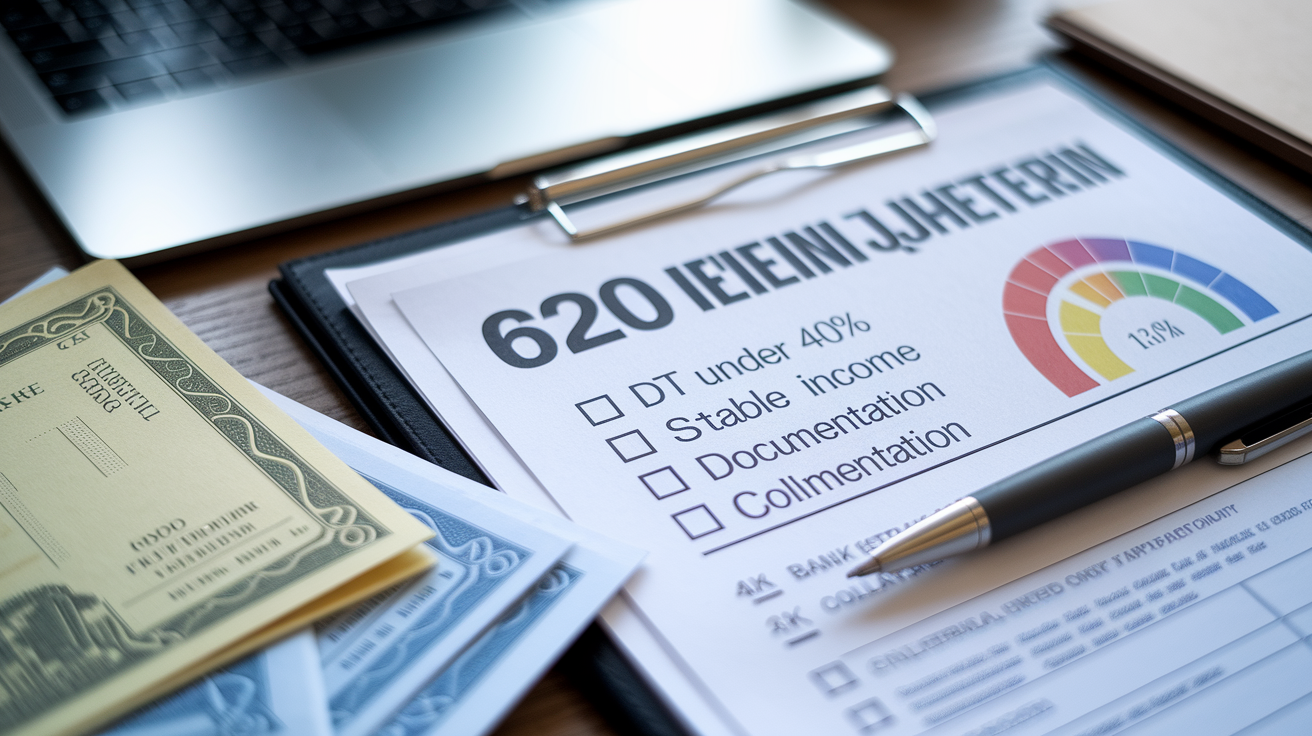
Lenders evaluate three primary factors when you apply. Your credit score, your debt to income ratio, and your employment stability. Most personal loan consolidation programs require a credit score of at least 620, though securing a competitive rate typically demands a score in the mid 600s or higher. Your DTI (total monthly debt payments divided by gross monthly income) should ideally sit below 40%. Higher ratios signal elevated risk and may result in a denial or a higher APR. Steady employment and verifiable income demonstrate that you can meet the new payment obligation month after month.
Expect to provide documentation during the application process. Lenders will ask for recent pay stubs or tax returns to confirm income, a government issued ID, and a list of the debts you plan to consolidate along with current balances and creditor details. Some lenders verify employment directly with your employer. Others may request bank statements to assess cash flow and savings. If you’re applying for a secured option like a home equity loan, an appraisal of your property will be required to determine available equity.
Membership or relationship requirements can also apply, especially with credit unions. Many credit unions require you to join by opening a savings account and meeting eligibility criteria (such as living in a certain area or working for a participating employer) before you can apply for a consolidation loan. Typical loan amounts range from a few thousand dollars up to $100,000, with repayment terms offered up to 60 months for most personal loans.
Five core qualification factors lenders assess:
- Credit score: Minimum typically 620; higher scores unlock better rates.
- Debt to income ratio: Under 40% preferred; includes all monthly debt payments except mortgage.
- Stable income and employment: Verifiable pay stubs or tax returns; consistent job history.
- Required documentation: ID, income proof, list of debts to consolidate, bank statements.
- Collateral (if applicable): Home appraisal for equity loans; no collateral needed for unsecured personal loans.
How to Calculate Whether Debt Consolidation Will Save You Money

Run the numbers before you commit. Start by listing every debt you want to consolidate. The current balance, interest rate, and minimum monthly payment for each. Add up the monthly payments to see your total current obligation, then calculate the weighted average APR by multiplying each balance by its rate, summing those products, and dividing by the total balance. That weighted average is the benchmark your consolidation loan must beat to deliver real savings.
Next, gather quotes from lenders. Note the offered APR, repayment term in months, and any upfront fees (origination charges, balance transfer fees, or closing costs). Use an online loan calculator or a simple amortization formula to compute the new monthly payment and total interest you’ll pay over the loan term. Add any fees to that total interest figure to get your true cost of consolidation, then compare it to what you’d pay if you continued making your current payments until all debts were cleared.
| Item | Before Consolidation | After Consolidation |
|---|---|---|
| Monthly Payment | $850 | $620 |
| Weighted APR | 21.5% | 10.0% |
| Total Interest (48 months) | $9,200 | $4,760 + $600 fee = $5,360 |
Six steps to calculate net savings:
- List all current debts: balance, APR, minimum payment for each account.
- Sum monthly payments and calculate weighted average APR: multiply each balance by its rate, add the results, divide by total balance.
- Get consolidation quotes: note APR, term length, monthly payment, and any fees.
- Calculate total consolidation cost: multiply new monthly payment by term, add origination or transfer fees.
- Calculate current total cost: estimate remaining interest on existing debts if you continue current payments.
- Compare totals and find break even point: subtract consolidation cost from current cost; if positive, you save; divide fees by monthly savings to find break even in months.
Alternatives to Debt Consolidation If It’s Not the Right Fit

If your debt is small enough to pay off within six to twelve months using your existing income, consolidation may cost more in fees and interest than simply attacking the balances directly. The debt snowball method (paying off the smallest balance first while making minimums on the rest) builds psychological momentum with quick wins. The debt avalanche method targets the highest interest account first to minimize total interest paid. Both strategies work when you have the discipline to stick with a payment plan and don’t need the structure of a fixed loan.
Debt Management Plans, offered by nonprofit credit counseling agencies, provide a middle path. A counselor negotiates with your creditors to lower interest rates and waive fees, then consolidates your payments into a single monthly deposit to the agency, which distributes funds to creditors on your behalf. DMPs typically run three to five years and include budgeting education and ongoing financial coaching. Making them a good option if you need external accountability and support but don’t qualify for a low rate consolidation loan.
Five alternatives when consolidation isn’t the right choice:
- Debt snowball: Pay smallest balances first for quick wins and motivation; continue rolling payments into the next account.
- Debt avalanche: Attack highest interest debts first to save the most money overall; requires patience but maximizes savings.
- Creditor negotiation: Contact lenders directly to request lower interest rates or temporary hardship programs; many issuers will reduce rates for customers with good payment history.
- Debt Management Plan (DMP): Work with a certified counselor to negotiate reduced interest over a 3 to 5 year repayment window, with built in budgeting support.
- Credit counseling and budgeting: Free or low cost sessions with a certified counselor to assess your situation and recommend the best path forward, whether consolidation, a DMP, or a DIY payoff plan.
Building a Post‑Consolidation Plan to Stay Out of Debt

Consolidation only solves your debt problem if you change the habits that created it. Once you’ve paid off your credit cards with the loan proceeds, resist the urge to use those cards for everyday purchases. Or worse, to treat the zero balances as newfound spending power. Keep the accounts open to preserve your credit history and available credit, but store the physical cards somewhere inconvenient or freeze them in a block of ice if you need a barrier between impulse and swipe.
Build a small emergency fund as quickly as possible, even if it’s just $500 to start. That cushion prevents you from reaching for a credit card the next time your car needs a repair or a medical bill arrives. Once you’ve established that buffer, direct any extra cash toward accelerating your consolidation loan payoff. Most loans allow early repayment without penalties, and every extra dollar cuts your total interest.
Set up automatic payments from your checking account to ensure you never miss the consolidation loan due date. Late payments not only trigger fees and potential rate increases, they also damage the credit score you’re working to rebuild. Schedule the payment for a few days after your paycheck hits, so the funds are always available. Set a calendar reminder a week before each due date to verify your account balance.
Four actions to maintain momentum after consolidating:
- Avoid new credit card purchases: Use cash or a debit card for discretionary spending; keep credit cards for true emergencies only.
- Automate your loan payment: Link your checking account to the lender and schedule payments immediately after payday to prevent missed due dates.
- Build a $500 to $1,000 emergency buffer: Save small amounts weekly until you have enough to cover minor unexpected expenses without borrowing.
- Track progress monthly: Review your loan balance and remaining term each month; celebrate milestones like paying off 25% or 50% of the principal to stay motivated.
Final Words
You saw the steps to decide if consolidation fits: who benefits, DTI over 40%, and which debts typically qualify.
The post explained how consolidation works, the pros and cons, the main methods, and what lenders look for.
We also showed a simple math check, alternatives, and a post-consolidation plan to avoid new debt.
If you’re asking should i consolidate my debt, use this rule: a lower APR, stable income, and a firm plan to stop new borrowing usually means move forward. Either way, you’ve got options and a clear next step.
FAQ
Q: Is it a good idea to consolidate debt?
A: Consolidating debt is a good idea when you can get a lower APR, have steady income, and won’t add new debt; if you only make minimum payments or have DTI over 40%, consider it.
Q: How long will it take to pay off $20,000 in credit card debt?
A: Paying off $20,000 in credit card debt depends on APR and monthly payment. At 20% APR: $1,000/mo ≈ 2 years, $500/mo ≈ 5.5 years, $400/mo ≈ 9 years.
Q: What does Dave Ramsey say about consolidating debt?
A: Dave Ramsey says to avoid consolidation loans; he recommends the debt snowball method, stop using credit cards, and follow a strict budget to pay balances off faster.
Q: How much is the payment on a $50,000 consolidation loan?
A: A $50,000 consolidation loan payment depends on APR and term. Example: at 8% APR over 60 months the payment is about $1,015 per month; exact amount varies with rate and fees.