


What if your credit card payments never seem to shrink because of the interest rate, not your spending? Rolling multiple high-rate cards into one lower-rate loan or a 0% balance-transfer can turn months of interest into real progress on the principal. Debt consolidation for high-interest credit cards actually works when the new APR is several points lower, fees don’t erase the savings, and you stop adding new charges — this post shows how to pick the right route and the exact first steps. If you only do one thing now, gather your balances and prequalify with a few lenders.
How Consolidation Lowers High-Interest Credit Card Costs
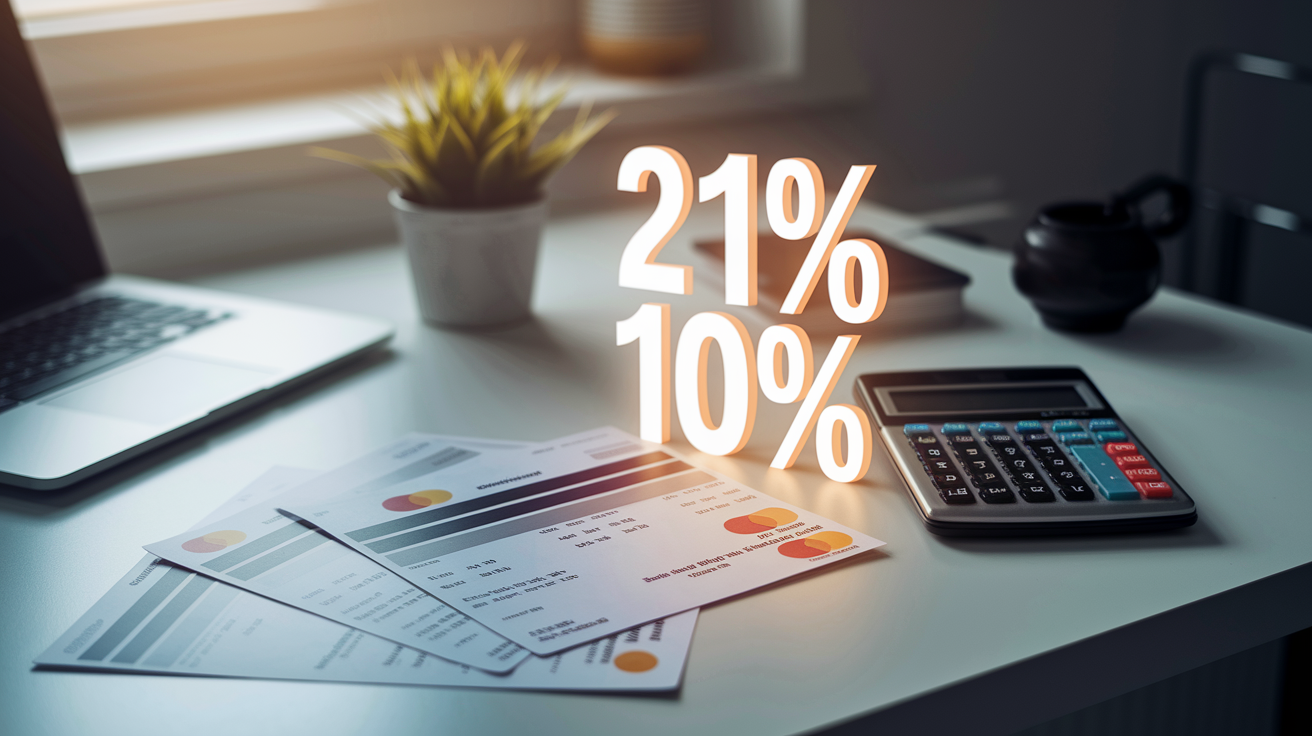
Consolidating high-interest credit card debt means rolling multiple balances into one new payment. Usually through a balance transfer card, personal loan, or structured program. The whole thing works because the new product carries a lower interest rate than your existing cards. Move a balance from a card charging 21% APR to a loan at 10%, and suddenly every payment chips away at principal instead of feeding interest charges.
This works best when your credit score gets you better rates and you actually commit to paying off the new balance without piling on more debt. Say you consolidate $10,000 spread across cards averaging 21% APR into a 60-month personal loan at 10%. Your monthly payment drops from about $270 to roughly $212, and your total interest falls from around $6,230 to about $2,750. That’s roughly $58 a month back in your pocket and about $3,480 saved over the life of the loan. Balance transfer cards offering 0% APR for 6 to 21 months can eliminate interest entirely during the promotional window if you can pay off the balance before the period expires.
Most consolidation paths involve a trade between a fee and long-term savings. Balance transfers charge 3 to 5 percent of the amount moved, and personal loans may deduct an origination fee of 0 to 8 percent from your proceeds. Even with those costs, consolidation usually delivers real relief when your starting APR is high and the new rate cuts your interest by several percentage points.
Five consolidation benefits:
- Lower interest rate that shrinks the portion of each payment going to finance charges
- Simplified monthly payments by replacing multiple due dates with one fixed date
- Faster payoff timeline because more of each dollar reduces principal
- Lower monthly payment if you choose a longer term, freeing up cash flow
- Reduced overall cost from paying less interest over the life of the debt
Consolidation Options for High-Interest Credit Card Debt
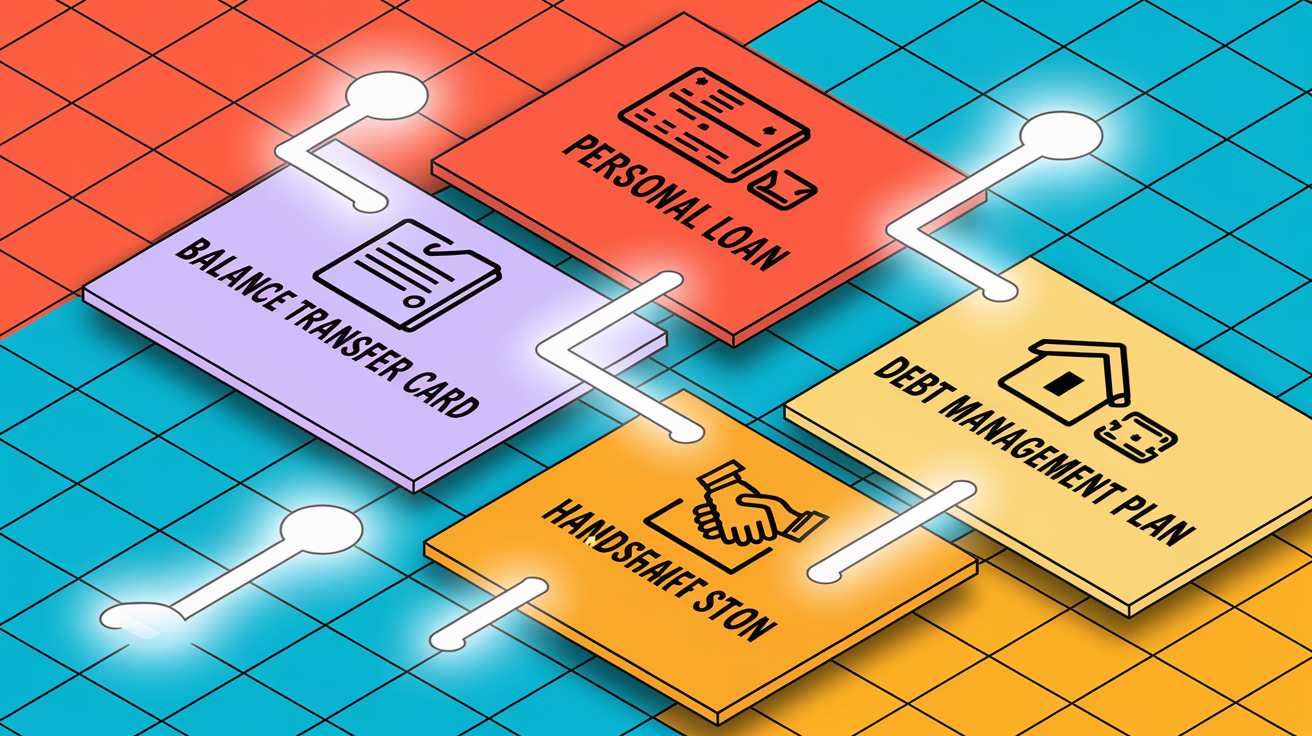
Balance Transfer Cards
Balance transfer credit cards let you move existing balances to a new card that offers a promotional 0% APR, typically lasting 6 to 21 months. The transfer costs 3 to 5 percent of the amount you move, so shifting $10,000 adds $300 to $500 to your balance. If you can pay off the entire balance before the intro period expires, you avoid interest altogether. Once the promotional window closes, the standard APR jumps to 18 to 30 percent or higher. Late payments during the promo can void the 0% rate immediately. Best balance transfer offers require good to excellent credit, usually a FICO score around 670 or above.
Personal Loans
An unsecured personal loan gives you a lump sum to pay off your cards, then you repay the lender in fixed monthly installments over 24 to 84 months. APRs range from roughly 6 to 36 percent depending on your credit score, with the lowest rates reserved for borrowers above 720. Lenders often charge an origination fee between 0 and 8 percent, deducted from the amount you receive. Borrow $10,000 with a 3% fee and you get $9,700, yet owe the full $10,000. Approval and funding typically happen within 1 to 7 business days, and many lenders offer direct payment to your creditors so you never touch the money.
Debt Management Plans
Nonprofit credit counseling agencies can enroll you in a debt management plan that consolidates your unsecured balances into a single monthly payment sent to the agency, which then distributes funds to your creditors. The counselor negotiates lower interest rates and waived late fees on your behalf. Programs usually run 3 to 5 years, with a one-time setup fee of $0 to $100 and monthly fees of $20 to $75. While you’re on the plan, creditors require you to close your cards and avoid opening new credit. Can feel restrictive but helps prevent new debt from piling up.
Home Equity Options
If you own a home with equity, you can borrow against it through a home equity loan or home equity line of credit (HELOC) at rates commonly between 4 and 10 percent. Closing costs run 2 to 5 percent of the loan amount, though some lenders waive them. These loans offer lower rates because your home secures the debt, but that same collateral puts your property at risk. Miss payments and you face foreclosure. Use this route only if you’re confident in your ability to repay and the interest savings justify putting your home on the line.
| Method | Typical APR/Rate | Fees | Best For |
|---|---|---|---|
| Balance Transfer Card | 0% intro (6–21 months), then 18–30%+ | 3–5% transfer fee | Good credit, can pay off within promo period |
| Personal Loan | 6–36% fixed | 0–8% origination | Predictable fixed payments, any credit tier |
| Debt Management Plan | Negotiated lower rates | $0–$100 setup + $20–$75/month | Struggling to afford minimums, multiple accounts |
| Home Equity Loan/HELOC | 4–10% | 2–5% closing costs | Homeowners with equity, low rate priority |
Comparing Consolidation Loan Offers and Total Costs

Start by gathering your current balances, APRs, and monthly payments, then request quotes from at least three lenders. Your credit score heavily influences the APR you’ll see. Borrowers with excellent credit (FICO 720 and up) typically qualify for personal loan rates between 6 and 12 percent. Good credit in the 670 to 719 range often lands rates of 10 to 18 percent, while fair or poor scores below 670 can push APRs into the 18 to 36 percent zone. Balance transfer cards follow a similar pattern, with the longest 0% intro periods and highest credit limits reserved for top-tier scores.
Total repayment cost depends on four factors: the APR, any origination or transfer fees, the loan term in months, and your monthly payment amount. A lower APR saves interest but watch for origination fees that eat into those savings. An 8% origination fee on $10,000 costs $800 up front, which can offset months of interest reduction. Longer terms shrink your monthly payment but stretch interest charges over more years, so compare both the monthly obligation and the total dollars you’ll pay over the life of the loan.
What to compare across offers:
- Annual percentage rate (APR) and whether it’s fixed or variable
- Origination fees, transfer fees, or closing costs expressed as a dollar amount
- Loan term in months and whether you can prepay without penalty
- Estimated monthly payment and total interest paid over the full term
To decide if consolidation makes sense, your new APR should sit several percentage points below your current weighted average rate, and the total cost after fees should still come in lower than what you’d pay sticking with your cards. Run the numbers both ways. If a 3% balance transfer fee on $10,000 adds $300 but the 0% promo lets you pay zero interest for 15 months, that $300 is worthwhile only if you can clear the balance before the promo ends and avoid the revert rate.
Qualifying for a High-Interest Credit Card Consolidation Loan

Lenders evaluate your credit score, income, employment history, existing debt, and debt to income ratio when you apply for a consolidation loan. Credit score thresholds vary. Some lenders accept scores as low as 560, while others set floors around 600 to 670. A higher score unlocks better rates and higher borrowing limits. If your score falls short, consider adding a co-signer with stronger credit or offering collateral like a vehicle to secure the loan and lower the rate.
Income verification confirms you can afford the new monthly payment. Expect to provide recent pay stubs, bank statements, tax returns if you’re self-employed, and a list of monthly obligations including rent, utilities, existing loan payments, and other recurring bills. Lenders calculate your debt to income ratio by dividing total monthly debt payments by gross monthly income, and most prefer that number below 40 to 50 percent. Employment stability matters too. Lenders look for steady income over at least a few months, though requirements differ by lender.
You’ll need a government-issued photo ID, your Social Security number, and account numbers plus current balances for every creditor you want to pay off. Some lenders let you prequalify with a soft credit check that won’t affect your score, so you can compare offers before committing. Once you submit a full application, the lender runs a hard inquiry that may drop your score by a few points temporarily. Approval decisions typically arrive within minutes to a few business days, and funded loans disburse in 1 to 7 business days depending on the lender and whether they pay creditors directly.
Step-by-Step Process to Consolidate High-Interest Credit Card Balances
-
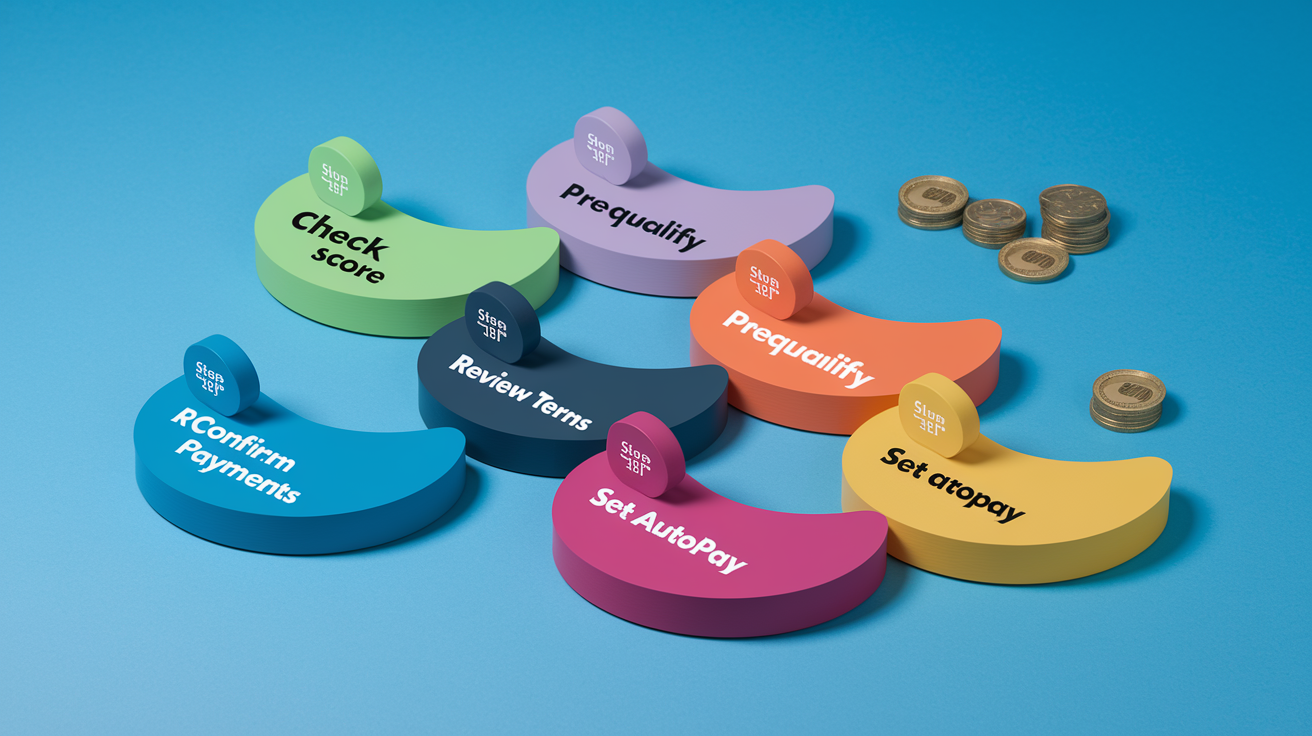
Check your credit score and gather statements showing current balances, APRs, and minimum payments for all cards you want to consolidate. Use a free credit monitoring service or request your report to confirm there are no errors dragging your score down.
-
Prequalify with three to five lenders using soft credit checks so you can compare APRs, fees, terms, and monthly payments without multiple hard inquiries. Look for offers that clearly beat your current rates after accounting for any origination or transfer fees.
-
Submit a full application to your chosen lender or card issuer. Provide identification, proof of income, employment details, and the list of creditor accounts. The lender will run a hard credit pull at this stage, which may cause a small temporary dip in your score.
-
Review and accept the loan terms once approved. Confirm the APR, monthly payment, term length, and any fees. For balance transfers, note the promotional period end date and the revert APR. For personal loans, check whether the lender pays creditors directly or deposits funds into your account.
-
Confirm creditors are paid within one to two billing cycles for balance transfers or within a few days for direct-pay loans. Log in to each old account to verify the balance shows zero, and keep paying minimums on cards until the transfer posts to avoid late fees.
-
Set up autopay for your new loan or consolidated payment to avoid missed due dates. Keep paid-off credit card accounts open if they carry no annual fee. Closing them can hurt your credit utilization ratio and shorten your average account age, both of which can lower your score.
Resist the urge to use the newly available credit on your paid-off cards. Running up fresh balances defeats the purpose of consolidation and can leave you worse off than before, owing both the new loan and a second round of card debt. Treat consolidation as a one-time reset, not a recurring move.
Calculator Guide and Real-Number Savings Example for Consolidation

Before you commit to any consolidation offer, calculate the total cost of your current debt versus the new option. You need six pieces of information: your total balance across all cards, the APR on each card (or a weighted average if you want a single number), your current combined monthly payment, the proposed consolidation APR, the new loan term in months, and any upfront fees like origination or transfer charges.
For a fixed-rate personal loan, the monthly payment formula is P equals r times PV divided by one minus the quantity one plus r to the negative n power, where r is your monthly interest rate (annual APR divided by 12) and n is the number of months. Multiply that monthly payment by the term to get total repaid, then add any fees to find your all-in cost. Compare that number to what you’d pay on your cards, either the total if you keep making current payments, or an estimate based on minimum payments that stretch repayment over years.
Inputs to gather:
- Total balance across all cards you want to consolidate
- Current APR for each card, or weighted average APR
- Current total monthly payment (or required minimums)
- Proposed consolidation APR and whether it’s fixed or variable
- Loan term in months
- Upfront fees: balance transfer fee (3 to 5%), origination fee (0 to 8%), or closing costs
Worked example: You carry $10,000 in credit card balances at an average APR of 21%. If you keep paying $270 per month at that rate, you’ll spend about 60 months paying off the debt and rack up roughly $6,230 in interest, for a total cost around $16,230. Now consolidate that $10,000 into a personal loan at 10% APR with a 60-month term and no origination fee. Your new monthly payment drops to about $212, total interest falls to roughly $2,750, and you pay around $12,750 all in. Monthly savings: about $58. Total savings: roughly $3,480. If you’ve ever opened your bank app and immediately regretted it, yeah, same. This is the kind of math that makes that dread disappear.
Pros, Cons, and Credit Score Effects of Consolidation
Consolidation can lower your interest rate, simplify your payment schedule, and help you pay off debt faster by directing more of each payment toward principal. A single fixed monthly payment makes budgeting predictable, and paying off revolving balances drops your credit utilization ratio, one of the biggest factors in your credit score. Lower utilization often lifts your score within a few months, even after the small temporary dip from a hard inquiry.
On the downside, you may not qualify for a rate low enough to beat your current cards if your credit is fair or poor. Origination fees and balance transfer fees can cancel out interest savings if the rate difference is slim, and stretching the term to lower your monthly payment means you’ll pay more interest over time. Secured loans like home equity products put your collateral at risk, and late payments on balance transfer cards can void the promotional APR immediately, leaving you with a higher rate than you started with. Debt management plans close your cards during the program, which can hurt utilization and limit your access to credit in emergencies.
Three consolidation pros:
- Lower interest rate cuts the portion of each payment going to finance charges
- Single monthly payment eliminates the stress of tracking multiple due dates
- Improved credit utilization and payment history can raise your score over time
Three consolidation cons:
- Origination or transfer fees can offset interest savings if the rate gap is narrow
- Late payments or missed payments void promotional rates and hurt your credit
- Secured loans risk foreclosure or repossession if you can’t keep up with payments
Common Pitfalls and Mistakes That Make Consolidation Less Effective

The biggest mistake is treating consolidation as permission to keep spending. If you transfer balances to a new card or pay off cards with a loan, then immediately run up fresh charges, you’ll end up deeper in debt with both the new loan payment and a second wave of card balances to manage. Close that loop by removing cards from your wallet, deleting saved payment info from online retailers, and building a small cash buffer so you’re not tempted to swipe when an unexpected expense hits.
Another trap is underestimating fees or missing the fine print on promotional periods. A 0% balance transfer sounds great until you realize the transfer fee is 5% and the promo ends in 12 months, leaving you with a $10,000 balance at 24% APR if you can’t pay it off in time. Origination fees up to 10% can turn a seemingly good personal loan rate into a mediocre deal once you factor in the upfront cost. Always confirm that creditors have been paid after you receive loan funds or complete a transfer. Some borrowers assume the process is automatic, then discover weeks later that old accounts are still open and accruing interest.
Final Words
Cutting your rate and combining bills is the point: consolidation turns several high-rate cards into one lower-rate payment and can shrink what you pay in interest each month. That’s the immediate win.
You saw the main options—balance transfers with 0% intro periods, personal loans with APRs around 6–36%, and DMPs or home equity choices—plus typical fees and a $10,000 example that showed roughly $3,480 in interest savings.
If you can, compare APRs, fees, and terms, set up autopay, and move forward with debt consolidation for high interest credit cards. Small steps add up.
FAQ
Q: How does consolidation lower high-interest credit card costs?
A: Consolidation lowers high-interest credit card costs by moving several balances into one loan or card with a lower APR, reducing interest charges and creating a single monthly payment for simpler tracking and payoff.
Q: When does consolidation work best for high-rate credit card debt?
A: Consolidation works best when you have fair-to-excellent credit, steady income, reasonable debt-to-income ratio, and access to lower APR options so the new rate and fees net a clear savings.
Q: How much could I save by consolidating $10,000 at 21% APR to 10% APR?
A: That example saves about $3,480 in interest over the repayment period, showing how cutting APR from 21% to 10% on a $10,000 balance can produce large savings.
Q: What consolidation options are available and what are the trade-offs?
A: The main options are balance transfer cards (0% for 6–21 months, 3–5% fee), personal loans (6–36% APR, 24–84 months), debt management plans (setup and $20–$75/month), and home equity loans/HELOCs (4–10%, closing costs, foreclosure risk).
Q: What typical APRs, promo periods, and fees should I expect?
A: Expect personal loan APRs roughly 6–36%, balance transfer promos 0% for 6–21 months with 3–5% transfer fees, origination fees 0–8%, DMP fees $20–$75/month, and home equity closing costs 2–5%.
Q: How do I compare offers and calculate total costs?
A: Compare APR, upfront fees, loan term, and monthly payment, then total the interest plus fees. The new APR must be several percentage points lower to offset fees and justify the switch.
Q: What do lenders check when qualifying me for a consolidation loan?
A: Lenders check your credit score (some lenders accept ~560–600), income, employment history, debt-to-income ratio, and documentation (ID, SSN, pay stubs, bank statements); approvals often finalize in 1–7 business days.
Q: What step-by-step process should I follow to consolidate balances?
A: Start by prequalifying (soft pull), apply (hard pull), arrange transfer or loan disbursement, confirm creditor payoffs, set up autopay, and keep accounts open while avoiding new card charges.
Q: How will consolidation affect my credit score?
A: Consolidation can briefly drop your score from a hard inquiry (<10 points), then often helps by lowering credit utilization and improving payment history—if you avoid missed payments and new balances.
Q: What common mistakes make consolidation less effective?
A: Common mistakes include missing a payment and losing promo APRs, ignoring transfer caps or fees, continuing to charge cards after consolidation, and failing to confirm creditors were fully paid.