


Is rolling all your debts into one loan a smart move—or a neat way to bury problems deeper?
Debt consolidation can cut what you pay when the new APR is meaningfully lower than your current weighted average (credit cards often run 20–25% APR, personal loans average about 12%).
But it only helps if you stop adding balances and can afford the new monthly payment.
In short: consolidation is worth it when it meaningfully lowers interest and you won’t rack up new credit. If not, choose a focused repayment plan instead.
Clear Guidance on Whether Debt Consolidation Loans Are the Right Move
Debt consolidation rolls multiple debts into one loan or a 0% balance transfer card so you make a single monthly payment. Common tools include unsecured personal loans (typically 2 to 7 years at fixed APRs) and balance transfer credit cards that offer introductory 0% periods. The central question is whether the new APR meaningfully beats your current weighted average APR, since consolidation saves money only when it actually lowers the interest you’re paying.
Consolidation is beneficial when the new APR is substantially below your current debts and when you’re prepared to stop accumulating new balances. Credit cards average 20% to 25% APR, while personal loans average about 12%. Any debt with an APR above 7% is considered high interest and should be prioritized for consolidation or aggressive repayment. If you can secure a consolidation loan at 12% and most of your existing debt sits at 20% or higher, the savings are real. If your credit score or fees mean the consolidation APR is only a point or two lower, the benefit evaporates.
Consolidation makes sense when:
- The new loan APR is meaningfully lower than your current weighted average APR
- You have stable income and can afford the new monthly payment for the entire term
- You’re committed to not recharging the credit cards you just paid off
- Fees such as origination or balance transfer charges don’t erase the interest savings
- Your credit score is strong enough (often 670 or higher) to qualify for favorable rates
When consolidation isn’t a strong idea:
- Your credit score is below 670 and you only qualify for rates similar to or higher than current debts
- High fees or a much longer repayment term increase total interest paid
- You lack the discipline to avoid re-accumulating debt on cleared credit lines
- You’re converting unsecured debt to secured debt (like a home equity loan) without fully understanding collateral risk
- You can get faster repayment with a DIY snowball or avalanche method targeting your highest rate debts
Consolidating $10,000 of credit card debt at 22% APR into a 5 year personal loan at 12% APR reduces your monthly payment from roughly $276 to about $222 and saves approximately $3,227 in total interest over the life of the loan. That example assumes fully amortizing loans with no fees and that you don’t add new debt. The math works only when you maintain on-time payments for the entire term and resist the temptation to use freed up credit lines.
Understanding How Debt Consolidation Loans Work

Debt consolidation means replacing multiple debts with one payment. Instead of juggling due dates, interest rates, and minimum payments across several credit cards or loans, you take one new loan or balance transfer card to pay off everything else. The goal is simplicity and, ideally, a lower overall APR. The new product carries a single monthly payment and one interest rate, which makes budgeting easier and can reduce the total interest you pay if you qualify for a good rate.
The structural difference between secured and unsecured consolidation is critical. Unsecured consolidation loans and balance transfer cards are based on your creditworthiness alone and don’t require collateral, so defaulting damages your credit score but doesn’t put physical assets at risk. Secured consolidation loans, like home equity loans or home equity lines of credit (HELOCs), use your home as collateral. That means missing payments can lead to foreclosure. Secured options often carry lower rates because the lender has less risk, but the borrower’s risk is much higher.
Personal Loan Method
A personal loan for consolidation is an unsecured, fixed rate loan with a set repayment term, typically 2 to 7 years. You borrow a lump sum to pay off existing debts, then make equal monthly payments to the lender until the loan is fully repaid. The fixed APR and predictable payment schedule make it easy to budget and plan, and many lenders allow early repayment without penalties, which lets you save on interest if you pay ahead. Personal loans often have minimum amounts around $5,000, and approval depends on credit score, income stability, and debt to income ratio. If your credit score is strong enough to qualify for a rate meaningfully below your current weighted average, a personal loan delivers straightforward savings and a clear payoff date.
Balance Transfer Card Method
A balance transfer card lets you move high interest balances to a new credit card that offers a promotional 0% APR period, often lasting 12 to 21 months. During that window you pay no interest, so every payment reduces principal directly. The catch is that transfer fees (typically 3% to 5% of the transferred balance) and annual fees can add up. And if you don’t pay off the full balance before the promotional period ends, the card reverts to a double digit APR that may be as high or higher than what you started with. Balance transfer cards work best for borrowers who can repay the entire balance within the promo window and who have the discipline not to use the card for new purchases.
Home Equity and HELOC Method
Home equity loans and HELOCs use the equity in your home as collateral, converting unsecured credit card or personal loan debt into a secured loan. These products often carry lower APRs because the lender can foreclose if you default, which shifts risk to you. Home equity loans come with closing costs similar to a mortgage (appraisal fees, title fees, and origination charges), and HELOCs may have variable rates that can rise over time. Choosing this route means your home is at risk if you miss payments, and the closing costs can reduce or eliminate interest savings unless you’re consolidating a large balance. This method is best reserved for borrowers who fully understand the collateral risk and who can confidently maintain payments for the life of the loan.
Evaluating the Benefits and Drawbacks of Debt Consolidation Loans
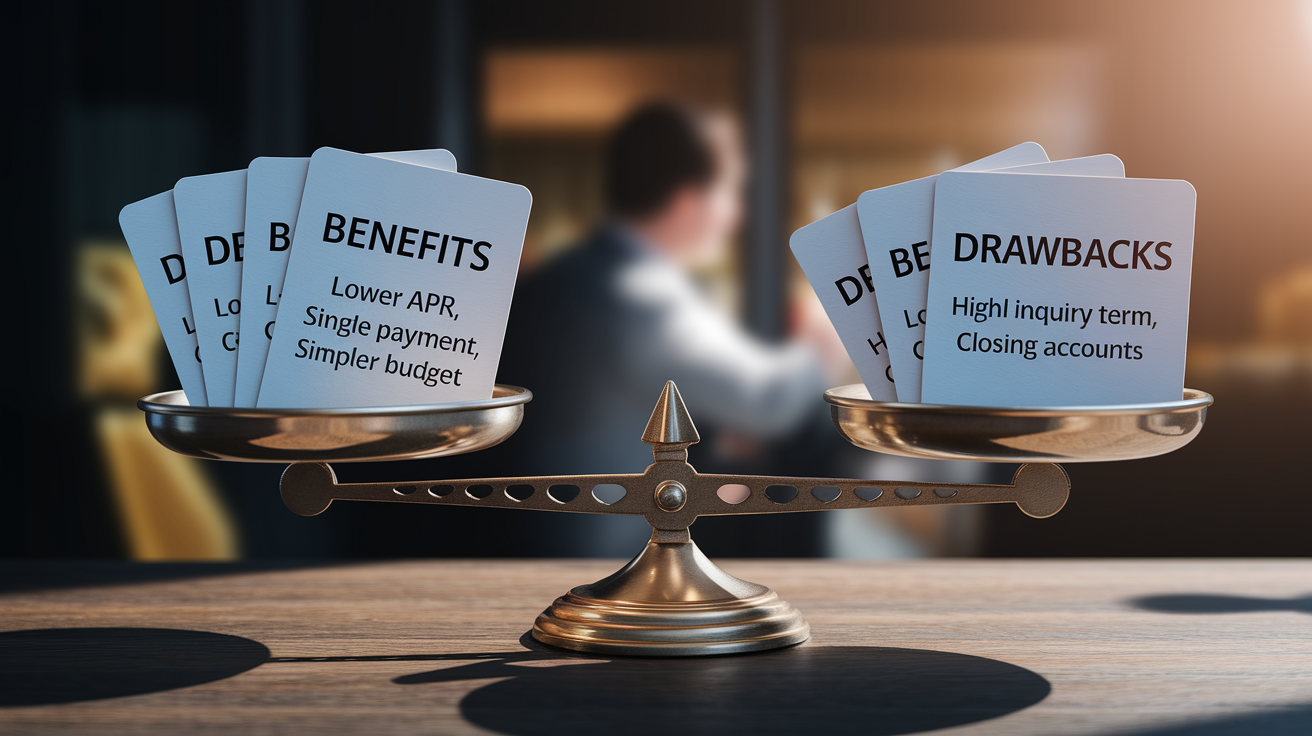
Consolidation can improve credit utilization if you pay off revolving credit card balances and leave the accounts open, because utilization is the ratio of balances to total available credit. A lower utilization percentage boosts your credit score over time. Making a single on-time payment each month is easier to manage than several payments across multiple accounts, which improves consistency and reduces the chance of late payments. Payment history is about 35% of your credit score and amounts owed (including utilization) make up another 30%, so consolidation can mechanically improve both factors if you stay current.
Hard credit inquiries when you apply for a consolidation loan can lower your score by roughly 10 points for about one year, and opening a new account reduces the average age of your credit history, which can also drag scores down temporarily. If you close paid off accounts after consolidating, you reduce your total available credit and increase utilization, which may lower your score. Conversely, keeping accounts open preserves available credit and account age, but only if you don’t recharge those cards. The credit score improvement from consolidation typically becomes visible within a few months of consistent on-time payments.
Benefits:
Lower APR (if you qualify) reduces total interest paid and monthly payment.
Single monthly payment simplifies budgeting and reduces risk of missed payments.
Reduced credit card utilization improves credit score if accounts stay open and unused.
Drawbacks:
Hard inquiry and new account temporarily lower credit score by a few points.
Longer repayment terms can increase total interest paid even at a lower APR.
Closing paid accounts after consolidation reduces available credit and average account age, lowering score.
Longer loan terms mean smaller monthly payments but more total interest over the life of the loan. A 7 year personal loan at 12% APR will cost significantly more in total interest than a 3 year loan at the same rate, even though the monthly payment is lower. If affordability forces you to choose a longer term, make sure the lower APR still delivers net savings compared to paying your current debts separately. Always compare total interest paid, not just monthly payment size, to see if consolidation truly reduces cost.
When Debt Consolidation Loans Make Sense (and When They Don’t)
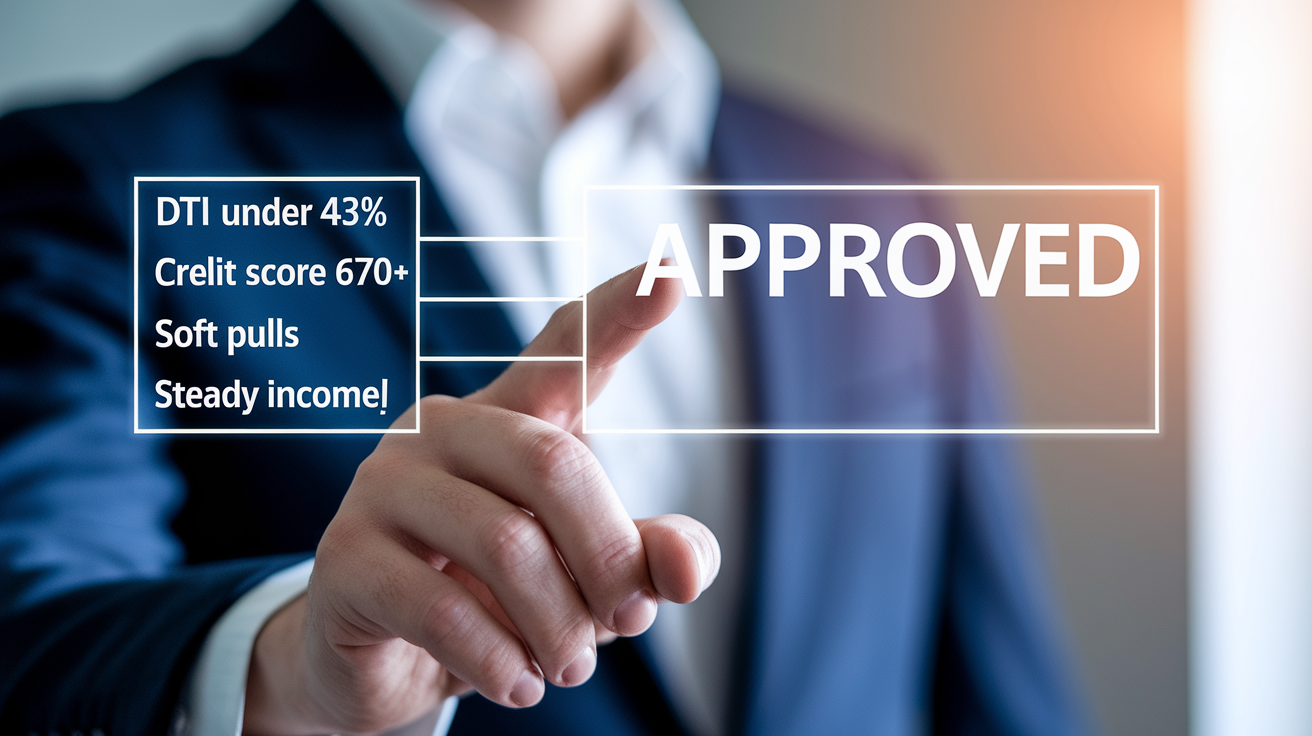
Lenders evaluate creditworthiness using credit score, income stability, and debt to income ratio (DTI). A score of 740 or above often qualifies you for the lowest APRs, while scores between 670 and 739 may secure competitive but higher rates. Borrowers with scores below 670 often face APRs that are no better than existing debt, making consolidation a poor financial move. DTI, calculated as total monthly debt payments divided by gross monthly income, should typically be below 40% to 43% to qualify for most consolidation loans, though thresholds vary by lender.
Hard credit pulls are required for final approval and cause a temporary score dip of about 10 points, but many lenders offer soft pull prequalification that lets you see estimated rates without affecting your score. High origination fees or balance transfer fees can erase interest savings, so borrowers must calculate total cost including fees to confirm consolidation is worthwhile. If your credit score is poor and you can only qualify for a consolidation APR that matches or exceeds your current weighted average, you’re better off focusing on improving credit or paying debts directly using a snowball or avalanche method.
Steps to confirm you qualify:
- Calculate your DTI by dividing total monthly debt payments by gross monthly income.
- Check prequalified rates from multiple lenders using soft pulls to avoid unnecessary hard inquiries.
- Review your credit score and confirm it meets lender thresholds for favorable APRs (typically 670 or higher).
- Verify stable income by gathering recent pay stubs, tax returns, or bank statements lenders require.
- Confirm you can provide documentation such as government issued ID, proof of address, and debt account statements for the application.
Comparing Debt Consolidation Loans to Other Debt Solutions
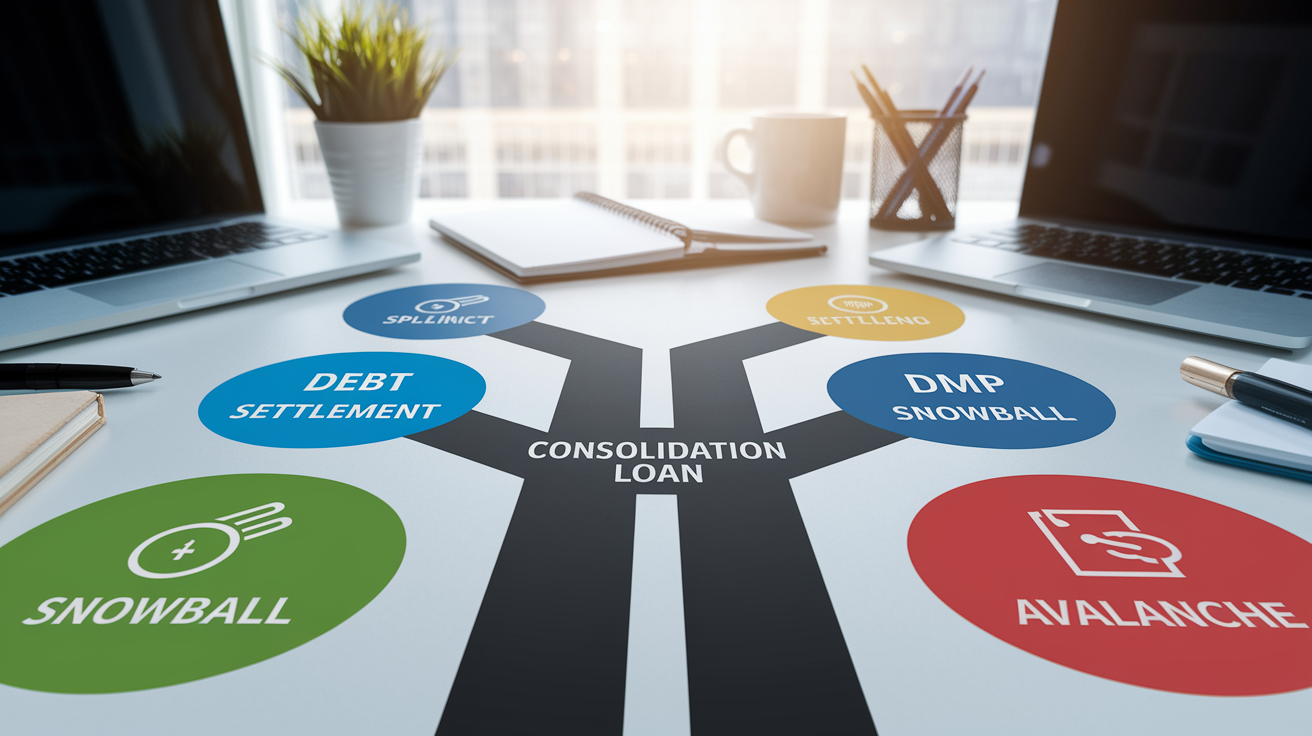
Debt settlement, bankruptcy, nonprofit debt management plans (DMPs), and DIY snowball or avalanche methods are the main alternatives to consolidation loans. Each option affects your credit differently and works best in specific situations. Debt settlement involves negotiating with creditors to pay less than the full balance owed, often through a third party company that charges fees and may advise you to stop making payments while negotiating, which severely damages your credit score and can trigger tax liability on forgiven debt. Bankruptcy can discharge many unsecured debts but remains on your credit report for up to 10 years and carries long term consequences for loan eligibility and interest rates.
Nonprofit credit counseling and DMPs structurally outperform consolidation for borrowers who can’t qualify for lower APRs or who need external accountability. A DMP typically lasts 3 to 5 years and involves a counselor negotiating lower interest rates and fee waivers directly with your creditors while you make a single monthly payment to the counseling agency, which distributes it to creditors. You don’t take on new debt, and many DMPs include financial education and budgeting support. Snowball and avalanche methods are DIY payoff strategies that don’t require new loans. The snowball method pays off the smallest balance first to build motivation, while the avalanche method targets the highest APR debt first to minimize total interest paid. Both require discipline but avoid fees, new accounts, and hard inquiries.
Credit report timelines matter when comparing options. A consolidation loan remains on your report for up to 10 years after you pay it off. Debt settlement and bankruptcy also stay on reports for up to 10 years from the date of discharge or settlement. A DMP itself doesn’t appear on your credit report, but the individual accounts enrolled in the plan show as “managed by credit counseling agency,” which some lenders view neutrally. Successfully completing a DMP and making on-time payments can improve your score over time without adding a new loan account.
Debt Settlement and Bankruptcy Considerations
Debt settlement companies negotiate with creditors to accept a lump sum that’s less than your full balance, often requiring you to stop making payments for months to pressure creditors into settling. Missed payments tank your credit score, and forgiven debt above $600 may be reported to the IRS as taxable income. Settlement fees can reach 20% to 25% of the enrolled debt, and there’s no guarantee creditors will agree to settle. Bankruptcy stops collection activity and can discharge unsecured debt, but it’s a last resort. Chapter 7 bankruptcy stays on your report for 10 years, Chapter 13 for 7 years, and both make it difficult to qualify for new credit or favorable loan terms for years afterward.
Nonprofit Credit Counseling and DMPs
Nonprofit credit counseling agencies review your budget, negotiate directly with creditors to reduce interest rates and waive fees, and consolidate your payments into one monthly amount you send to the agency. DMPs typically run 3 to 5 years and require you to close enrolled credit accounts, which can temporarily lower your credit score by reducing available credit. The benefit is a structured, non-loan solution that often lowers total interest and includes budgeting education. DMPs work best for borrowers who need accountability and whose creditors are willing to participate, which most major card issuers are.
Snowball vs Avalanche Comparison
The debt snowball method pays off the smallest balance first, regardless of interest rate, to create quick wins and build momentum. Once the smallest debt is gone, you roll that payment into the next smallest balance. The avalanche method pays off the highest APR debt first to minimize total interest paid, which is mathematically optimal but may feel slower because high rate debts are often large. Snowball prioritizes motivation and behavioral consistency, while avalanche prioritizes total cost savings. Both require you to make minimum payments on all other debts while directing extra money toward the target balance. Neither adds a new loan or hard inquiry, making them ideal for borrowers who can’t qualify for lower consolidation rates or who want to avoid new debt entirely.
The Costs of Consolidation Loans: Fees, Terms, and Total Interest Factors
Origination fees, balance transfer fees, and closing costs can reduce or eliminate the interest savings consolidation promises. Personal loans often charge origination fees between 1% and 8% of the loan amount, deducted from the proceeds or added to the balance. Balance transfer cards typically charge 3% to 5% of the transferred amount as a one-time fee, and some cards also carry annual fees. Home equity loans and HELOCs involve closing costs similar to a mortgage, including appraisal fees, title insurance, and attorney fees, which can total thousands of dollars. If fees exceed the interest you’ll save, consolidation becomes a net loss.
Early repayment is often allowed without penalty on personal loans, which lets you save interest by paying ahead of schedule. Some lenders even offer autopay discounts of 0.25% to 0.50% on the APR if you set up automatic payments. Reviewing loan disclosures before signing is essential because the Truth in Lending Act requires lenders to provide total cost, APR, payment schedule, and fee details in writing. Comparing offers side by side using total interest paid over the full term, not just monthly payment or advertised APR, shows the true cost.
Common fees and costs:
- Origination fees on personal loans (1% to 8% of loan amount)
- Balance transfer fees on credit cards (3% to 5% of transferred balance)
- Annual fees on balance transfer cards
- Closing costs on home equity loans and HELOCs (appraisal, title, attorney fees)
- Prepayment penalties (rare on personal loans, more common on HELOCs and some secured products)
Credit Score Effects Before, During, and After Debt Consolidation
Applying for a consolidation loan triggers a hard credit inquiry, which can lower your score by about 10 points for roughly one year. Opening a new account reduces the average age of your credit history, which is about 15% of your credit score, and may cause an additional temporary dip. If you consolidate revolving credit card debt and leave the accounts open, your credit utilization drops immediately because your balances fall to zero while your total available credit remains the same, which can boost your score within a billing cycle or two. If you close accounts after consolidating, you lose that available credit, utilization rises, and your score may drop instead.
On-time payments on the new consolidation loan improve payment history over time, and payment history is the single largest factor in credit scoring at about 35%. Many borrowers see score improvements within a few months of consolidating if they make every payment on time and don’t recharge the paid off accounts. Amounts owed, which include utilization, make up about 30% of your score, so keeping balances low or at zero on revolving accounts after consolidation has a strong positive effect.
Leaving paid accounts open preserves the average age of your credit history and maintains higher total available credit, both of which support your score. A consolidation loan remains on your credit report for up to 10 years after you pay it off, and the account shows as “paid in full” or “closed” once repayment is complete. Balance transfer card accounts remain on your report until you close them and then for up to 10 years after closure. The long term credit benefit of consolidation depends entirely on maintaining on-time payments and avoiding new debt accumulation.
Calculating Whether a Debt Consolidation Loan Will Save You Money
Gather the balance, APR, and minimum monthly payment for every debt you plan to consolidate, then calculate your weighted average APR by multiplying each balance by its APR, summing those products, and dividing by the total balance. If your weighted average APR is 20% and you can consolidate at 12%, the rate improvement is meaningful. If the consolidation APR is only 18%, the benefit is smaller and fees may erase it entirely. Compare the total interest you’ll pay on current debts over a realistic payoff timeline (use an amortization calculator or loan payoff calculator) to the total interest on the consolidation loan over its term.
Monthly payment affordability is the next test. If the consolidation loan payment is higher than you can reliably pay every month, the term may be too short or the loan amount too large. Stretching the term lowers the monthly payment but increases total interest paid, so balance affordability with total cost. Total interest comparison is the final step. Use an amortization schedule for both your current debts and the proposed consolidation loan to see which costs less over the full repayment period. Term length review confirms whether a longer consolidation term still delivers net savings or whether it simply defers cost.
| Method | Monthly Payment | Total Interest |
|---|---|---|
| Original debt ($10,000 at 22% APR, 60 months) | ~$276 | ~$6,560 |
| Consolidated loan ($10,000 at 12% APR, 60 months) | ~$222 | ~$3,333 |
| Savings | ~$54 per month | ~$3,227 over 5 years |
The example above assumes no fees and that you don’t add new debt during the repayment period. If the consolidation loan carries a 5% origination fee on $10,000, that’s $500 added to the cost, reducing the net savings to about $2,727. If you recharge the credit cards you just paid off, you’ll owe both the consolidation loan and new balances, which eliminates savings and increases total debt.
Steps to calculate savings:
- Calculate weighted average APR of current debts (sum of [balance × APR] divided by total balance).
- Run a monthly payment test to confirm the consolidation payment fits your budget for the entire term.
- Compare total interest paid on current debts versus the consolidation loan over the full repayment period.
- Review term length to ensure a longer consolidation term doesn’t raise total interest paid despite the lower APR.
Documentation, Approval Factors, and Application Requirements for Consolidation Loans
Lenders verify your creditworthiness using your credit score, review your debt to income ratio to confirm you can afford the new payment, and require proof of income such as recent pay stubs, tax returns, or bank statements. Many lenders offer soft pull prequalification that estimates your rate without a hard inquiry, which lets you compare offers without affecting your score. Final approval requires a hard credit pull, government issued ID, proof of address (utility bill or lease agreement), and account statements showing the balances you plan to consolidate.
Some lenders allow cosigners, who agree to repay the loan if you default, which can help you qualify for a lower rate if your credit is weak. Adding a cosigner puts their credit at risk if you miss payments. Secured loans require collateral such as a home or vehicle, which the lender can seize if you default. Collateral reduces the lender’s risk and often lowers your APR, but it raises your risk significantly.
Common application requirements:
- Credit score and credit report review (hard pull for final approval)
- Debt to income ratio calculation to confirm affordability
- Proof of income (pay stubs, tax returns, bank statements)
- Cosigner credit evaluation if applicable
- Collateral appraisal and documentation for secured loans
Building a Repayment Strategy After Consolidating Debt
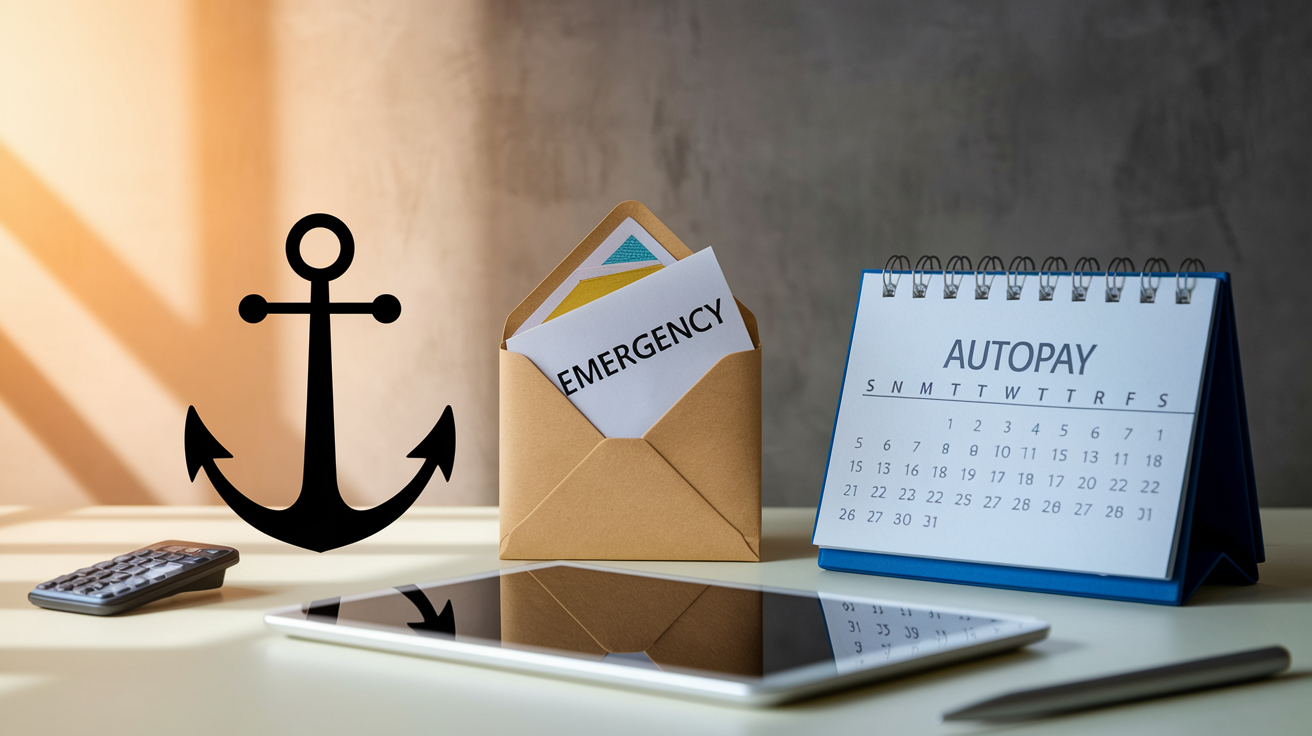
Budgeting with consolidation means treating the new loan payment as a non-negotiable monthly expense and building your spending plan around it. On-time payments improve your credit score over time and reduce total interest paid, while missed payments trigger late fees, raise your APR, and damage your credit. Setting up autopay ensures you never miss a due date, and many lenders offer a small APR discount (0.25% to 0.50%) for enrolling in autopay, which saves money and simplifies repayment.
Building or maintaining an emergency fund while repaying a consolidation loan prevents you from relying on credit cards when unexpected expenses hit. Even a small buffer of $500 to $1,000 can keep you from missing a loan payment or recharging paid off cards. Prioritize on-time loan payments first, then contribute whatever you can to an emergency fund in a separate savings account.
Refinancing a consolidation loan can lower your monthly payment or APR if your credit score has improved or interest rates have fallen since you first borrowed. Refinancing extends the repayment term, which reduces the monthly payment but may increase total interest paid unless the new APR is meaningfully lower. Refinance only when the total cost over the new term is less than what you’d pay on the existing loan, and avoid refinancing repeatedly because each application causes a hard inquiry and resets the repayment clock.
Avoiding Consolidation Scams and Predatory Lenders
Predatory lenders charge excessive fees, guarantee loan approval regardless of credit, or demand upfront payment before providing any service. Legitimate lenders check credit and income before offering approval, never guarantee approval to everyone, and don’t require payment before disbursing a loan. Common scam tactics include pressure to act immediately, vague or missing fee disclosures, and requests for payment via wire transfer or prepaid card. Reviewing all disclosures and comparing offers from multiple lenders protects you from predatory terms.
Borrower protections vary by state, but federal laws such as the Truth in Lending Act require lenders to disclose APR, total cost, fees, and repayment terms in writing before you sign. Reporting suspected scams to your state attorney general, the Consumer Financial Protection Bureau, or the Federal Trade Commission can help stop fraudulent lenders. Safe practices include checking lender licensing in your state, reading online reviews, confirming physical business addresses, and never paying upfront fees for loan approval.
Red flags to watch for:
- Guaranteed approval regardless of credit score or income
- Upfront fees required before loan disbursement
- Pressure to sign immediately without time to review terms
- Vague or missing fee disclosures and APR details
- Requests for payment via wire transfer, prepaid card, or cryptocurrency
Key Questions People Ask About Debt Consolidation Loans
Understanding how consolidation affects credit, eligibility for future loans, and daily financial routines helps borrowers make informed decisions. Consolidation simplifies payments but changes your credit profile by adding a new account and closing or reducing balances on others, which can temporarily lower your score and affect your ability to qualify for new credit until payment history on the consolidation loan improves your profile. New consolidation accounts remain on your credit report for up to 10 years after payoff, and the single payment structure requires consistent budgeting to avoid missed payments.
Credit report and eligibility considerations include the short term score dip from hard inquiries and new accounts, the long term benefit of on-time payments, and the risk that missed payments on a consolidation loan damage credit more quickly than missed payments spread across several smaller accounts. Lenders evaluating you for new loans will see the consolidation account and may ask about it during underwriting, especially if the loan is recent or if you’ve continued to carry balances on other accounts after consolidating.
Single payment structures affect financial routines by reducing the number of due dates and simplifying tracking, but they also require discipline to avoid reusing credit lines that now have zero balances. Borrowers who consolidate and then recharge cards often end up with more total debt than they started with, which defeats the purpose and worsens their financial position.
Will debt consolidation hurt my credit score?
Short term, yes. A hard inquiry and new account can lower your score by about 10 points for roughly one year. Long term, many borrowers see improvement from lower utilization and consistent on-time payments.
Should I consolidate or pay debts separately using snowball or avalanche?
Both are valid. Consolidation favors simplicity and a predictable payoff date. Snowball and avalanche save more interest if you can aggressively target the highest rate debt and don’t need a single payment structure.
What’s the best consolidation method?
Personal loans are most flexible for mixed debt types and offer fixed terms. Balance transfer cards work best if you can fully repay during the promotional 0% period.
How long does a consolidation loan stay on my credit report?
New loans remain on your report for up to 10 years after you pay them off. Balance transfer card accounts remain until closed and then up to 10 years after closure.
Can I use my credit cards after consolidating?
Technically, yes, but doing so defeats the purpose. Recharging cards after consolidation increases total debt and may prevent you from affording the consolidation loan payment.
Does consolidation affect my ability to get new loans?
Temporarily. A recent hard inquiry and new account may lower your score slightly, which can reduce approval odds or raise rates on new credit. After several months of on-time payments, your score typically improves and future loan eligibility strengthens.
Final Words
Compare your weighted average APR to the new loan’s APR and fees. That’s the quick test this post walks you through.
We covered personal loans, balance-transfer cards, secured options, credit effects, and fees. Example: $10,000 at 22% into 12% can save about $3,227 over five years. Avoid new borrowing and use autopay.
So, are debt consolidation loans a good idea? They can be if the rate, fees, and your repayment plan line up. Stick to the plan and you’ll likely come out ahead.
FAQ
Q: Is it smart to get a loan to consolidate debt?
A: Getting a loan to consolidate debt is smart when the new loan’s APR is meaningfully lower than your weighted average APR, fees are low, and you won’t run up new balances.
Q: How to pay off $30,000 in debt in 1 year?
A: Paying off $30,000 in debt in one year requires about $2,500 per month plus interest; accelerate with higher income, big cuts, windfalls, or a lower-rate consolidation loan and strict repayment plan.
Q: What are the disadvantages of debt consolidation loans?
A: The disadvantages of debt consolidation loans include longer terms that may increase total interest, origination or transfer fees, a hard credit inquiry, risking collateral on secured loans, and the temptation to re-borrow.
Q: How long will it take to pay off $20,000 in credit card debt?
A: Paying off $20,000 in credit card debt depends on APR and payment size; at $500/month it often takes 4–6 years, while $1,000/month can clear it in about 2 years.