


Consolidating debt won’t always save you money.
Sometimes it just moves balances into a loan with its own high rate.
Rates start with market benchmarks (like the fed funds rate and prime), then lenders add margins based on your credit score, debt-to-income, and loan type.
This article explains how those pieces stack up, compares typical APR ranges for cards, personal loans, and HELOCs (home equity lines of credit), and gives a simple rule to estimate what you’ll pay.
If you only do one thing today, check your credit score and current APRs before you apply.
Understanding How Debt Consolidation Interest Rates Work

Consolidation loan rates start with two benchmark rates. The federal funds rate, set by the Federal Reserve, sits between 4.25% and 4.50% right now, averaging around 4.33%. Lenders take that fed funds average and add roughly 3 percentage points to get the prime rate, which lands around 7.33% currently. Prime acts as the baseline for most consumer lending, though it’s not your final consolidation rate.
From there, lenders build your specific APR by stacking borrower-risk factors onto that prime baseline. They’re looking at your credit score, debt-to-income ratio, credit history, and what kind of loan you’re asking for. Someone with a 780 credit score and low debt might see a margin of 2 percentage points added to prime, putting them around 9.33% APR. A borrower with a 620 score and heavier debt could see a margin of 10 to 15 points, pushing their APR into the high teens or beyond.
Your final consolidation APR is really three things combined: the current market rate environment, the lender’s own pricing margins, and your personal financial profile. When the Federal Reserve moves the fed funds rate, prime shifts with it, and lenders adjust the rates they’re offering on new loans. That’s why consolidation rates move around over time. Even if your credit hasn’t changed, the underlying benchmarks can shift, and lenders tighten or loosen their margins based on market conditions and how much risk they’re willing to take on.
Key Factors That Influence Debt Consolidation Loan Rates

Lenders zero in on a few borrower-specific factors when setting your rate. Credit score sits at the top. Scores above 740 typically unlock the lowest APRs, while scores below 660 push rates higher. Scores under 600 often result in very high rates or outright denials. Your debt-to-income ratio (DTI) matters just as much. Lenders want to see that your existing monthly debt obligations don’t eat up too much of your gross income. Most prefer DTI below 40%. Income stability also plays a role. Steady W-2 income from a long-held job looks better than fluctuating freelance earnings. Many lenders require at least two to three years of established credit history, so newer borrowers may face steeper margins even with decent scores.
External factors shape the rates lenders are willing to offer. Market interest rates, particularly the 10-year Treasury yield and the pricing on mortgage-backed securities, influence what lenders pay to raise capital, which flows into the APRs they charge consumers. Lender margins vary by institution. Credit unions often price lower than for-profit banks, and online lenders may undercut both to capture volume. The type of loan you choose affects your rate too. Secured loans (backed by collateral like your home or car) carry lower APRs because the lender’s risk is reduced. Unsecured personal loans command higher rates since there’s no asset to claim if you default.
Here’s what lenders review when setting your rate:
- Credit score level (thresholds around 740+, 660–739, 600–659, below 600)
- Debt-to-income ratio (monthly debt payments divided by gross monthly income)
- Income verification (pay stubs, tax returns, employment history)
- Credit history length (years of active accounts and payment records)
- Loan type (secured vs. unsecured, collateral offered or not)
Comparing Credit Card APRs to Consolidation Loan Rates

Credit card APRs are typically variable and tied directly to the prime rate. Most card issuers take the current prime rate (around 8% in many recent examples) and add a borrower-specific margin that can range from 10 to 20 percentage points or more. That means a cardholder with average credit might see an APR of 23% (prime 8% + 15-point margin), while someone with weaker credit could land at 28% or higher. These rates shift whenever the Federal Reserve moves the fed funds rate, so a card that charges 22% today could rise to 24% after a couple fed hikes.
Debt consolidation loans usually offer fixed, single-digit to mid-teens APRs. An unsecured personal consolidation loan for someone with good credit might come in around 7% to 12%. A borrower with fair credit could see 13% to 18%. Secured consolidation products like home equity loans or cash-out refinances often land in the 6% to 7% range, well below typical card APRs. The difference between paying 24% on revolving balances and 10% on a fixed consolidation loan can translate to thousands of dollars in interest saved and a much faster payoff timeline.
Balance-transfer credit cards offer another comparison point. Many issuers provide 0% introductory APR periods lasting 12 to 18 months, which can be powerful if you can pay off the transferred balance before the promo expires. The catch is a balance-transfer fee, commonly 1% to 3% of the amount moved. A $10,000 transfer at 3% costs $300 upfront, but if you clear the balance during the 0% window, you avoid all interest. Often a better outcome than even a low-rate consolidation loan. After the intro period ends, the card’s standard variable APR kicks in, usually in the high teens or low twenties.
| Product Type | Typical APR Range | Notes |
|---|---|---|
| Credit Card (variable) | 22%–28% | Tied to prime; rate can rise with fed moves |
| Unsecured Consolidation Loan | 7%–18% | Fixed rate; depends on credit score and lender |
| Balance-Transfer Card (promo) | 0% for 12–18 months, then 18%–25% | 1%–3% transfer fee applies upfront |
Fixed vs. Variable Rates in Debt Consolidation

Fixed-rate consolidation loans lock your interest rate and monthly payment for the entire term. Once you sign, the rate stays the same whether the Federal Reserve raises or lowers the fed funds rate. That predictability makes budgeting straightforward. You know exactly what you’ll pay each month and when the loan will be paid off. Mortgages work the same way once you lock in your rate. Even if market rates climb, your 6% mortgage stays at 6%. Fixed rates are the standard for most personal debt consolidation loans, and they’re the safer choice if you value stability.
Variable-rate products, like home equity lines of credit (HELOCs) and most credit cards, adjust periodically based on movements in the prime rate. If the fed funds rate increases, prime rises, and your HELOC or card APR follows within a billing cycle or two. That means your monthly interest charge can climb even if you haven’t borrowed more. HELOCs are especially sensitive. They’re often priced as prime plus a small margin (for example, prime + 0.5%), so every quarter-point fed hike translates directly into higher payments. Variable rates can work in your favor when rates are falling, but they expose you to risk when rates rise.
Here’s a quick comparison of fixed and variable rates:
- Fixed-rate pros: Predictable payment, immune to fed rate changes, easier to budget over multi-year terms.
- Fixed-rate cons: May start higher than initial variable rates; no benefit if market rates drop.
- Variable-rate pros: Can start lower than fixed rates; payments decrease if benchmark rates fall.
- Variable-rate cons: Payments can rise unexpectedly; harder to predict total interest cost; risk of payment shock if rates spike.
How Loan Terms Affect Interest Costs Over Time

Extending your repayment term lowers your monthly payment but dramatically increases the total interest you’ll pay. A $20,000 consolidation loan at 6% APR spread over 30 years results in roughly $23,167 in interest charges over the life of the loan. More than the original principal. The same $20,000 at 6% paid off in 5 years costs around $6,400 in interest, less than a third of the 30-year figure. Longer terms mean more months of interest accrual, and early payments are heavily weighted toward interest rather than principal.
Credit card minimum payments illustrate the extreme end of this problem. A $20,000 balance at 24% APR with a typical minimum payment structure (often 2% of the balance or a floor amount) might require a $566.67 monthly payment in the first month. If you only pay minimums, the balance shrinks slowly because most of each payment goes to interest (around $400 the first month on $20,000 at 24%). Total interest paid over time can reach $36,026 or more, and it can take decades to pay off if you never increase the payment amount.
Shortening your loan term speeds up principal paydown and reduces total interest, but it raises your monthly payment. A $15,000 consolidation loan at 13% APR over 5 years costs roughly $341 per month and about $5,475 in interest. The same loan at 13% over 3 years would push the monthly payment above $500 but cut total interest to around $3,200. The tradeoff is straightforward: pay more each month to save more over time, or stretch payments to ease monthly cash flow at the cost of higher lifetime interest.
Real Examples: How Much You Can Save with Lower Interest Rates

Consider a $20,000 credit card balance at 24% APR. Interest alone runs about $400 per month. If you only make minimum payments, total interest over the repayment period can exceed $36,000. That’s nearly double the original debt. Refinancing or consolidating that same $20,000 into a 6% fixed-rate loan over a reasonable term (say, a 30-year mortgage cash-out refinance) cuts total interest to around $23,167. Even though that’s still a large sum, you save roughly $13,000 compared to the credit card scenario, and you clear the debt in a defined timeframe instead of carrying a revolving balance indefinitely.
Another common example: three credit cards, each carrying $5,000 at an average APR of 22%. Combined monthly payments of $125 per card total $375. At those rates and payment levels, you’d pay about $12,375 in interest over time. Consolidating the $15,000 total into a single loan at 13% APR for 5 years drops your monthly payment to around $341 and cuts total interest to approximately $5,475. That’s a savings of nearly $6,900 in interest, and you finish a year earlier than you would have on the credit card minimums.
| Debt Scenario | APR | Total Interest | Interest Saved |
|---|---|---|---|
| $20,000 credit card (minimum payments) | 24% | ~$36,026 | Baseline |
| $20,000 consolidated at 6% (30 years) | 6% | ~$23,168 | ~$13,000 |
| $15,000 consolidated at 13% (5 years) | 13% | ~$5,475 | ~$6,900 vs. 22% cards |
How to Qualify for the Lowest Debt Consolidation Rates
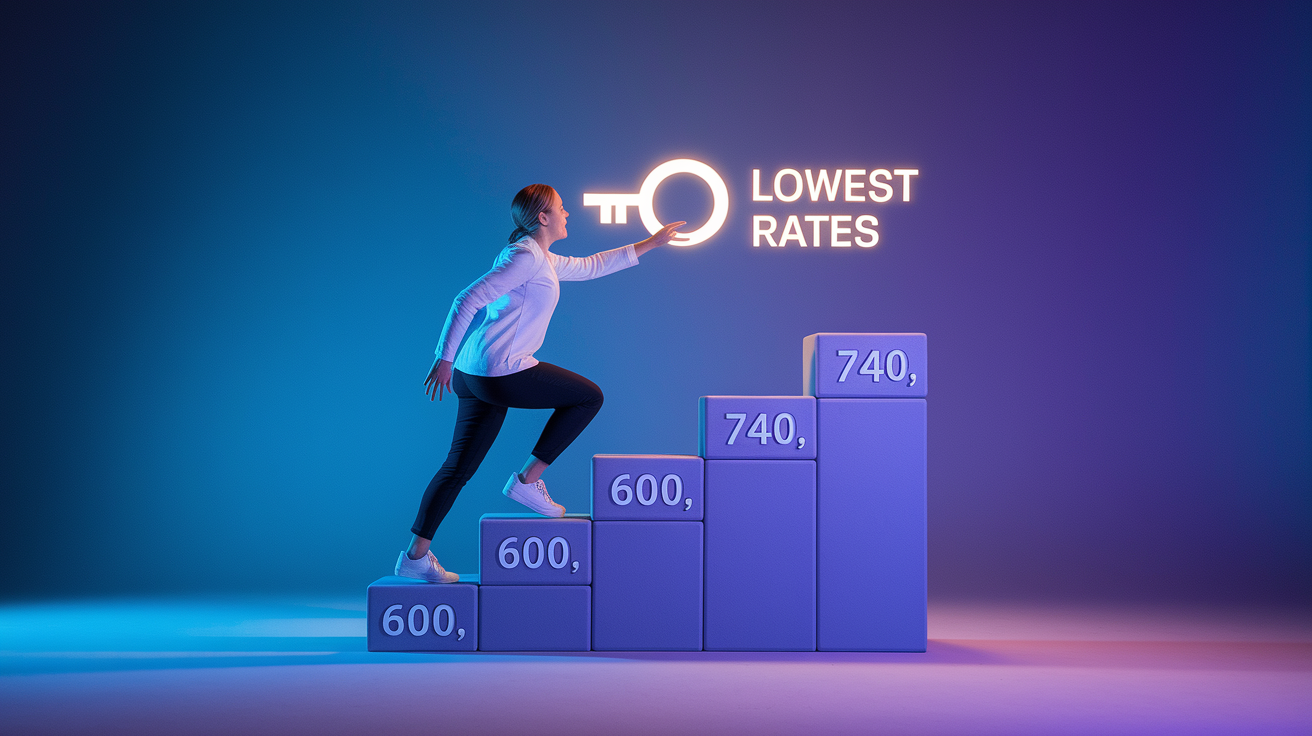
Credit score is the single biggest lever you control. Lenders typically reserve their lowest APRs for borrowers with scores of 740 or higher. If your score sits in the 660 to 739 range, you’ll qualify for mid-tier rates. Below 660, expect higher APRs. Below 600, you may face rejection or rates so high they negate any consolidation benefit. Before you apply, pull your credit reports from all three bureaus and dispute any errors. Incorrect late payments, accounts that aren’t yours, or outdated collections can drag your score down by dozens of points.
Debt-to-income ratio matters almost as much as your score. Lenders calculate DTI by dividing your total monthly debt payments (credit cards, auto loans, student loans, existing mortgage or rent) by your gross monthly income. Most lenders want to see a DTI below 40%, and the lower you go, the better your rate. Paying down balances before you apply can improve both your DTI and your credit utilization ratio, which is a major component of your credit score. Even paying off a single high-balance card can shift you into a better rate tier.
Prequalification tools let you check rates with a soft credit pull, which doesn’t affect your score. Use them to compare offers from multiple lenders before committing to a full application. Once you submit a formal application, the lender will run a hard inquiry, which can temporarily ding your score by a few points. Clustering all your rate shopping into a short window (usually 14 to 30 days) minimizes the impact, as scoring models often treat multiple inquiries in that period as a single event.
Here are six actions that can lower your offered rate:
- Improve your credit score by paying down balances and correcting report errors
- Reduce your debt-to-income ratio by paying off smaller balances or increasing income
- Correct any inaccuracies on your credit reports before applying
- Avoid opening new credit accounts or taking on new debt in the months before applying
- Gather documentation (recent pay stubs, tax returns, bank statements) to smooth out the application
- Compare at least three lender offers using soft-pull prequalification to find the best rate
Secured vs. Unsecured Consolidation Options and Their Interest Rates
Secured consolidation loans use an asset (most commonly your home) as collateral, which significantly lowers the lender’s risk and, in turn, your interest rate. Home equity loans and home equity lines of credit (HELOCs) often come in around 6% to 6.75% APR in recent examples, far below typical credit card rates. Cash-out refinances work similarly: you replace your existing mortgage with a larger one, pocket the difference, and use that cash to pay off high-rate debts. As of the first quarter of 2025, U.S. homeowners held roughly $17.3 trillion in home equity, so many have the capacity to tap this option. For a detailed comparison of cash-out refinancing and home equity products, see Cash-out refinance vs. home equity loans.
Unsecured consolidation loans don’t require collateral, which makes them accessible to renters and anyone who doesn’t want to risk their home. But lenders charge higher APRs to compensate for the added risk. Rates typically range from 7% to 18% or more, depending on your credit profile. Even at the higher end, that’s usually cheaper than credit card debt, but the gap between secured and unsecured rates can be substantial. A borrower with good credit might see a 7% APR on an unsecured loan versus a 6% rate on a home equity loan, a small difference. A borrower with fair credit might face 15% unsecured versus 6.5% secured, a much larger spread.
Here are the key tradeoffs for secured consolidation loans:
- Lower interest rates: Often half or less than unsecured loan APRs
- Higher borrowing limits: Equity-based products can support larger consolidations
- Foreclosure risk: Miss payments and you can lose your home
- Longer approval process: Appraisals, title work, and underwriting take more time than unsecured loans
Fees That Increase the Effective Interest Rate
Origination fees, balance-transfer fees, and appraisal charges can all add to the true cost of borrowing, sometimes turning a seemingly attractive rate into a mediocre deal. Unsecured personal loans often carry origination fees of 1% to 6% of the loan amount, deducted from the proceeds at funding. A $10,000 loan with a 5% origination fee means you receive $9,500 but owe $10,000 plus interest. That fee effectively raises your APR, even if the stated rate looks competitive.
Balance-transfer credit cards usually charge 1% to 3% of the transferred amount as a one-time fee. Moving $15,000 at a 3% fee costs $450 upfront. If the card offers 0% APR for 18 months, that fee might still be worth it compared to months of 22% interest, but you have to factor it into your payoff plan. Secured loans (home equity loans and cash-out refinances) can include appraisal fees ($300 to $500), title fees, and closing costs that add hundreds or thousands to the total expense. Those costs can negate interest savings if you don’t keep the loan long enough to recoup them.
| Fee Type | Where It Applies | Effect on APR |
|---|---|---|
| Origination Fee | Unsecured personal loans | Raises effective APR by 1% to 6% depending on loan size and term |
| Balance-Transfer Fee | Credit cards with 0% promo APR | Adds 1%–3% upfront cost; amortize over promo period to calculate true rate |
| Appraisal & Closing Costs | Home equity loans, cash-out refinances | Can add $500 to $3,000+; increases effective rate if loan is paid off early |
| Prepayment Penalty | Some personal and auto loans | Charged if you pay off early; reduces benefit of extra payments |
When Debt Consolidation Interest Rates Won’t Save You Money

Consolidation only works when the new rate is meaningfully lower than your current weighted average APR. If you’re consolidating three cards at 20%, 22%, and 24% APR and your consolidation loan comes in at 18%, the savings are marginal, especially after fees. You might end up paying nearly as much interest, with the added risk of a longer loan term that stretches payments over more years. Always calculate total interest paid under both scenarios before committing.
Extending the repayment term can backfire even if the rate drops. Rolling short-term credit card debt into a 15 or 30-year mortgage might cut your monthly payment, but you’ll pay interest for decades on purchases that should have been cleared in a few years. If your current mortgage rate is 3% and you refinance into a 6.5% cash-out loan to consolidate cards, you’re also giving up a valuable low rate on the majority of your mortgage balance. A tradeoff that rarely makes sense unless card debt is overwhelming.
Secured consolidation loans carry foreclosure risk. If you use a home equity product to pay off unsecured credit cards, you’ve converted unsecured debt into secured debt. Miss payments on the credit cards and you face collections and credit damage. Miss payments on a home equity loan and you can lose your house. Borrowers with inconsistent income or spending-control issues should think twice before putting their home on the line.
Watch for these red flags in consolidation offers:
- Origination fees above 5% or unusual “processing” charges
- Variable rates with no cap; your payment could climb indefinitely
- Collateral requirements that put your home or car at risk for unsecured debt
- Loan terms longer than 7 years for unsecured debt or 15 years for secured products
- Upfront payment demands before loan approval or funding
Common Questions About Debt Consolidation Interest Rates
What’s the typical APR range for debt consolidation loans?
Unsecured personal consolidation loans generally range from 7% to 36% APR, with most creditworthy borrowers landing between 7% and 18%. Secured home equity products usually offer 6% to 7% or slightly higher, depending on market conditions.
How does prequalification affect my credit score?
Prequalification uses a soft credit pull and does not impact your score. Submitting a full application triggers a hard inquiry, which may lower your score by a few points temporarily.
How long does it take to get funded after approval?
Most lenders fund consolidation loans within one week of approval. Some online lenders offer same or next-day funding. Your first payment is typically due about one month after you receive the funds.
Can I consolidate all types of debt with one loan?
Consolidation loans are designed for unsecured debts like credit cards, medical bills, payday loans, and personal loans. You generally can’t consolidate federal student loans, tax debt, or secured loans like auto or mortgage balances into a single personal consolidation loan.
How do I calculate my effective interest rate when fees are included?
Add all upfront fees to the loan principal, then divide total interest paid (including fees) by the net amount you receive. Many lenders disclose an APR that incorporates fees. Compare APRs across offers rather than just the nominal interest rate.
Final Words
In the action, we cut through how consolidation rates are built: benchmark rates like the federal funds rate and the prime rate, then how lenders add margins based on borrower risk.
We walked through what lenders check, fixed versus variable rates, how loan terms and fees change total interest, and the situations where consolidation won’t save you money.
If you only do one thing next, prequalify with a soft pull, compare offers, and run the numbers. This roundup leaves debt consolidation interest rates explained so you can choose a lower-cost, lower-risk path forward.
FAQ
What’s a good interest rate for a debt consolidation loan?
A good interest rate for a debt consolidation loan typically ranges from 7% to 12% for borrowers with solid credit scores above 700. Rates below your current credit card APRs (often 22%–24%) represent meaningful savings and make consolidation worthwhile.
Why does Dave Ramsey say not to consolidate debt?
Dave Ramsey advises against debt consolidation because it doesn’t address spending habits and often extends repayment terms, increasing total interest paid. He argues consolidation can create false progress while you remain in debt longer, and warns that secured loans risk losing your home or car.
How to pay off $30,000 in debt in 1 year?
To pay off $30,000 in debt in one year, you need to pay approximately $2,500 per month, plus interest. This requires dramatically cutting expenses, increasing income through side work, selling assets, and directing every extra dollar toward the debt using either debt avalanche or snowball methods.
How much is the payment on a $50,000 consolidation loan?
The payment on a $50,000 consolidation loan depends on your interest rate and term length. At 10% APR over five years, you’d pay roughly $1,062 monthly. A three-year term at the same rate would cost about $1,613 monthly but save thousands in interest.