

Do you budget by the month or by every paycheck?
If your paychecks arrive every 14 days, a bi-weekly budget usually fits better because it matches cash flow and gives you two extra paychecks a year you can use for savings or debt.
If you’re paid on set dates, like the 1st and 15th, a monthly plan can be simpler.
This post lays out a clear decision rule, the trade-offs, and quick steps so you can pick and start the right budget this week.
Core Comparison of Bi‑Weekly Budgeting vs Monthly Budgeting
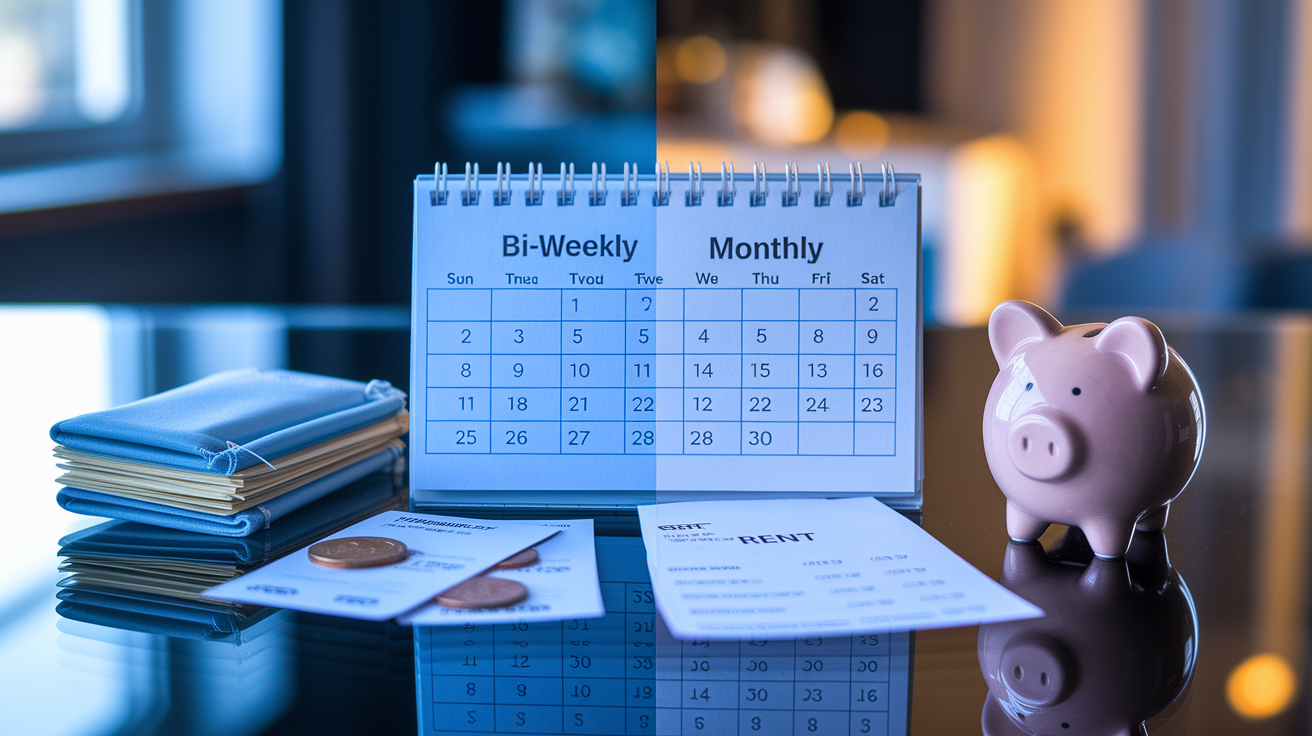
Bi-weekly budgeting means you’re planning around paychecks that show up every 14 days. That’s 26 times a year. Monthly budgeting organizes everything into one big 30 or 31 day window, which makes sense if your bills arrive on a monthly schedule. The real difference is timing. When money lands every two weeks but rent’s due once a month, you end up juggling. One check might disappear into rent and leave you with almost nothing, while the next one has to stretch across groceries, gas, and everything else for two more weeks.
Bi-weekly budgeting lets you match your spending plan to when paychecks actually arrive. You treat each pay period like its own two week cycle, so you’re not asking one check to cover an entire month of life. Monthly budgeting works fine if you’re paid once or twice a month on predictable dates. Like the 1st and 15th. Because your income timing already lines up with when bills are due. But if you’re paid every other Friday, monthly budgeting creates a mismatch. It can feel like you’re always behind or always guessing which paycheck covers what.
The upside of bi-weekly budgeting is those two “extra” paychecks each year. Because 26 paychecks spread across 12 months means some months get three paydays. You can use those third checks for savings, debt payoff, or building a cushion. Monthly budgeting doesn’t create that natural surplus unless you plan for it on your own.
Here’s a quick breakdown:
Bi-weekly budgeting uses 26 pay periods per year. Monthly budgeting uses 12 billing cycles. Bi-weekly reduces cash flow stress by matching spending to paycheck arrival every 14 days. Monthly budgeting can force you to stretch one paycheck across a full month if you’re paid bi-weekly. Bi-weekly planning gives you two natural opportunities per year to save or pay down debt with “extra” paychecks. Monthly budgeting works best when income timing and bill timing already line up, like salaried employees paid twice a month.
How a Bi‑Weekly Budget Works and Why It Fits 26 Paychecks
A bi-weekly budget starts with one rule. Every two weeks, you get paid. Every two weeks, you plan what that paycheck needs to cover. Instead of looking at the whole month and hoping it works out, you break your financial life into 14 day chunks. This matches the reality of bi-weekly pay and stops you from treating paychecks like they’re interchangeable when they’re actually covering different time windows.
The mechanics are pretty straightforward. You write down your typical take home pay for one paycheck. Then you list your fixed monthly expenses. Rent or mortgage, car payment, student loans, cable, internet, groceries, any regular subscription or bill. Divide each of those monthly totals by two. That’s the amount you need to set aside from each paycheck to cover that bill. Subtract all those half bill amounts from one paycheck, and what’s left is your spending money for the next two weeks. Move the bill money into a separate savings account or pay the bills bi-weekly if your creditors allow it. For goals, vacation, emergency fund, debt payoff, subtract that amount next and move it into a dedicated savings account. The remainder is yours to spend without worry.
Here’s the process:
Record your typical take home pay per paycheck (after taxes, health insurance, retirement contributions). List every fixed monthly expense with its due date and amount. Divide each monthly bill by two to calculate the per paycheck allocation. Subtract the total of all those half bill amounts from your current paycheck. Transfer that total into a separate savings or bill pay account, or make bi-weekly payments to stay ahead of due dates. Subtract your goal contributions (emergency fund, debt payoff, vacation fund) into another savings account, then spend the remainder over the next two weeks.
The real advantage shows up twice a year. Because 52 weeks divided by two week pay periods equals 26 paychecks, and most budgeting guides assume 24 paychecks (two per month), you’ll have two months where a third paycheck arrives. That third check isn’t for splurging. It’s your chance to leap ahead. Pay an extra mortgage payment toward principal, knock out a credit card balance, or pad your emergency fund by a full paycheck. Over time, those two extra checks per year let you build a buffer that makes the rest of your budgeting feel easier.
Understanding a Monthly Budget and How It Aligns With Monthly Billing Cycles
Monthly budgeting organizes all your income and expenses into a single 30 or 31 day window. You add up everything you expect to earn in a month, list every bill and expense due that month, and make sure income minus expenses equals zero or better. This method works well when your income arrives in predictable monthly or twice monthly chunks. Say, the 1st and the 15th. Because your paycheck timing naturally matches the way landlords, utility companies, and lenders send their bills.
The challenge appears when you’re paid bi-weekly. If you get a paycheck every 14 days, some months you’ll receive two paychecks and other months you’ll receive three. That inconsistency makes it harder to rely on a fixed monthly plan, because the amount of income hitting your account in any given month can vary. A monthly budget also requires you to stretch one paycheck across a longer period. If your first paycheck of the month goes mostly to rent, you’re left waiting two weeks or more until the next check arrives to cover groceries, gas, and everything else. That creates a cash flow squeeze even when your total income is more than enough to cover your total expenses.
Still, plenty of households prefer monthly budgeting because it simplifies planning around predictable, recurring costs. When your mortgage, car payment, insurance premium, and subscription services all renew on roughly the same schedule, it’s easier to think in month long cycles. Monthly planners often average variable costs, like groceries and gas, across the month and adjust as they go. The method works fine as long as your income timing doesn’t force you to juggle which bills get paid from which paycheck.
Paycheck Timing and Cash‑Flow Differences Between the Two Budgeting Methods
The math behind pay frequency is simple but the cash flow consequences are real. If you’re paid bi-weekly, you receive 52 weeks divided by 14 days, which equals 26 paychecks per year. If you’re paid twice a month, common schedules include the 1st and 15th, or the 7th and 18th, you receive exactly 24 paychecks per year. That two paycheck difference means your bi-weekly checks are about 7.7 to 8 percent smaller than twice monthly checks when annual income is the same. But because they arrive more often, you’re never stuck waiting a full month between deposits.
Third paycheck months are where bi-weekly earners gain a structural advantage. Most months you’ll see two paychecks, but twice a year a third check lands in the same calendar month. That third check isn’t extra income in an annual sense. It’s already part of your yearly total. But it gives you a one time opportunity to move money toward goals without disrupting your regular spending plan. You can use it to pay down a credit card balance, add to your emergency fund, or prepay a bill so you’re one payment ahead for the rest of the year.
| Pay Type | Paychecks Per Year | Typical Check Size | Cash Flow Impact |
|---|---|---|---|
| Bi-weekly | 26 | ~8% smaller | Two “extra” checks; more frequent income |
| Twice monthly | 24 | ~8% larger | Consistent two per month timing |
| Monthly | 12 | Largest | Long gaps between paychecks |
| Weekly | 52 | Smallest | Frequent income but harder to align with monthly bills |
Switching from 26 pay periods to 24 can create the illusion that you’re suddenly earning more, because each paycheck is larger. Switching the other direction, from twice monthly to bi-weekly, can feel like a pay cut even though your annual income hasn’t changed. The key is to stop comparing paycheck size and start thinking in annual terms. Calculate your yearly take home, then divide by the number of paychecks you actually receive. That’s your per paycheck planning number. If you live with a partner and one of you is paid bi-weekly while the other is paid twice monthly, you don’t need to change your pay cycles or your jobs. Just combine both incomes into a single monthly spending plan and coordinate who pays which bills from which check.
Which Bills Fit Better With Each Budgeting Style
Bi-weekly budgeting works best when you divide large, fixed monthly bills into two smaller chunks and assign each chunk to a specific paycheck. Rent or mortgage, car payment, student loan minimums, insurance premiums, internet, and groceries can all be split in half. If your rent is 1,200 per month, set aside 600 from each bi-weekly paycheck. Move that money into a separate savings account or checking subaccount so it’s ready when the due date arrives. Some creditors let you make bi-weekly payments, which means you can actually pay half your credit card or car loan every two weeks and get ahead of the interest cycle.
Monthly budgeting aligns naturally with bills that renew on a fixed date every 30 or 31 days. Rent and mortgage companies expect one payment per month, usually due on the 1st. Utilities, insurance, and subscription services follow the same rhythm. If your income also arrives on predictable monthly dates, like the 1st and 15th, you can match bill due dates to paycheck dates without much juggling. The first paycheck of the month can cover rent and half of your other bills. The second paycheck covers the rest plus discretionary spending.
The real challenge for bi-weekly earners using monthly budgeting is that paycheck arrival doesn’t line up with due dates. If you’re paid on the 7th and 21st, but rent is due on the 1st, you’re always paying rent from the previous month’s second paycheck or dipping into savings to cover the gap. That’s why bi-weekly budgeters often prefer to prepay. Use the paycheck that arrives early in the month to pay bills due later in the month, and use the paycheck that arrives later to pay bills due early the next month. Over a few cycles, you can get a full payment ahead, which eliminates timing stress.
Here’s how to assign bills to each budgeting style:
Bi-weekly budgeting: divide monthly bills by two and allocate one half to each paycheck. Pay bills bi-weekly when creditors allow it. Use prepay strategies to stay one payment ahead. Monthly budgeting: group all bills by due date and assign them to the nearest paycheck. Automate payments on the 1st or 15th to match twice monthly income. Credit cards: make bi-weekly payments to reduce interest and stay ahead of the due date. Some issuers let you schedule payments every 14 days. Rent and mortgage: if paid bi-weekly, set aside half with each check so the full amount is ready by the due date. If paid monthly, reserve the entire amount from the first or second paycheck depending on timing. Utilities and subscriptions: treat these as fixed monthly costs and divide by two for bi-weekly planning or pay in full from one designated paycheck in monthly plans. Variable expenses like groceries and gas: estimate a two week amount for bi-weekly budgets. Estimate a full month amount for monthly budgets and adjust weekly as needed.
Practical Scenarios Comparing Bi‑Weekly vs Monthly Budgets
Let’s say your monthly bills total 3,000. That includes rent, utilities, car payment, groceries, insurance, internet, and a student loan. To figure out how much you need per bi-weekly paycheck, convert that monthly number to an annual total. 3,000 times 12 equals 36,000. Then divide by 26 paychecks. That’s 1,384.62 per paycheck. If you’re paid twice a month instead, divide 36,000 by 24, which equals 1,500 per paycheck. The difference, about 115 per check, is why bi-weekly paychecks feel smaller even when annual income is identical.
If you’re paid on the 3rd and 17th of each month, you can map bills to paychecks by due date. The paycheck that arrives on the 3rd can cover bills due between the 16th and the end of the month. The paycheck on the 17th covers bills due between the 1st and the 15th of the next month. That way, you’re always paying bills a few days before they’re due instead of scrambling at the last minute. In months where a third paycheck lands, usually twice a year, you can use that check to fund your emergency savings, knock out a chunk of credit card debt, or prepay a recurring bill so you’re a full cycle ahead.
Sample Bi‑Weekly Budget Scenario
You bring home 2,000 every two weeks after taxes. Your fixed bills are 1,200 per month for rent, 300 for a car payment, 150 for utilities, 100 for internet, 400 for groceries, 150 for insurance, and 200 for a student loan. That’s 2,500 per month or 30,000 per year. Divide 30,000 by 26 paychecks and you need to set aside 1,153.85 per paycheck for bills. Subtract that from 2,000 and you have 846.15 left. If you want to save 200 per paycheck toward an emergency fund, subtract that next. You’re left with 646.15 for discretionary spending over the next two weeks. Gas, eating out, clothing, entertainment. When a third paycheck arrives, you already have your bills and savings funded for that two week window, so the entire 2,000 can go toward a goal like paying off your credit card or adding to a vacation fund.
Sample Monthly Budget Scenario
You bring home 4,000 per month, paid in two 2,000 checks on the 1st and 15th. Your bills total 2,500 per month, same as the scenario above. You allocate 1,250 from the first paycheck to cover rent, half the car payment, half the utilities, and half the groceries. The second paycheck covers the remaining 1,250 in bills plus your 400 monthly savings goal. After bills and savings, you have 1,100 left for discretionary spending. The advantage here is predictability. Every month looks the same. The downside is that if an unexpected expense hits early in the month, like a car repair, you might need to borrow from next month’s budget or dip into savings, because you won’t see another paycheck for two full weeks.
Templates and Tools for Both Budgeting Styles
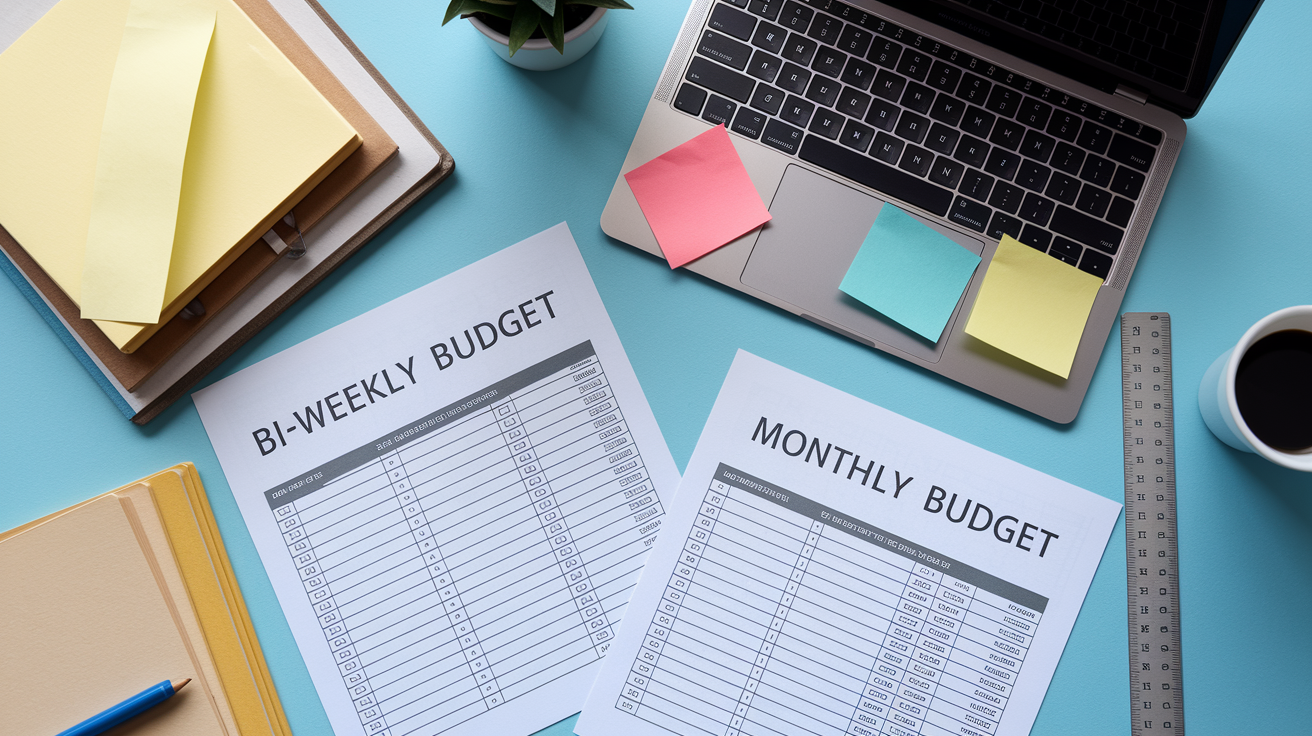
A bi-weekly budget template starts with a single paycheck amount at the top. Below that, you list every fixed monthly expense and divide each by two. Subtract the total from your paycheck, and the template shows how much is left for goals and discretionary spending. Most templates include a section for the two “extra” paychecks per year, with checkboxes or dropdowns to assign that money to specific goals like debt payoff or emergency savings. The best bi-weekly templates are designed around a two week spending cycle, with space to track daily expenses and compare actual spending to the plan.
A monthly budget template organizes income and expenses into a single calendar month. You enter your total monthly income, then list fixed expenses by category. Housing, transportation, food, insurance, debt, savings. Variable expenses like entertainment and clothing get their own line with an estimated monthly amount. The template calculates the difference between income and expenses and shows whether you’re living within your means or overspending. Monthly templates often include year to date columns so you can track whether you’re on pace with annual goals. Both template types can be built in a simple spreadsheet or downloaded from budgeting apps that support pay period planning.
| Template Type | Best For | Inputs Needed | Time Interval |
|---|---|---|---|
| Bi-weekly budget template | Employees paid every 14 days | Single paycheck amount, fixed monthly bills | Two week cycles; 26 per year |
| Monthly budget template | Salaried or twice monthly earners | Total monthly income, all monthly expenses | One month cycles; 12 per year |
| Zero based budget template | Both pay schedules | Every income source, every planned expense | Flexible; aligns with pay period |
| Sinking fund tracker | Bi-weekly or monthly; goal focused | Target amounts, contribution per period | Per paycheck or per month |
| Paycheck calendar | Bi-weekly earners with irregular due dates | Pay dates, bill due dates | Yearly view, mapped by week |
How to Convert a Monthly Budget Into a Bi‑Weekly Plan (and Vice Versa)

Converting a monthly budget to a bi-weekly plan starts with annual totals. Take each monthly expense, multiply it by 12 to get the yearly cost, then divide by 26 to find the per paycheck amount. For example, if you spend 400 per month on groceries, that’s 4,800 per year. Divide 4,800 by 26 and you need to set aside about 184.62 per paycheck for groceries. Do the same math for every fixed and variable expense. Add up all the per paycheck amounts, and that’s your baseline spending per pay period. Subtract that total from your take home pay to see what’s left for goals and discretionary spending.
Converting a bi-weekly budget to a monthly plan is simpler. Multiply one paycheck by two. If you bring home 2,000 every two weeks, your conservative monthly budget baseline is 4,000. That assumes 24 paychecks per year instead of 26, so it’s a safer number for planning fixed bills. When the two “extra” paychecks arrive, treat them as windfalls for savings or debt payoff rather than increasing your monthly spending baseline. This method eliminates the risk of overspending in months when only two paychecks land.
The reason to convert is to eliminate cash flow mismatches. If your bills come monthly but your income arrives bi-weekly, a bi-weekly plan keeps you from waiting too long between paychecks. If your income is predictable twice a month and your bills are predictable monthly, a monthly plan simplifies tracking. Either way, the goal is to make your plan match your actual income rhythm.
Here’s the conversion process:
Write down every monthly expense with its dollar amount. Multiply each monthly expense by 12 to calculate the annual cost. Divide each annual cost by 26 to get the per bi-weekly paycheck allocation. Add up all per paycheck allocations to find your total bi-weekly spending requirement. Subtract that total from your bi-weekly take home pay to determine per paycheck discretionary and goal money. If converting the other direction, multiply one bi-weekly paycheck by 2 to create a conservative monthly income baseline.
Choosing the Right Budgeting Cadence for Your Income Pattern

Bi-weekly budgeting fits best when your income arrives every 14 days and your expenses fluctuate week to week. If you’re paid every other Friday, planning in two week chunks means you’re never stretching a paycheck across a month or guessing which bills to pay first. The method also works well if your expenses vary. Some weeks are expensive because of car repairs or medical co-pays, and other weeks are light. A bi-weekly reset gives you a built in chance to adjust without waiting a full month to course correct.
Monthly budgeting works well when your income is predictable and your expenses are mostly fixed. Salaried employees paid twice a month on set dates, like the 1st and 15th, benefit from monthly planning because their paycheck timing matches their bill timing. If your rent, utilities, insurance, and loan payments don’t change month to month, a single monthly plan is easier to maintain than dividing everything by two. The psychological benefit is that you only have to review and adjust your budget once a month instead of every two weeks.
The behavioral advantage of paycheck based budgeting is the frequent reset. Every two weeks, you start fresh. If you overspent in one cycle, you can tighten up in the next without waiting 30 days. That shorter feedback loop helps you stay aware of your spending and makes it easier to catch problems early. Monthly budgeting offers a longer planning horizon, which some people find calming because they’re not checking their budget as often. The right choice depends on whether you value frequent check ins and flexibility or prefer a longer, more stable planning window.
Implementation Steps for a Smooth Transition Between Budgeting Styles
Switching from a monthly budget to a bi-weekly budget, or the reverse, requires one planning session and a few weeks of adjustment. The core framework is zero based budgeting, which means every dollar you earn gets a job. Income minus expenses minus savings should equal zero. Whether you’re planning by paycheck or by month, the principle is the same. The difference is the time window and the size of the income chunk you’re planning around.
Start by identifying your exact pay frequency and writing down one full paycheck amount after all deductions. If you’re moving from monthly to bi-weekly, convert your monthly bills to per paycheck amounts using the annual divide by 26 formula. If you’re moving from bi-weekly to monthly, multiply one paycheck by two to create your monthly income baseline. Build a spending plan that assigns every dollar to a category. Fixed bills, variable expenses, savings goals, discretionary spending. Automate as much as you can. Set up recurring transfers to move bill money into a dedicated account on payday, and schedule automatic payments so you’re never late.
Here’s the full implementation checklist:
Identify your pay frequency (bi-weekly = 26 per year; twice monthly = 24 per year; monthly = 12 per year) and write down your take home amount per paycheck. List every fixed bill with its due date and monthly cost. For bi-weekly budgeting, divide each by two to calculate the per paycheck amount. Create a zero based spending plan that assigns every dollar of income to a specific category. Bills, savings, goals, discretionary spending. Open a separate savings or checking account to hold money set aside for bills, and automate transfers on payday so the money moves before you’re tempted to spend it. Use the first or second “extra” paycheck (if bi-weekly) to build a buffer equal to at least one full paycheck or two weeks of expenses. Once that buffer exists, use future extra checks for debt payoff or goal funding. Set up automatic bill payments aligned with your pay schedule. Bi-weekly payments for credit cards if allowed, or scheduled payments a few days after each payday for rent, utilities, and loans. Review your budget once a month (or every other paycheck if bi-weekly) and adjust category amounts based on actual spending. Track any changes in income, due dates, or expenses and update your plan immediately.
Final Words
in the action, we walked through definitions, paycheck math (26 vs 12), cash-flow differences, templates, conversion steps, and clear how-to actions for switching.
If you’re paid every 14 days, divide monthly bills by two and use extra paychecks for savings or debt. If you get paid monthly, use a calendar and average variable costs to avoid surprises.
If you only do one thing this week, pick a cadence and automate a transfer to cover fixed bills. That simple step will make the bi-weekly budget vs monthly budget choice feel manageable and set you up to make steady progress.
FAQ
Q: Is it better to budget biweekly or monthly? Is it best to budget weekly or monthly?
A: Whether it’s better to budget biweekly, weekly, or monthly depends on your pay schedule and bills. Match cadence to how you’re paid: biweekly for 26 paychecks, monthly for fixed bills, weekly for hourly income.
Q: What is the 70/20/10 rule money?
A: The 70/20/10 rule means allocate 70% to needs, 20% to savings or debt, and 10% to wants. Use it as a simple baseline and adjust for high debt or irregular income.
Q: What are the 4 types of budgets?
A: The four common budget types are zero-based (every dollar assigned), envelope (cash categories), 50/30/20 (needs/wants/savings), and incremental (last period plus changes). Pick one based on goals and income stability.