


What if one simple rule could make every paycheck less stressful and more useful?
The 50/30/20 rule does that: split your take-home pay into needs, wants, and savings plus debt, with 50 percent, 30 percent, and 20 percent.
It limits nonessential spending, gives you room to enjoy life, and makes saving automatic.
In this post I’ll show what fits in each bucket, give real dollar examples, and list clear steps to apply or tweak the rule for different incomes or heavy debt.
Clear Breakdown of the 50/30/20 Budget Rule Framework
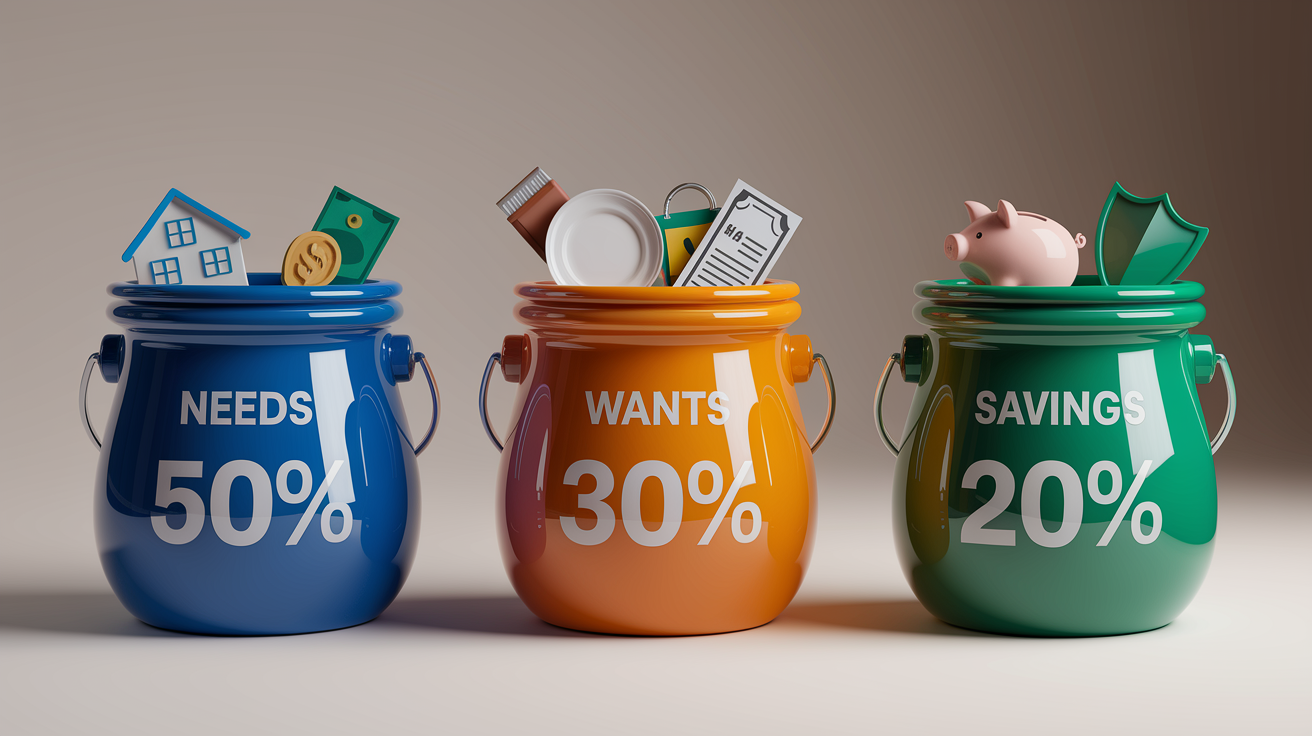
The 50/30/20 rule splits your take home pay into three buckets: needs, wants, and savings plus debt. It’s an easy-to-follow, percent based plan popularized by Elizabeth Warren and her daughter in All Your Worth. Think of it as a quick template for deciding how much of each paycheck goes to essentials, fun, and future security.
Start with your monthly net income. That’s what actually lands in your bank account after taxes, health insurance premiums, and retirement contributions. Then aim for 50 percent to cover needs, 30 percent for wants, and 20 percent for saving or paying down debt. So if your net pay is $4,000 a month, that looks like $2,000 for needs, $1,200 for wants, and $800 toward savings or extra debt payments.
Why bother? Because the rule forces limits on discretionary spending while making saving a habit. It keeps your essentials from getting out of hand, lets you enjoy life without guilt, and builds a cushion for emergencies or goals. When you can see the dollar caps for each bucket, it’s a lot harder to drift into overspending.
Quick examples of items in each bucket:
- Needs: rent or mortgage, electric and gas bills.
- Needs: groceries, commute or work transportation.
- Wants: dining out, streaming services.
- Wants: concerts, clothes bought for fun.
- Savings and debt: monthly emergency fund deposits.
- Savings and debt: extra credit card payments or retirement contributions.
Understanding Budget Categories Within the 50/30/20 Rule

Needs are the bills you can’t skip without real consequences to your health, safety, or ability to work. Housing, basic utilities, food, insurance, minimum loan payments, child care, and necessary transportation all fit here. Aim to keep these under 50 percent of your net income. On a $3,500 monthly take home, that cap is $1,750. Example split: $1,250 rent, $150 utilities, $300 groceries equals $1,700.
Wants are the nonessentials that make life nicer but can be paused if cash gets tight. Think restaurants, gym memberships, vacations, gadgets, and subscription boxes. Wants get 30 percent of your net income. With $3,500 a month you’d have $1,050 for wants. Maybe $300 for restaurants, $50 for streaming, $200 for shopping, leaving $500 for other discretionary things.
| Category | Examples | Typical Monthly Range | % of Net Income |
|---|---|---|---|
| Needs | Rent, utilities, groceries, insurance, minimum debt payments | $1,250 to $3,000 | 50% |
| Wants | Dining out, entertainment, hobbies, travel, subscriptions | $750 to $1,800 | 30% |
| Savings and Debt | Emergency fund, retirement, extra debt payments | $500 to $1,200 | 20% |
| Emergency Fund Target | 3 to 6 months of needs | $3,750 to $18,000 | Goal based |
How to Apply the 50/30/20 Budget Rule to Your Monthly Income
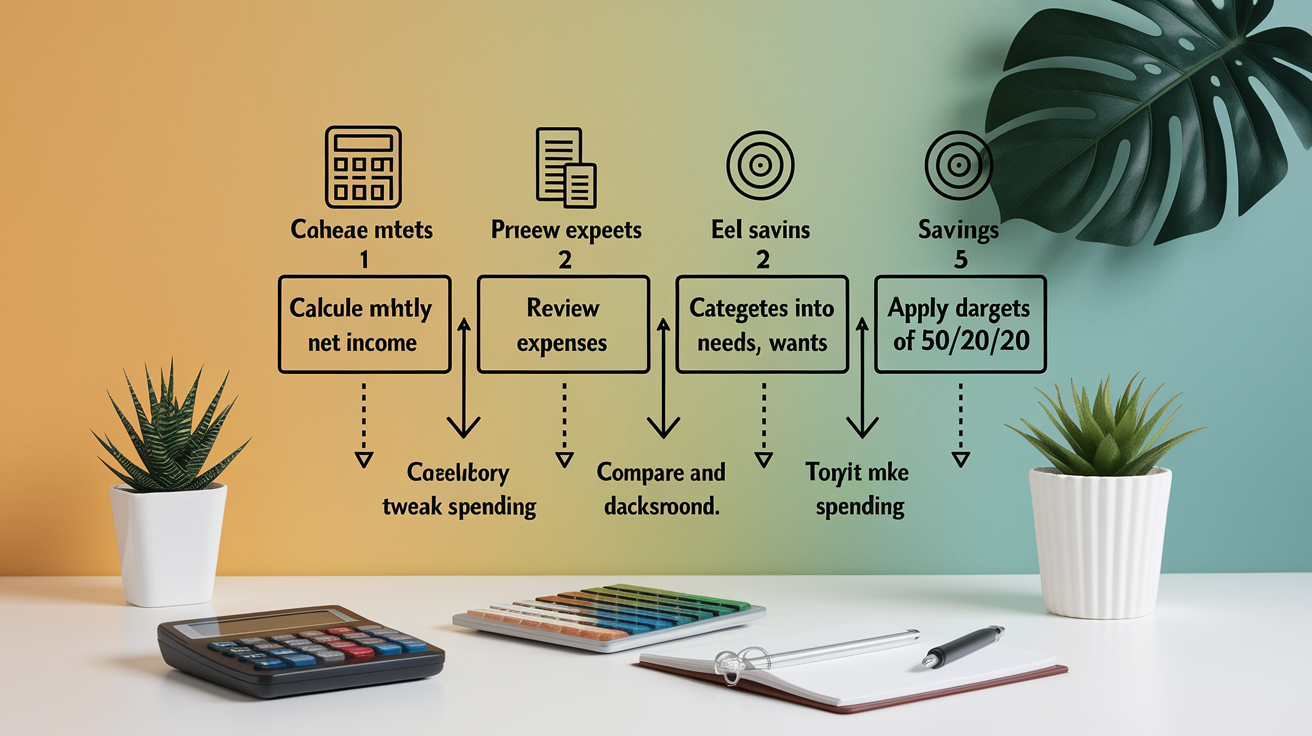
Follow these steps and you’ll have a working plan, not just a rule of thumb.
- Calculate your monthly net income. Add paychecks, side gigs, freelance cash after taxes. If it varies, average the last three to twelve months.
- Pull your bank and card statements and list every expense from the past month. Include the subscriptions you forgot about.
- Sort each expense into need, want, or savings and debt. Be honest. A basic phone plan is a need. The premium unlimited plan with the newest phone is a want.
- Multiply your net income by 0.50, 0.30, and 0.20 to get dollar targets. On $4,000 net: needs $2,000, wants $1,200, savings and debt $800.
- Compare actual spending to those targets and tweak. If needs are $2,400 but the cap is $2,000, look for cheaper housing, lower insurance, or cut groceries. If wants are over, pause a subscription or eat out less.
Revisit the plan every three to twelve months or after big changes. A raise, move, or paid off loan means you should recalc the dollar amounts. The percentages stay the same, but the numbers shift with your life.
Example Budgets Using the 50/30/20 Rule

Seeing exact numbers helps. Here are three income scenarios and the straight allocations.
| Monthly Net Income | Needs (50%) | Wants (30%) | Savings and Debt (20%) |
|---|---|---|---|
| $2,500 | $1,250 | $750 | $500 |
| $4,000 | $2,000 | $1,200 | $800 |
| $6,000 | $3,000 | $1,800 | $1,200 |
If your needs exceed the 50 percent cap, you’ll either need cheaper housing, to shift dollars from wants, or to increase income. At $2,500 net, if rent plus essentials add up to $1,350 against a $1,250 needs cap, you’ve got choices: find cheaper rent, cut groceries, or pull a bit from wants.
At higher incomes, needs may stay similar in absolute dollars while wants and savings grow. That’s when you can bump savings above 20 percent and accelerate goals like retirement or a big trip.
Pros and Cons of the 50/30/20 Budget Rule

The biggest win is simplicity. Three categories, easy math. It forces a minimum savings habit and gives you permission to enjoy life. Save $800 a month on $4,000 net and you’re putting away $9,600 a year without overthinking it.
But it’s not perfect. In expensive cities 50 percent for needs can be unrealistic when rent takes 40 percent to 60 percent of your income. Freelancers with irregular pay will find strict monthly percentages tricky. And heavy high interest debt might need more than 20 percent to get paid down fast.
Main strengths and weaknesses at a glance:
- Pro: Beginner friendly, minimal tracking needed.
- Pro: Ensures at least 20 percent goes to savings and debt every month.
- Pro: Flexible as income or expenses change.
- Con: Can break down in high cost areas where rent dominates.
- Con: Irregular income complicates percentage rules.
- Con: Large debt loads may require more aggressive repayment than 20 percent allows.
Adjusting the 50/30/20 Rule for Different Incomes
Treat the rule as a starting point, not a straightjacket. If rent consumes 60 percent of your net, move to something like 60 percent needs, 20 percent wants, 20 percent savings or 70 percent needs, 20 percent wants, 10 percent savings while you sort housing or boost income. If you’re earning a lot and needs are low, crank up savings beyond 20 percent and reach goals faster.
If you’ve got high interest credit card debt, shift money from wants to debt repayment until it’s gone. On $4,000 net, moving from 50/30/20 to 50/20/30 by reallocating $400 from wants to debt can shave years off the payoff timeline.
Common variations people use:
- 60/20/20 for when needs exceed 50 percent.
- 50/20/30 to push more into savings or debt repayment.
- 70/20/10 as a short term survival split.
- 40/30/30 for high earners who want more saving and investing.
- 50/10/40 for aggressive savers.
For irregular income, average your net over six to twelve months and build a larger emergency fund. Aim for six months of needs before you give full tilt to wants. That buffer helps during lean months.
Tools and Templates That Support the 50/30/20 Rule

You don’t need fancy apps. A spreadsheet works fine. Or paper. The point is consistency.
Useful tools to get started:
- Monthly budget worksheet with columns for date, net income, needs, wants, savings and variance.
- Simple allocation calculator to convert net income into the three dollar targets.
- Emergency fund calculator that multiplies monthly needs by three and six.
- Debt payoff timeline tool that divides balance by extra monthly payment to estimate months to zero.
- Savings priority checklist to rank goals like starter emergency fund, employer match, high interest debt, full emergency fund, and extra retirement contributions.
Automation helps. Set up direct deposits so 20 percent hits a savings account before you see it. When saving happens first, spending just fits around what’s left.
Final Words
Start by figuring your take-home pay and split it: 50% needs, 30% wants, 20% savings and extra debt payments. That split shows where money goes and sets clear limits.
Plug your numbers into a worksheet, compare to the targets, and adjust if rent or debt pushes needs above 50%. Automate monthly transfers to savings.
If you’re asking what is the 50/30/20 budget rule, it’s an easy percentage-based plan for after-tax income. Try it for one month, tweak where needed, and you’ll likely feel more control.
FAQ
Q: How much should I save if I make $3,000 a month?
A: If you make $3,000 a month, save about $600 (20%) using the 50/30/20 rule. If you have high-interest debt or no emergency fund, shift some wants toward savings/debt until managed.
Q: What is the 75-15-10 rule?
A: The 75-15-10 rule is a stricter budget split: 75% needs, 15% wants, 10% savings. Use it when essentials take most of your income or as a short-term plan to catch up on bills.
Q: Does the 50/30/20 rule actually work?
A: The 50/30/20 rule works as a simple guideline with clear targets: 50% needs, 30% wants, 20% savings. It needs tailoring for high living costs, irregular pay, or heavy debt.
Q: What does Dave Ramsey say about the 50/30/20 rule?
A: Dave Ramsey says the 50/30/20 rule isn’t his approach; he prefers zero-based budgeting and cash envelopes. He recommends a $1,000 starter emergency fund, then aggressive debt payoff with the debt snowball.