


Most retirement advice sells a single number.
That’s misleading and can ruin plans.
This post gives clear age-based benchmarks that actually work, using recent survey data plus salary multiple targets.
Use your age group’s median as a realistic comparison, the salary multiple as your goal, and the averages as context.
If you’re behind, you’ll find simple catch-up steps and monthly saving targets to start today.
If you only do one thing now, set up automatic payroll deferrals and aim for 10 to 15% of pay, then increase it when you get raises.
Core Retirement Savings Targets by Age Group (Immediate Benchmarks)

These benchmarks combine actual 2022 Survey of Consumer Finance data with commonly recommended salary multiple targets. They’ll give you the fastest way to see if you’re on track, behind, or ahead for retirement. Use your age group’s median as a realistic comparison point, the salary multiple target as your personal goal, and the average as context for how balances are distributed across all households.
| Age Group | Average Savings | Median Savings | % With Accounts | Salary-Multiple Target |
|---|---|---|---|---|
| Under 35 | $49,130 | $18,880 | ~50% | 1× by age 30 |
| 35–44 | $141,520 | $45,000 | 62% | 3–4× by age 40 |
| 45–54 | $313,220 | $115,000 | 62% | 6× by age 50 |
| 55–64 | $537,560 | $185,000 | Data not specified | 8× by age 60 |
| 65–74 | $609,320 | $200,000 | 51% | 10× by age 67 |
| 75+ | $462,410 | $130,000 | 42% | Drawdown phase |
Understanding Retirement Savings Milestones Through Your 20s, 30s, 40s, 50s, and 60s

Decade based retirement planning works because your income, expenses, and compounding timeline all shift in predictable ways as you age. Savings accelerate naturally over time, thanks to rising income in your peak earning years and the compounding effect of early contributions. The goal is to align your behavior with those shifts so you don’t leave decades of growth on the table.
In your 20s and 30s, the priority is building the habit and capturing free money. Get your full employer 401(k) match first, then open a Roth IRA if you’re eligible. Roth accounts make sense early in your career because your tax rate’s often lower now than it’ll be in retirement. Decades of tax free growth matter more than the upfront deduction. Even small monthly contributions in your 20s can grow into six figures by retirement because they’ve got 40 years to compound.
Your 40s and 50s are when income usually peaks and expenses stabilize, at least in some areas. This is when you should funnel raises and bonuses directly into retirement accounts, review and consolidate old 401(k) plans from previous employers to reduce fees and simplify tracking, and consider whether Roth conversions or backdoor Roth strategies fit your tax situation. If you’re not yet saving 15% of your gross income by your mid 40s, this is the decade to get there.
In your early 60s, maximize catch up contributions, evaluate whether you can afford to retire at your target age, and start preparing for the shift from accumulation to income. If you turned 50 or older, you’re eligible for catch up contributions in most retirement accounts. Starting in 2025, ages 60 to 64 can use a larger “super catch up” allowance in many employer plans. Use this window to close any remaining gaps, especially if you started late or took time away from saving.
Start automatic payroll deferrals or monthly transfers in your 20s to make saving effortless. Increase your savings rate by at least 1% every time you get a raise or bonus. Use catch up contributions starting at age 50 to add thousands more per year to your accounts. Optimize your tax strategy by balancing traditional (tax deferred) and Roth (tax free withdrawal) accounts. Review your investment allocation every few years to make sure it matches your risk tolerance and timeline.
How Much to Save Monthly to Hit Age Based Retirement Targets
Most financial professionals recommend saving between 10% and 20% of your gross income for retirement, with 15% often cited as the practical middle ground. If you start saving around 10 to 15% of your salary in your 20s and keep it up, you should reach the benchmark of one year’s salary saved by age 30. From there, continued contributions plus compounding can help you stay on track for the 3 to 4× target by 40, 6× by 50, and so on.
Here’s a concrete example. If you earn $50,000 at age 25 and save 15% per year, that’s $7,500 annually. Assuming modest raises and average investment returns, you could reach $50,000 in savings by age 30. If you keep saving 15% as your income grows to $60,000, then $70,000, the combination of your contributions and investment growth should put you near $180,000 to $240,000 by age 40. Returns matter, but starting early and staying consistent matters more than trying to time the market or chase high returns.
The challenge is that many people start late. An April 2024 survey found that 59% of adults had either no retirement savings or less than $49,000 total. If you don’t start saving until your 30s or 40s, you’ll need to save closer to 20% or more to catch up, or plan to work a few extra years. The math is straightforward. Fewer years to save and compound means a higher required savings rate.
Factors That Influence How Much You Should Save by Age

Your personal retirement savings target depends on the lifestyle you expect to fund, the cost of living where you plan to retire, and how inflation will erode purchasing power over 20 or 30 years. Someone planning to travel frequently and live in a high cost city will need a much larger nest egg than someone who owns their home outright in a low cost area and plans a quiet retirement. Inflation alone can cut your purchasing power in half over a typical retirement, so even modest lifestyle plans require substantial savings.
Investment return assumptions and longevity also matter. If your investments earn 6% annually after inflation instead of 8%, you’ll need to save more to hit the same target. If you live to 95 instead of 85, your money has to last a decade longer. Healthcare and long term care expenses add another layer of unpredictability, especially if Medicare doesn’t cover everything or if you need assisted living. These variables mean the same salary multiple target might be enough for one person and too little for another.
Social Security expectations shape your required savings, too. As of January 2025, the average Social Security payment for a retired worker is about $1,976 per month. In an April 2024 survey, 41% of adults viewed Social Security as supplemental income, 31% saw it as their primary source, 16% weren’t counting on it at all, and 12% were unsure. If you expect Social Security to cover most of your basic expenses, you can aim for a smaller nest egg. If you assume benefits will be reduced or you plan to retire before you’re eligible, you’ll need more saved.
Your health and family longevity history affect how long your savings must last. The age you plan to retire changes how many years you have to save and how many years you’ll draw income. Outstanding debt at retirement, like a mortgage or student loans, increases the income you’ll need. Geographic cost of living can double or halve the nest egg required to maintain the same lifestyle.
Catch Up Strategies If You’re Behind on Retirement Savings by Age

People fall behind on retirement savings for predictable reasons. Starting a career late, taking time off to raise kids or care for family, paying down student loans or credit card debt, facing medical expenses, or simply not prioritizing retirement early enough. The 2022 Survey of Consumer Finance shows that even in the 45 to 54 age group, the median household has only $115,000 saved, well below the 6× salary benchmark for age 50. If that describes you, you’re not alone, and there are clear steps to close the gap.
Standard catch up contribution rules let you add extra money to most retirement accounts starting at age 50. In 2025, that means you can contribute more to your 401(k), 403(b), IRA, and other plans than younger workers. These higher limits let you save thousands more per year during your peak earning decade, when you’re often better positioned financially and your kids may be out of the house or closer to independence.
Starting in 2025, many employer retirement plans also allow a “super catch up” for workers aged 60 to 64. This provision raises the contribution limit even higher than the standard age 50 catch up, giving you a narrow window to accelerate savings right before retirement. If your plan offers it and your budget allows, maxing out this super catch up window can add a significant boost to your final account balance.
Raise your contribution rate by at least 1 to 2% per year until you hit 15 to 20% of gross income. Cut one major recurring expense, redirect that monthly amount into your retirement account, and automate the transfer so it’s not a monthly decision. Consolidate old 401(k) accounts and IRAs to reduce fees, simplify management, and make it easier to track whether you’re on target. Redirect raises, bonuses, tax refunds, and windfalls straight into retirement savings before you adjust your lifestyle to the extra income. Pay off high interest debt first if the interest rate is above 7 to 8%, since eliminating that expense frees up cash flow you can then redirect to retirement contributions.
Best Retirement Accounts to Use for Age Based Saving
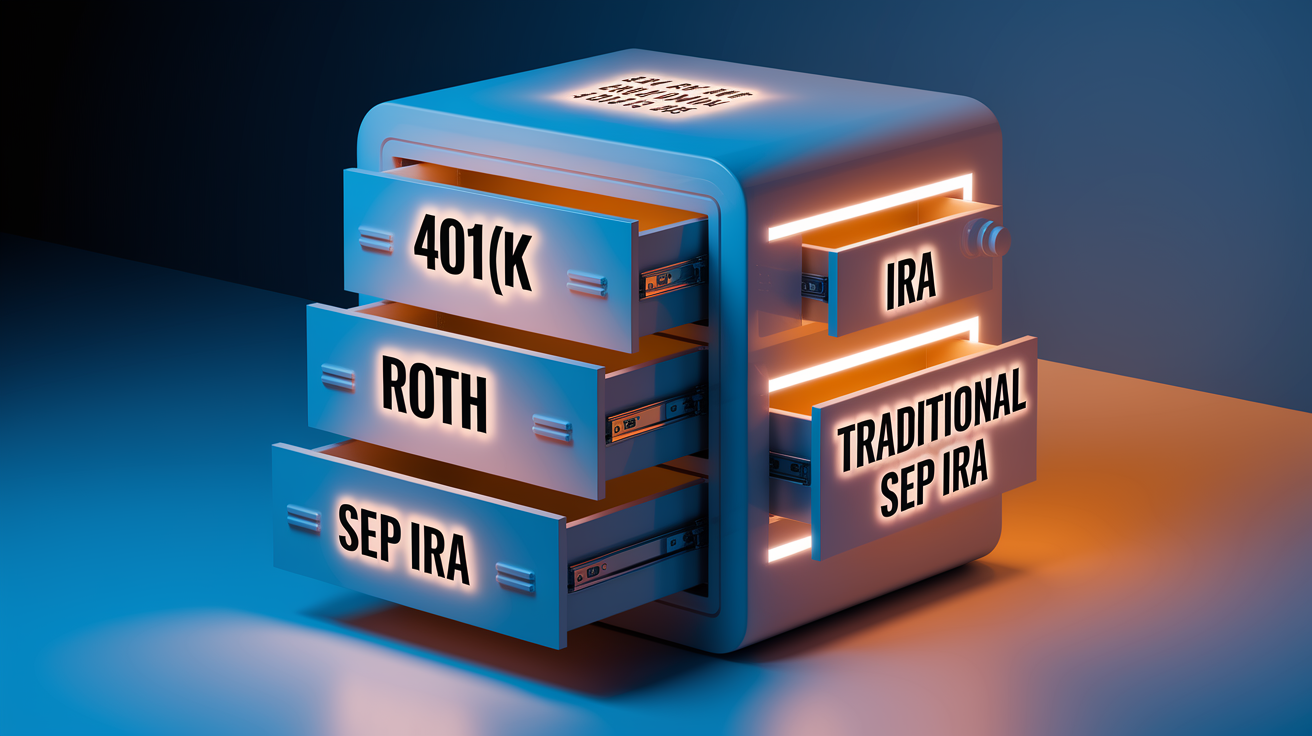
The core retirement accounts are employer sponsored plans like a 401(k), 403(b), or 457(b), and individual retirement accounts like a Traditional IRA or Roth IRA. Employer plans often include a company match, which is the single highest return “investment” available because it’s immediate, guaranteed money. If your employer matches 50 cents on the dollar up to 6% of your salary, you’re earning a 50% return on that portion before any market gains. Always contribute at least enough to get the full match.
Traditional accounts let you defer taxes now and pay them later when you withdraw the money in retirement. Roth accounts work the opposite way. You pay taxes on contributions today, but qualified withdrawals in retirement are completely tax free. Roth accounts make the most sense early in your career when your tax bracket is lower. Traditional accounts often make more sense in your peak earning years when the upfront deduction saves you more. Many people use both, creating tax diversification that gives flexibility in retirement.
If you’re self employed or run a small business, SEP IRAs and solo 401(k) plans let you contribute much larger amounts than a standard IRA. A SEP IRA allows contributions up to 25% of net self employment income, and a solo 401(k) lets you make both employee and employer contributions, potentially allowing you to save over $60,000 per year depending on income and plan rules. These options are especially useful if you’re starting late and need to catch up quickly.
Employer 401(k) or 403(b) means high contribution limits, potential employer match, pre tax or Roth options. Traditional IRA gives you tax deferred growth, and deductibility depends on income and whether you have an employer plan. Roth IRA involves after tax contributions, tax free withdrawals, income limits apply, ideal for early career savers. SEP IRA or Solo 401(k) offers high contribution limits for self employed, flexible contribution timing, good for catch up savings.
How Compound Interest Shapes Your Retirement Savings Path by Age

Compound interest is the reason early contributions matter so much more than late ones. Every dollar you invest in your 20s has 40 years to grow, and each year’s growth generates its own growth in future years. The 2022 Survey of Consumer Finance data shows this effect clearly. Average balances rise from about $49,000 for households under 35 to over $600,000 for those aged 65 to 74. Part of that growth comes from higher incomes and larger contributions over time, but a significant portion comes from decades of compounding.
Here’s what that looks like in practice. If you contribute $5,000 per year starting at age 25 and earn an average 7% annual return, by age 65 you’ll have around $1 million. Roughly $800,000 of that is investment growth, not your contributions. If you wait until age 35 to start saving the same $5,000 per year, you’ll end up with around $500,000 by 65, half as much, even though you only skipped ten years of contributions. Those early years are disproportionately powerful because they compound the longest.
A $10,000 contribution at age 25 could grow to over $100,000 by age 65 at 7% annual returns. The same $10,000 contributed at age 45 grows to about $38,000 by age 65. Starting ten years earlier can double your final balance even if you save the same total amount.
Withdrawal Planning and How It Connects Back to Saving Enough by Each Age

The traditional safe withdrawal rate guideline is 4% per year. If you retire with $1 million, you’d withdraw $40,000 in the first year and adjust for inflation each year after. This rule is designed to make your money last 30 years, but it’s not guaranteed, especially if you retire during a market downturn or live longer than average. Some planners now recommend 3 to 3.5% as a safer starting point, which means you need a larger nest egg to generate the same income. If you want $50,000 per year in retirement income and use a 4% rule, you need $1.25 million saved. At 3.5%, you need about $1.43 million.
Required minimum distributions add another layer. Once you reach age 73 (as of current law), you must start withdrawing a percentage of your traditional IRA and 401(k) balances each year, and those withdrawals are taxed as ordinary income. If you saved entirely in traditional accounts and have a large balance, RMDs can push you into a higher tax bracket and increase Medicare premiums. That’s why many planners recommend using a mix of traditional and Roth accounts, giving you flexibility to control taxable income in retirement and avoid RMD penalties.
Inflation and longevity risks shape how much you need to save in your 50s and 60s. If you retire at 65 and live to 90, your savings need to last 25 years, and inflation will steadily reduce what each dollar can buy. Healthcare and long term care costs often rise faster than general inflation, especially in your 70s and 80s. To manage these risks, you need a larger cushion than the basic salary multiple targets suggest, or a plan to maintain some growth oriented investments even in retirement. That’s why hitting the 8× salary target by 60 and 10× by 67 matters. It builds in a buffer for the unknowns.
Age Based Retirement Planning Examples for Realistic Scenarios
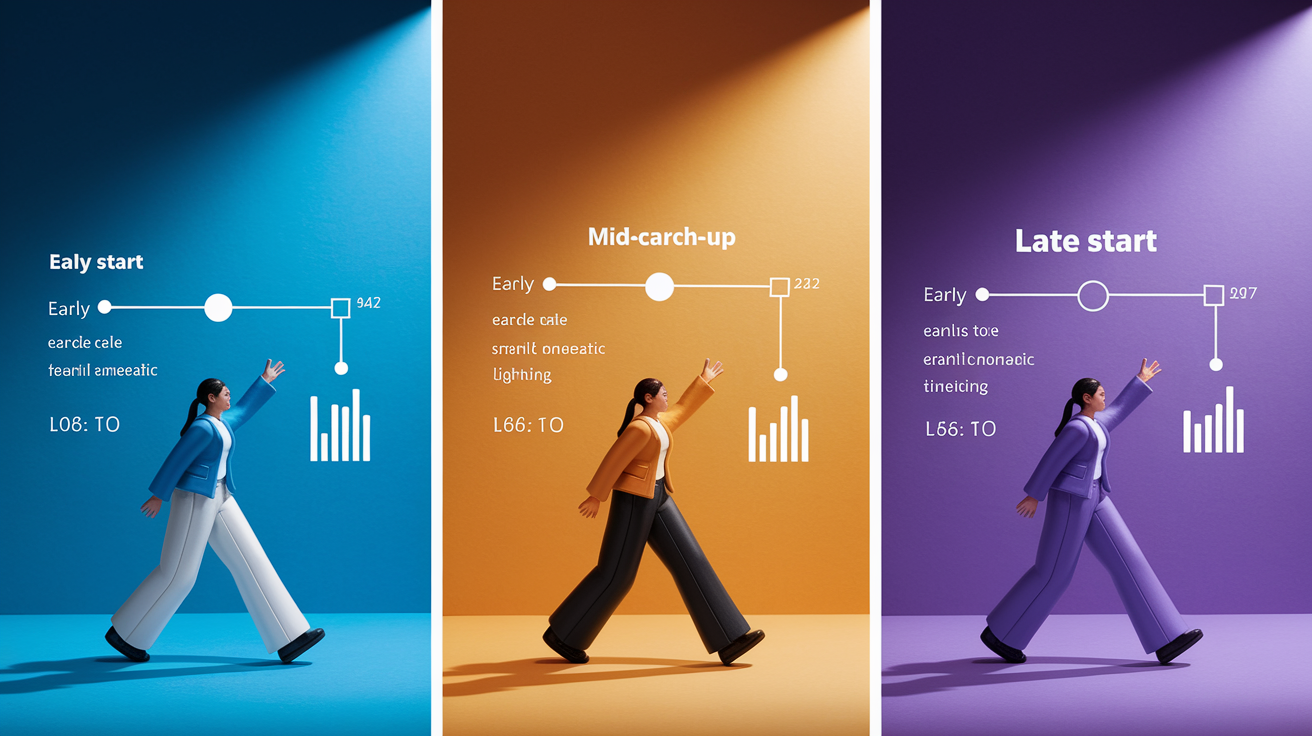
If you start at age 25, earn $50,000, and save 15% of your salary each year while your income grows modestly with inflation and promotions, you could reach about $50,000 saved by age 30 (1× salary), $200,000 by age 40 (roughly 3 to 4× a $60,000 salary), and over $500,000 by age 50 (approaching 6× an $85,000 salary). By age 67, consistent saving and compounding could put you near $1.2 million, or about 10× your final salary if it’s around $120,000. Add in an average Social Security benefit of about $1,976 per month, and you’d have a sustainable retirement income.
If you don’t start saving until age 40, you’ll need a higher savings rate to catch up. Let’s say you earn $70,000 at 40 and commit to saving 20% per year, plus you use catch up contributions starting at 50. By age 50, you might have $150,000 saved. If you keep saving aggressively and maximize catch up limits from 50 to 64, you could reach $600,000 to $700,000 by age 65. That’s below the 10× benchmark if your final salary is $100,000, but combined with Social Security and possibly delaying retirement by a couple of years, it could still work depending on your expenses and location.
A late start scenario might look like this. You begin serious retirement saving at age 50 with little saved, but you earn $90,000 and can save 25% per year. You use standard catch up contributions, then super catch up contributions from age 60 to 64, and you plan to work until age 70 instead of 67. By age 70, you could accumulate $400,000 to $500,000, and delaying Social Security until 70 increases your monthly benefit significantly. It’s not the textbook path, but it’s a realistic plan that avoids running out of money if you keep expenses reasonable.
| Scenario | Starting Age | Savings Rate | Target Multiples | Expected Outcome |
|---|---|---|---|---|
| Early Start | 25 | 15% | 1× at 30, 10× at 67 | ~$1.2M by 67, on track for comfortable retirement |
| Mid-Career Catch-Up | 40 | 20% + catch-up at 50+ | 6× at 50, 8–9× at 65 | ~$600–700K by 65, workable with Social Security |
| Late Start | 50 | 25% + super catch-up 60–64 | Work to 70, delay Social Security | ~$400–500K by 70, requires expense discipline |
Final Words
Check where you stand against the core targets and decade milestones, using the salary-multiple benchmarks, SCF averages, and monthly savings rules from the post. Use the tables and examples to quickly spot gaps.
If you’re behind, pick one catch-up move—raise your contribution, redirect raises, consolidate accounts—and choose the right account for your stage (401(k), IRA, Roth).
Now run the numbers and ask yourself, how much should i save for retirement by age, then set one small automatic step today. Small, steady changes add up, and you’re moving in the right direction.
FAQ
Q: What is a good retirement savings by age?
A: A good retirement savings by age is a set of salary-multiple targets: aim for about 1× salary by 30, 3–4× by 40, 6× by 50, 8× by 60, and 10× by 67.
Q: How many people have $1,000,000 in retirement savings?
A: The number of people who have $1,000,000 in retirement savings is relatively small; most age groups’ median retirement balances remain well under that level.
Q: What is the 70/20/10 rule money?
A: The 70/20/10 rule money is a simple budget: spend 70% on living costs, save or invest 20%, and use 10% for debt repayment or charitable giving.
Q: Is $300,000 enough to retire at age 65?
A: Whether $300,000 is enough to retire at 65 depends on your expenses, expected Social Security and other income, and health costs; for most it’s low unless you plan a very modest lifestyle.