


What if paying the smallest balance first is quietly costing you hundreds or even thousands in interest?
The debt avalanche method flips that approach: you make minimums on every account and throw every extra dollar at the debt with the highest interest rate.
That saves the most money and usually gets you out of debt sooner because you stop the fastest-growing charges first.
If you want to cut total interest and can stay consistent, start the avalanche: rank by APR, pay minimums, and aim extra payments at the top-rate debt.
Clear Definition of the Debt Avalanche Strategy

The debt avalanche method is a repayment strategy where you make minimum payments on all your debts while throwing every extra dollar at the one with the highest interest rate. Once that debt’s gone, you roll the full payment into the next highest rate debt and repeat until everything’s cleared.
This saves you the most money because high rate debts rack up charges faster. Every dollar you put toward a 22% APR credit card cuts way more future interest than the same dollar on a 12% car loan. That’s why attacking the expensive debt first lowers what you’ll pay overall and usually gets you debt free sooner.
What defines the debt avalanche:
Interest rate ranking. You sort debts by APR from highest to lowest, and balance size doesn’t matter.
Minimums only on lower rate debts. Every account except your top priority gets just the required minimum.
All extra money goes to one target. Your surplus funds hit the single highest interest debt until it’s eliminated.
Rollover momentum. When you pay off a debt, you immediately add that freed payment to the next one on the list.
How the Debt Avalanche Method Works Step by Step

A clear process keeps you from accidentally splitting extra payments across multiple accounts, which just dilutes your interest savings. Sticking to a fixed order means every dollar does maximum work.
Here’s how to run the debt avalanche:
List every debt. Write down the account name, current balance, interest rate, and minimum monthly payment. Skip your mortgage unless you’re deliberately including it.
Rank by interest rate. Sort from highest APR to lowest. If you’ve got variable rate debts, use the current rate and update your ranking if something jumps significantly.
Figure out your extra payment. Look at your budget and decide how much above all minimums you can consistently send each month. Even $50 makes a real difference.
Pay minimums on everything except the top debt. Hit the required minimum on every account so you avoid late fees and credit damage. Send your full extra amount only to the highest interest rate debt.
Kill the highest rate debt. Keep this pattern going every month until that top balance hits zero.
Roll the payment forward. Once a debt’s paid off, add that entire monthly payment (minimum plus extra) to the next debt on your interest ranked list. Repeat until you’re done.
Example Calculation of the Debt Avalanche in Action

Real numbers help you see how the avalanche cuts interest faster than minimum only payments. If you’ve ever felt like your balances barely move despite paying every month, this example shows why focusing extra money on high rate debt matters so much.
Say you’ve got four debts and $350 available above all minimums each month. Under the avalanche, you’d send that entire $350 to the personal loan at 24% APR because it’s got the highest rate, even though the balance is bigger than the medical bill. You’d keep paying $50 on the credit card, $40 on the car loan, and $25 on the medical bill. Once the personal loan’s paid off, you’d roll the freed up $450 (its $100 minimum plus your $350 extra) into the credit card at 18%, which speeds up that payoff dramatically.
| Debt Name | Balance | Interest Rate | Payment Priority |
|---|---|---|---|
| Personal Loan | $5,000 | 24% APR | 1 (target first) |
| Credit Card | $3,200 | 18% APR | 2 (target second) |
| Car Loan | $8,000 | 6% APR | 3 (target third) |
| Medical Bill | $1,200 | 0% APR | 4 (target last) |
Targeting the 24% loan first stops your fastest growing interest balance and frees up that payment sooner. If you instead threw $350 at the smallest balance (the $1,200 medical bill at 0%), you’d clear it fast but keep paying 24% interest on the $5,000 loan for months longer, which costs you hundreds in extra interest.
Debt Avalanche vs Debt Snowball Comparison

The core difference is what you prioritize. Avalanche ranks debts by interest rate. Snowball ranks them by balance size and ignores APR completely. If your highest rate debt happens to also be your smallest balance, both methods would target it first. But when those two factors point different directions, the strategies split.
Avalanche is mathematically optimal because it cuts compounded interest. But snowball gives you faster visible wins. If paying off a $500 balance in two months keeps you motivated enough to stick with the plan for two years, that psychological edge can beat the extra interest cost for some people. Your personality and stress level matter as much as the math.
What separates avalanche from snowball:
Total interest paid. Avalanche saves the most. Snowball typically costs more in interest over the full repayment period.
Payoff speed. Avalanche often shortens your timeline to debt free if you stay disciplined. Snowball might take longer but can feel faster emotionally.
Motivation. Snowball delivers early wins and frequent account closures. Avalanche gives fewer early milestones but steady cost reduction.
Complexity. Both are simple to set up. Avalanche needs you to track interest rates, snowball only needs balances.
Best fit. Avalanche works for patient, analytical people focused on saving money. Snowball suits people who need quick confidence boosts to stay on track.
Advantages and Drawbacks of the Debt Avalanche Method

The biggest advantage is you pay less interest overall. Sometimes you save hundreds or even thousands compared to making only minimum payments. Focusing on high APR debt also shortens your total repayment period because you’re shrinking the balances that grow fastest. If you’ve got credit cards at 20% or higher and a car loan at 5%, the avalanche stops the expensive debt from compounding while you make steady progress on the cheaper one.
The main drawback is your highest interest debt might also be your largest balance, which means your first payoff can take many months. If you’re someone who needs to see an account hit zero within a few weeks to stay motivated, the avalanche can feel discouraging early on. It also takes consistent discipline. You’ve got to stick with the plan even when progress feels invisible, and you can’t let a windfall tempt you into splitting payments across multiple debts just to “see movement everywhere.”
What you gain and what you trade off:
You save the most total interest and make the most efficient use of every extra dollar.
You cut high cost debt faster, which protects you from compounding charges.
The ranking is clear and logical. Once you’ve listed your rates, there’s no subjective decisions.
But visible progress is slow if your top priority debt has a large balance.
You get fewer early wins, which can make it harder to keep momentum for months.
It requires patience and trust in the math, especially when that first payoff feels far away.
How to Implement the Debt Avalanche Method in Real Life
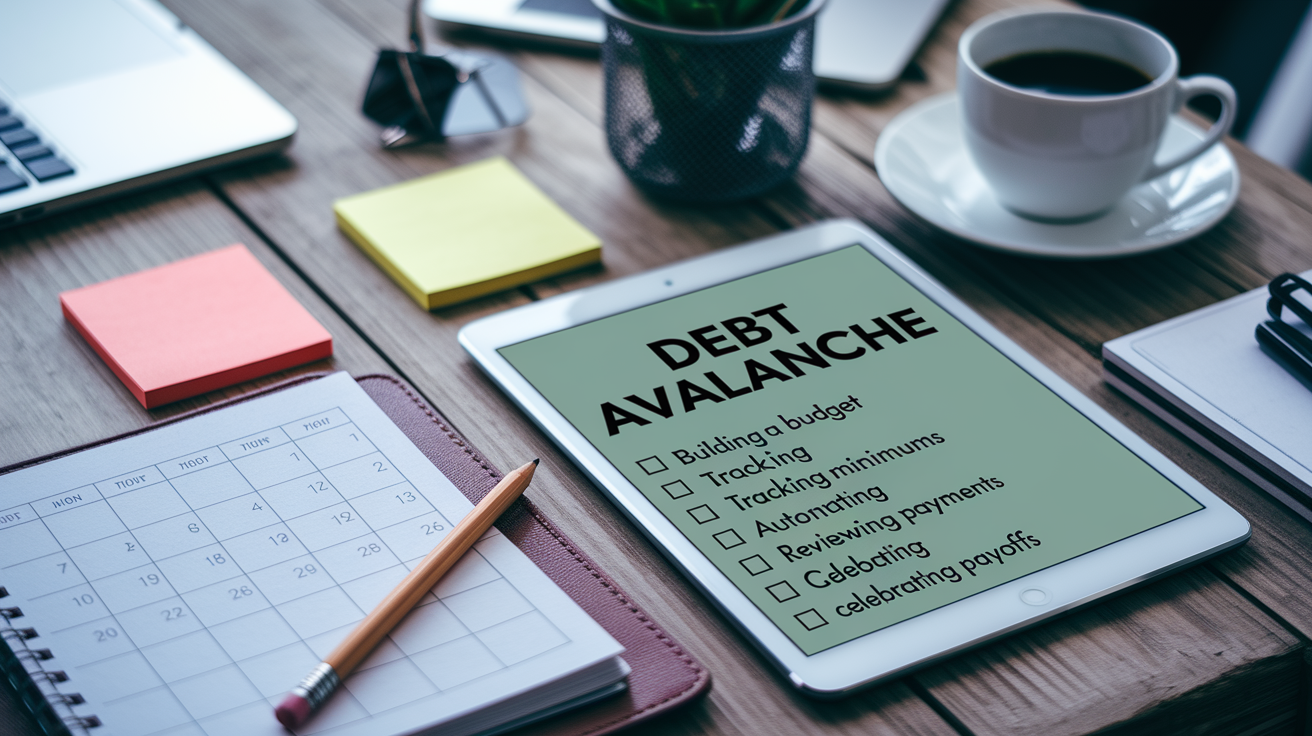
Strong setup increases your odds of success because debt repayment is a long game. Small mistakes like forgetting a minimum payment or miscalculating your extra amount can mess up months of progress. Spending an hour now to build a simple system saves you from decision fatigue and missed payments later.
How to actually implement the debt avalanche:
Build a realistic budget. Track your income and fixed expenses, then figure out how much you can sustainably put toward debt each month. Use a simple rule like allocating 20% of take home pay to debt payoff if your essentials are covered, or start with whatever amount you can commit to for at least six months.
Track minimum payments and due dates. Use a spreadsheet or a notes app to list each debt’s minimum, APR, and due date. Missing a minimum triggers late fees and interest rate penalties that can wreck your progress.
Automate minimum payments. Set up automatic payments for every minimum so you eliminate the risk of a missed due date. Then manually send your extra payment to the highest rate debt each payday.
Review and adjust quarterly. Check your interest rates every few months, especially on variable rate accounts like credit cards. If a rate changes enough to flip the ranking, update your target and redirect your extra payment.
Celebrate payoffs and roll payments immediately. When a debt hits zero, pause for a day to acknowledge the win. Then add that freed payment to the next debt on your list within the same billing cycle. The rollover effect is what makes avalanche acceleration work.
Stay consistent with your extra payment amount even when progress feels slow. If your top priority debt has a $4,000 balance and you’re putting an extra $200 toward it each month, you’ll eliminate it in under two years depending on the interest rate. And then that $200 plus the old minimum becomes a much larger payment on the next debt. The math compounds in your favor as each account falls off the list.
Final Words
We defined the debt avalanche strategy, showed the step by step process, ran a clear numbers example, compared avalanche vs snowball, and covered pros, cons, and practical setup tips.
If your goal is to cut total interest, choose the avalanche method; if you need quick wins to stay motivated, consider the snowball. First step: list every debt, note interest rates, and direct extra payments to the highest‑rate balance.
If you still wonder what is debt avalanche method, it’s focusing extra payments on the highest‑rate debt first. Small, steady moves add up.
FAQ
Q: Is it better to snowball or avalanche?
A: Choosing between snowball and avalanche depends on your goal: avalanche saves the most interest and usually pays debt faster; snowball gives quick wins for motivation. Pick avalanche for math, snowball if you need momentum.
Q: How to pay off a $30,000 debt in one year according to experts?
A: To pay off $30,000 in one year experts say aim for roughly $2,500 monthly, cut discretionary spending, boost income, refinance or consolidate to lower rates, and apply bonuses or tax refunds to the balance.
Q: Is $20,000 in credit card debt a lot?
A: Whether $20,000 is a lot depends on your income, interest rates, and monthly budget. At high rates it’s expensive; if payments force you to skip essentials, treat it as urgent and make a plan.
Q: How to pay off $10,000 credit card debt?
A: To pay off $10,000, pick a timeline, then use the avalanche or snowball method, consider a balance transfer or lower-rate loan, cut spending, and automate extra payments (about $840 monthly for 12 months before interest).