

What if the cheap thing ends up costing you more in the long run?
Cost per use is the simple math that prevents that.
Divide the total price (including tax and any required add-ons) by the number of times you expect to use it.
This shows what you actually pay per wear, cup, or load.
Use it to compare options, stop impulse buys, and pick items that make sense over time.
If the cost per use is lower than alternatives or below your personal limit, buy it. If not, skip it.
Core Method: How to Calculate Cost Per Use

Cost per use measures what you actually pay each time you use something. You take the total price and divide it by the number of times you’ll use it. A $100 jacket worn 50 times costs you $2.00 per wear. That same jacket worn just 5 times? $20.00 per wear. The formula doesn’t change, but the number of uses makes all the difference.
Here’s the basic formula: Cost per use = Purchase price ÷ Estimated total uses. This helps you compare items that look different on price tags but might deliver the same value over time. A $60 coffee maker used 1,000 times over three years costs $0.06 per cup. That often beats the $4.00 single cup you’d buy at a café. The method works best when you can realistically estimate how often you’ll use something and how long it’ll last.
Cost per use thinking shifts your focus from “Can I afford this today?” to “What will this actually cost me over time?” It’s useful for durable goods, clothing you’ll wear repeatedly, tools, appliances, and any purchase where frequency and lifespan vary widely. The formula becomes less reliable for one time purchases, perishables, or things you buy purely because they make you feel good. But for most everyday decisions it gives you a clearer picture than sticker price alone.
Here’s how to calculate cost per use for any product:
- Write down the purchase price, including taxes and any mandatory add ons like extended warranties or required accessories.
- Estimate the total number of times you’ll use the item over its expected lifespan. Multiply daily, weekly, or monthly use by the number of years it will last.
- Divide the purchase price by your total estimated uses to get the cost per use.
- Compare that number to alternatives or to your personal threshold for what feels reasonable in that category.
Factors That Influence Cost Per Use Accuracy

Your cost per use estimate is only as good as your assumptions about how long something lasts and how often you’ll actually use it. A $200 pair of running shoes might deliver 500 miles of use if you run three times a week. But if they sit in your closet after the first month, those shoes cost you $200 for a handful of jogs. Lifespan predictions fail when we overestimate our commitment, underestimate wear and tear, or ignore how our routines shift over time.
Material quality, usage intensity, and maintenance habits all change the true number of uses you’ll get. A cheap blender might handle 100 smoothies before the motor burns out. A commercial grade model runs 2,000 cycles and keeps going. Frequency matters too. Daily use accelerates wear, but seasonal items like winter coats can last a decade if stored properly. Skipping routine upkeep, using a product outside its intended purpose, or environmental factors like humidity and temperature swings can all shorten lifespan and drive up your real cost per use.
Five factors that change cost per use accuracy:
- Build quality and materials. Cheaper components fail sooner, cutting total uses short.
- Usage intensity. Heavy daily use wears items faster than occasional light use.
- Maintenance requirements. Products needing regular servicing add hidden costs and downtime.
- Environmental conditions. Heat, moisture, dust, and rough handling reduce durability.
- Behavioral fit. Items that don’t match your actual habits get abandoned early, lowering total uses.
Real World Cost Per Use Examples Across Products
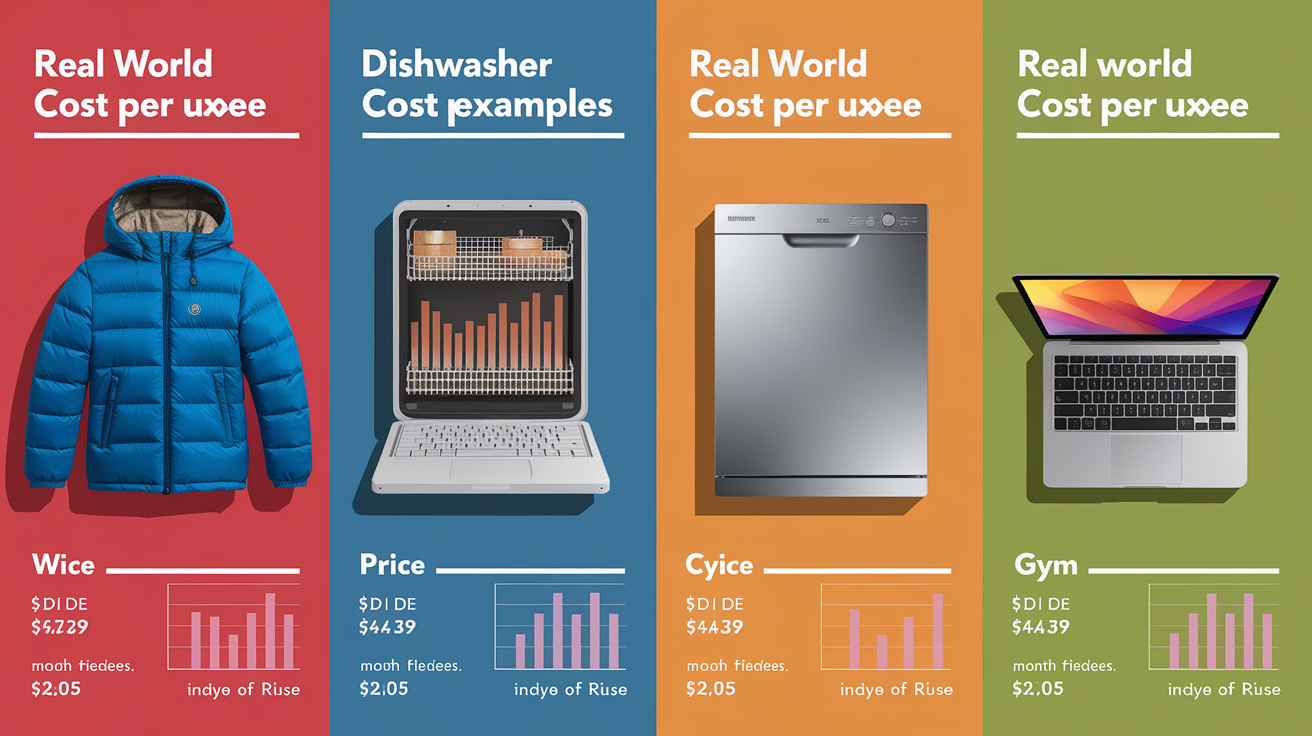
Clothing cost per wear shows the formula’s power most clearly. A $150 winter coat worn 50 times per year for four years gives you 200 total wears, or $0.75 per wear. A $30 trendy jacket worn five times before it goes out of style costs $6.00 per wear. The expensive coat delivers better long term value because it fits more situations, lasts longer, and you reach for it consistently. The cheaper jacket looks like a bargain until you divide by actual use.
Home appliances and electronics stretch cost per use across thousands of cycles or years of daily operation. A $600 dishwasher running twice a day for ten years delivers roughly 7,300 uses, working out to about $0.08 per load. A $1,000 laptop used every workday for four years (about 1,040 days) costs roughly $0.96 per day of use. Higher upfront prices often translate to lower per use costs when the item handles frequent, long term demand and doesn’t need early replacement.
Subscription services and memberships flip the equation. Monthly fees stay constant, but your cost per use drops as frequency rises. A $50 per month gym membership costs $1.67 per visit if you go 30 times, but $12.50 per visit if you only make it four times. Streaming services, software subscriptions, and even storage units follow the same logic. The more you use them, the lower your effective cost per use, and the better the value.
| Item Category | Example Price | Estimated Uses | Resulting Cost Per Use |
|---|---|---|---|
| Winter coat | $150 | 200 wears (50/year × 4 years) | $0.75 per wear |
| Dishwasher | $600 | 7,300 cycles (2/day × 10 years) | $0.08 per load |
| Laptop | $1,000 | 1,040 days (daily × 4 years) | $0.96 per day |
| Gym membership | $50/month | 30 visits/month | $1.67 per visit |
Estimating Future Usage Frequency

The best way to predict future use is to track your current habits for two to four weeks and scale up. If you brew coffee at home five mornings a week right now, that’s roughly 260 uses per year, or 1,300 uses over five years. Real behavior beats optimistic guesses every time. Check your calendar, count how many times you’ve used similar items in the past month, and use that baseline to project forward.
Lifestyle, season, and the item’s specific purpose all shape how often you’ll actually use something. A bread maker might get daily use if you bake for a family of five. But it’ll sit idle if you live alone and work late most nights. Seasonal gear like snow blowers or patio furniture only delivers value during part of the year, so multiply weekly use by the number of active weeks, not the full 52. Single purpose tools tend to get used less than versatile ones. If an item only solves one narrow problem, estimate conservatively.
Use industry averages as a starting point, then adjust for your own patterns. Appliance manufacturers and consumer research publish typical lifespans and usage rates. Dishwashers average 10 years, jeans last about 2 to 3 years with regular wear, laptops run 3 to 5 years before replacement. Those benchmarks help, but your personal routine matters more. If you know you rotate through five pairs of jeans instead of two, your per item use count drops. When in doubt, round your estimate down and add a margin for the unexpected.
Decision Framework: When a Purchase Is Worth It
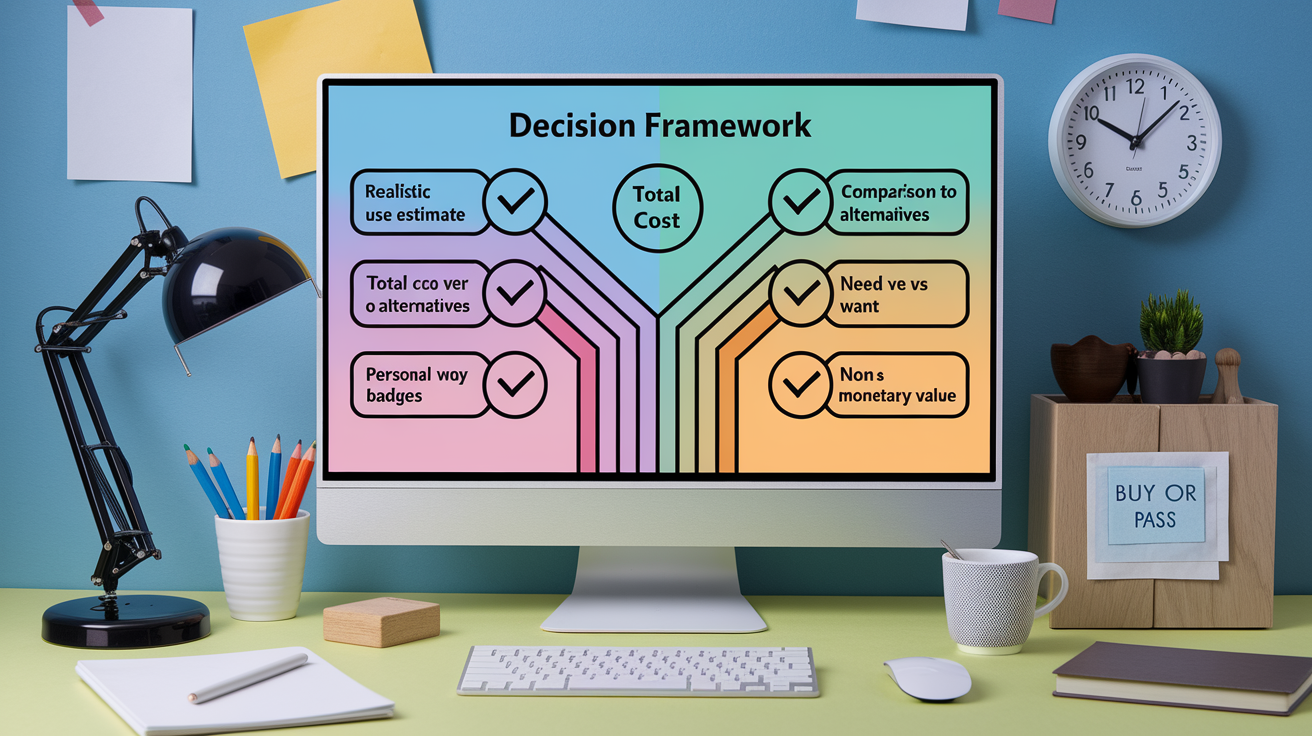
Run the cost per use calculation before you buy, then compare the result to cheaper alternatives and to your own spending threshold for that category. If a $200 item works out to $0.50 per use and a $100 version costs $0.60 per use because it wears out faster, the pricier option wins on value. If both land below your acceptable cost per use limit and you’ll actually use the thing, the purchase makes sense. Cost per use stops impulse buying by forcing you to defend the math, not just the feeling.
Combine the numbers with quality of life factors. Durability, warranty, repair options, convenience, and whether the item solves a real gap in your routine. A tool that saves you an hour every week might justify a higher cost per use than a gadget that’s slightly more fun but doesn’t change your day. Opportunity cost matters too. Money spent here can’t go toward something else, so weigh this purchase against other priorities and make sure it ranks high enough to earn the budget.
Six things to review before deciding whether to buy:
- Realistic use estimate. Track current habits or use conservative projections, not best case dreams.
- Total cost over lifespan. Add maintenance, consumables, repairs, and subtract expected resale value.
- Comparison to alternatives. Calculate cost per use for at least one other option in the same category.
- Personal threshold. Set an acceptable cost per use ceiling for this type of purchase and check if the item clears it.
- Need vs. want. Confirm the item fills a genuine gap, not boredom or a passing trend.
- Non monetary value. Factor in time saved, convenience, quality of life, and whether cheaper options compromise those benefits.
Final Words
You’ve got the core formula (price ÷ estimated uses), the factors that change that number, real examples, and a checklist to decide. Start by estimating realistic uses and plugging them into the 4-step Core Method so the math isn’t guesswork.
If you only do one thing today, test how to calculate cost per use before buying on one item you’re eyeing — it’ll show whether the higher price is worth it. Little checks like this build smarter habits and less buyer’s regret.
FAQ
Q: How do you calculate cost per use (what is the cost per use ratio)?
A: The cost per use (cost-per-use ratio) is the total price divided by expected uses. Example: $100 item ÷ 50 uses = $2 per use, showing true long-term value.
Q: What is the formula for calculating CPC?
A: The formula for calculating CPC (cost per click) is total ad spend divided by total clicks. Example: $200 spend ÷ 400 clicks = $0.50 per click.
Q: What is the TCO formula?
A: The TCO formula (total cost of ownership) adds purchase price plus ongoing costs: maintenance, repairs, energy, and disposal. TCO = purchase + operating + maintenance + disposal.