


What if you could add thousands to your retirement simply by changing one number at work?
Most people do nothing and leave thousands on the table.
You can start capturing the full 2024 limit today by adjusting your payroll deferral and switching on automatic escalation.
This guide gives a clear, step-by-step plan: the exact per-paycheck amounts to hit $23,000 this year, when to choose pre-tax versus Roth, how to avoid excess deferrals, and how to grab every dollar of employer match.
If you’re 50 or older, it also shows how to use the $7,500 catch-up.
Core Steps to Maximize 401(k) Contributions Immediately

The fastest way to reach the IRS maximum is adjusting your payroll deferral percentage right now and flipping on automatic escalation so you never think about it again. Most people leave thousands on the table because they never log into the benefits portal and change one number.
To hit the $23,000 elective deferral limit in 2024, you need to contribute $884.62 per paycheck on a biweekly schedule (26 pay periods), $958.33 per paycheck on a semi-monthly schedule (24 pay periods), or $1,916.67 per month if paid monthly. The percentage of salary required depends on your income. If you earn $100,000, you need to defer 23% of gross pay. At $75,000 salary, you’ll need roughly 30.7%. At $150,000, you need about 15.3%. Your payroll system will let you enter either a flat dollar amount or a percentage, whichever matches your preference and how your raises work.
Here’s the immediate action plan:
- Log into your employer’s payroll or benefits portal. Find the 401(k) or retirement plan section and look for “contribution rate” or “deferral percentage.”
- Calculate your target per paycheck amount. Divide $23,000 by the number of paychecks you receive in a year, or use the percentage formula (23,000 ÷ annual salary × 100).
- Choose pre-tax, Roth, or a mix. Both count toward the $23,000 limit. Select based on your tax situation and long term plan.
- Enter your new deferral amount or percentage. If your system allows it, set a dollar amount to guarantee you hit exactly $23,000. Otherwise use the percentage and monitor mid year.
- Enable automatic escalation if available. Many plans let you increase your contribution by 1% every year or after each raise. Turn this on to keep raising your savings without manual updates.
- Submit the change and note the effective date. Some plans update immediately. Others take effect the next pay period or at the start of the next quarter.
Check your first paystub after the change to confirm the new deduction amount matches your calculation and that your year to date contribution total is tracking correctly. Monitoring each paystub prevents accidental excess deferrals, which trigger tax headaches and corrective withdrawals you don’t want to deal with in April.
Understanding 401(k) Contribution Limits and How They Affect Your Maximization Strategy
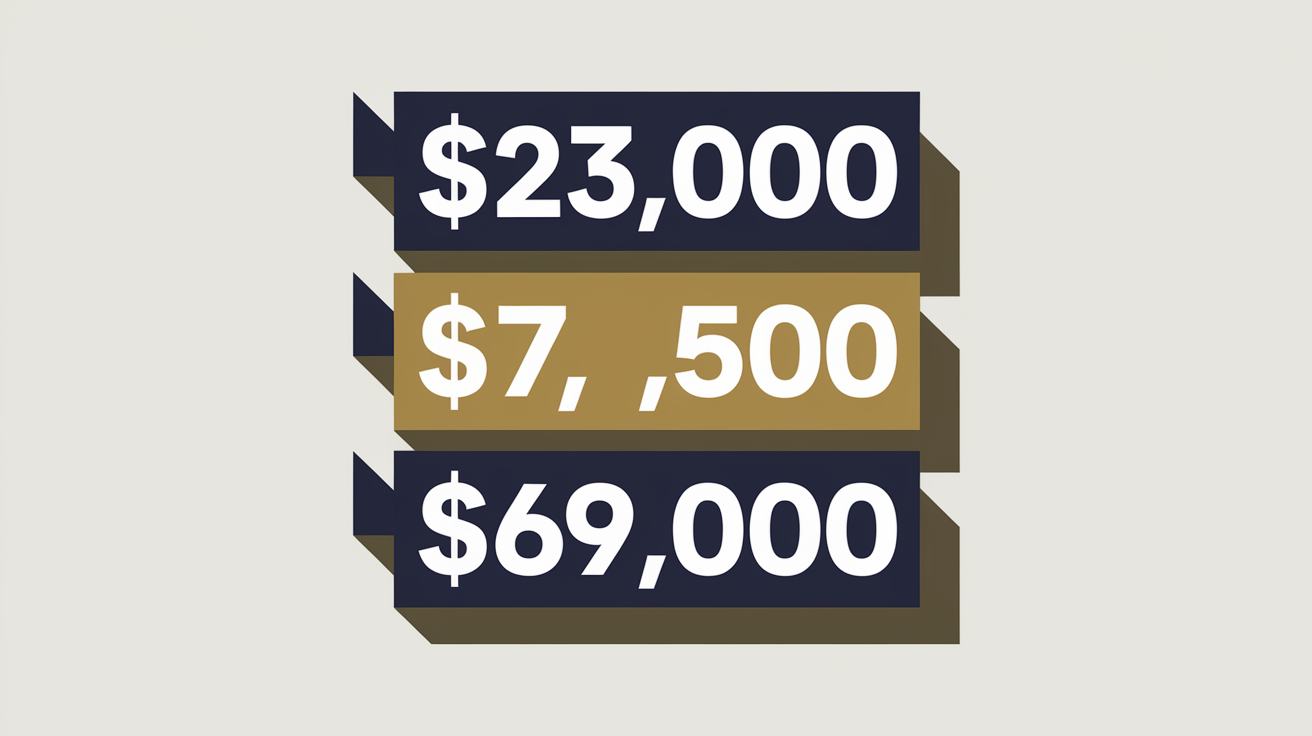
The 2024 IRS elective deferral limit is $23,000 for employees under age 50, and $30,500 for employees age 50 and older when you add the $7,500 catch up contribution. That $23,000 limit applies to the total of all your own pre-tax and Roth 401(k) contributions combined, so you can’t put in $23,000 pre-tax and another $23,000 Roth. There’s also a separate overall annual addition limit of $69,000 in 2024 (or $76,500 if you’re 50 or older), which includes your elective deferrals, employer match, and any after-tax contributions your plan permits.
If you contribute more than the elective deferral limit, the IRS considers the excess amount taxable income in the year you made it, and you’ll owe income tax again when you eventually withdraw it unless you request a corrective distribution before the tax filing deadline. Most payroll systems will stop your deferrals automatically once you hit the limit. But if you change jobs mid year or your employer doesn’t have a hard stop, you need to track your year to date total yourself.
Here’s a quick summary of the 2024 limits:
Elective deferral limit (employee contributions, pre-tax and Roth combined): $23,000
Catch up contribution (age 50 or older): additional $7,500, bringing total elective deferrals to $30,500
Total annual addition limit (employee, employer, after-tax): $69,000, or $76,500 with catch up
Excess deferral penalty: taxable income in contribution year and again at withdrawal unless corrected
The limits reset every January 1, which means your December 31 paystub should show a year to date contribution total that matches or stays under the $23,000 (or $30,500) cap. Tracking your running total every few months, especially if you switch jobs or get a big bonus, prevents you from crossing the line and dealing with the paperwork later.
Maximizing 401(k) Employer Match for Faster Growth

Your employer match is the highest guaranteed return you’ll ever get on invested money. So the first rule of maximizing contributions is to always capture the full match before worrying about hitting the IRS limit. A common match formula might be 100% of your contributions up to 3% of your salary, plus 50% of contributions on the next 2%. In that case, you need to contribute 5% of your pay to receive the maximum employer contribution equal to 4% of your salary. If you earn $100,000 and contribute 6% ($6,000), a simple 100% up to 6% match gives you another $6,000 from your employer, doubling your money immediately.
Employer contributions usually vest over time, meaning you don’t own the match money right away. A typical vesting schedule might be a three year cliff (0% vested until you hit three years of service, then 100% vested) or a five year graded schedule (20% per year starting at year one). Check your Summary Plan Description to understand when you fully own the match, because leaving before you’re vested means forfeiting unvested match dollars.
Common match formulas:
Dollar for dollar up to 6%: Contribute 6% to get a 6% match.
100% up to 3%, then 50% up to 5%: Contribute 5% to get a 4% match (3% plus 1%).
50% up to 6%: Contribute 6% to get a 3% match.
Timing your contributions carefully matters if your plan doesn’t offer a “true up.” If you front load your deferrals and hit the $23,000 limit before December, you might miss employer match deposits in later pay periods because you have zero contributions for those paychecks. Plans with a true up provision will calculate your total annual match at year end and add any shortfall, but not all plans have this feature. Here’s how to avoid losing match dollars:
Spread contributions evenly across all pay periods if your plan has no true up, so you receive match every paycheck.
Redirect bonuses into your 401(k) if the plan permits, which lets you hit the limit faster without changing your regular paycheck deferral.
Front load only if your plan offers a true up and you want your money invested earlier in the year.
Confirm your plan’s match timing rules by reading the plan document or asking HR.
Using Catch Up Contributions After Age 50 to Maximize 401(k) Output

If you turn 50 or older during the calendar year, you can contribute an additional $7,500 in 2024 on top of the standard $23,000 elective deferral limit, for a total of $30,500 in employee contributions. This catch up amount is designed to help older workers accelerate retirement savings in the years before they stop working, and it applies only to your own pre-tax and Roth deferrals, not to employer match or after-tax contributions.
Some 401(k) plans require you to manually enable catch up contributions in your payroll settings, while others automatically allow them once you reach age 50. Log into your benefits portal or contact HR early in the year you turn 50 to confirm the feature is activated, because missing even a few months means leaving over $600 per month on the table.
Steps to activate and use catch up contributions:
Verify your plan allows catch up deferrals. Nearly all 401(k) plans do, but double check your Summary Plan Description or ask your plan administrator.
Enable the catch up option in your payroll system. Look for a checkbox or separate field labeled “age 50 or older catch up” or similar. If you don’t see it, contact HR.
Adjust your deferral percentage or dollar amount. To hit $30,500 instead of $23,000, increase your per paycheck contribution by roughly $288 on a biweekly schedule ($7,500 ÷ 26 pay periods).
Budgeting Strategies to Increase 401(k) Contributions Over Time

If you can’t immediately afford to max out contributions, phase in increases gradually so your take home pay adjusts without a sudden shock. Raising your deferral by 1% every three months is nearly painless. On a $100,000 salary paid biweekly, a 1% increase reduces each paycheck by about $38 before accounting for tax savings, and most people absorb that without changing their lifestyle.
Reallocating money you’re already spending is often easier than cutting expenses. Cancel unused subscriptions, downgrade your phone plan, reduce dining out by one meal per week, or skip one discretionary purchase each month and redirect that exact dollar amount to your 401(k). A $200 per month reallocation adds $2,400 per year to your retirement savings without requiring a raise or bonus.
Another high impact tactic is to commit future income increases to retirement before you feel the extra cash. When you receive a raise, immediately increase your 401(k) deferral by the same percentage or apply half the raise to retirement and keep the other half for take home pay. Bonuses, tax refunds, overtime pay, and commission checks can be redirected into your 401(k) if your plan allows mid year lump sum contributions or if you temporarily raise your deferral percentage during bonus months.
Five budgeting tactics to free up contribution room:
- Set a phased increase schedule. Raise contributions by 1 to 2 percentage points every quarter until you hit your target rate.
- Redirect discretionary spending line items. Identify $100 to $500 per month in non-essential spending and move it to retirement.
- Apply raises and bonuses to retirement first. Increase deferral percentage by at least half of any pay increase.
- Maintain a 3 to 6 month emergency fund. Keep enough liquid savings outside retirement accounts so you never need to take a 401(k) loan or early withdrawal.
- Track your after-tax cost. Pre-tax contributions lower your taxable income, so a $1,000 contribution might only reduce take home pay by $700 to $800 depending on your tax bracket.
Pre-tax 401(k) contributions reduce your taxable income, which means the IRS effectively subsidizes part of your savings. If you’re in the 24% federal tax bracket and contribute an extra $5,000 pre-tax, your taxable income drops by $5,000 and you save roughly $1,200 in federal taxes, so the true cost to your paycheck is closer to $3,800. Roth contributions don’t reduce current taxes, but the same budgeting principles apply.
Roth vs Traditional 401(k) Choices When Trying to Maximize Contributions

Both Roth and traditional (pre-tax) 401(k) contributions count toward the same $23,000 elective deferral limit, so the choice between them doesn’t change how much you can contribute, only when you pay taxes on the money. Traditional contributions lower your taxable income now and defer taxes until you withdraw in retirement. Roth contributions are made with after-tax dollars but grow tax free and come out tax free in retirement if you follow the rules.
Your employer match always goes into a traditional (pre-tax) account regardless of whether your own contributions are Roth or traditional, which means you’ll have both types of money in retirement and can manage your tax bracket by choosing which bucket to withdraw from each year. Many people split contributions between Roth and traditional to create tax diversification, which reduces the risk of ending up in a high tax bracket later if tax rates rise or if required minimum distributions push income higher than expected.
When a Roth 401(k) Is Advantageous
Choose Roth contributions if you expect to be in a higher tax bracket in retirement than you are now, or if you’re early in your career with a relatively low income and decades of tax free compounding ahead. Roth also makes sense if you want to avoid required minimum distributions on your own contributions (Roth 401(k)s do have RMDs, but you can roll the account to a Roth IRA after leaving your employer to eliminate them) or if you want to leave tax free money to heirs.
When Pre-Tax 401(k) Contributions Offer More Value
Traditional pre-tax contributions work best when your current marginal tax rate is high and you expect lower taxable income in retirement, or when reducing taxable income today provides immediate benefits like qualifying for other tax credits, lowering student loan payments on income driven repayment plans, or reducing modified adjusted gross income for ACA premium subsidies. The tax deduction now can be worth more than the future tax bill if you retire to a state with no income tax or if you can fill lower tax brackets with withdrawals and Social Security.
After-Tax 401(k) Contributions and the Mega Backdoor Roth Strategy

If your plan permits after-tax contributions and offers in plan Roth conversions or in service withdrawals, you can contribute beyond the $23,000 elective deferral limit up to the total annual addition limit of $69,000 in 2024 (or $76,500 if age 50 or older). After-tax contributions are not the same as Roth contributions. You pay tax on the money going in, it grows taxable inside the 401(k), and you owe tax on the earnings when you withdraw unless you convert the contributions to Roth.
The mega backdoor Roth technique works by making after-tax contributions and then immediately converting them to Roth (either within the plan or by rolling them to a Roth IRA), which turns the taxable growth into tax free growth. This strategy is most valuable for high earners who have already maxed the $23,000 limit, maxed any available IRAs, and still have cash flow to save more.
Here’s a step by step example. You earn $200,000, contribute $23,000 in elective deferrals, and receive a $10,000 employer match. The total annual addition limit is $69,000, leaving $36,000 of room ($69,000 minus $23,000 minus $10,000). If your plan allows after-tax contributions, you contribute that $36,000 after-tax during the year and either convert it in plan to Roth 401(k) or roll it out to a Roth IRA via in service distribution, paying tax only on any growth between contribution and conversion (which is minimal if you convert frequently).
| Component | Amount (2024 example) | Explanation |
|---|---|---|
| Elective deferrals (pre-tax or Roth) | $23,000 | Your own contributions, subject to the $23,000 limit |
| Employer match | $10,000 | Employer contribution based on match formula |
| After-tax contributions | $36,000 | $69,000 total limit minus $23,000 minus $10,000; requires plan to allow after-tax and conversions |
Not all plans offer after-tax contributions, and fewer still allow in plan Roth conversions or in service rollovers while you’re still employed. Check your Summary Plan Description or ask your plan administrator whether these features are available, and verify there are no restrictions on conversion timing or frequency.
Investment Allocation Strategies Inside a 401(k) While Maximizing Contributions

Maxing your contributions matters only if the money grows, which means choosing an appropriate investment allocation inside the 401(k) and sticking with it through market ups and downs. Most 401(k) plans offer a menu of mutual funds, often including target date funds (which automatically adjust from stocks to bonds as you near retirement), index funds tracking broad market benchmarks, and actively managed funds.
Target date funds simplify the decision by bundling diversification and automatic rebalancing into a single fund. You pick the fund with a date closest to when you plan to retire (example: “Target 2050” if you expect to retire around 2050), and the fund gradually shifts from aggressive growth to conservative income as the date approaches. Index funds tracking the S&P 500, total U.S. stock market, or total international stock market typically have the lowest expense ratios and deliver returns that match the market, which historically beats most active managers over long periods.
Allocation tips for retirement plans:
Match your stock to bond ratio to your risk tolerance and timeline. A common rule of thumb is to hold your age in bonds (example: age 35 equals 35% bonds, 65% stocks), but adjust based on your comfort with volatility.
Minimize expense ratios. Every 0.5% in annual fees costs you tens of thousands over decades. Prioritize funds with expense ratios under 0.20%.
Diversify across asset classes. Combine U.S. stocks, international stocks, and bonds rather than concentrating in a single fund or sector.
Rebalancing to Maintain a Risk Appropriate Portfolio
Rebalancing means selling portions of investments that have grown beyond your target allocation and buying more of investments that have lagged, which forces you to sell high and buy low. Most experts recommend rebalancing once or twice per year, or whenever your allocation drifts more than 5 percentage points from your target. Many 401(k) plans offer automatic rebalancing. Turn it on and set a frequency so you never need to remember to do it manually.
Practical Examples and Calculators to Help You Reach the Maximum 401(k) Contribution

To contribute $23,000 in 2024 on a biweekly payroll, divide $23,000 by 26 paychecks to get $884.62 per paycheck. On a semi-monthly schedule (24 paychecks), you need $958.33 per paycheck. Monthly payroll requires $1,916.67 per month. Translating those dollar amounts into a percentage of your salary depends on your income level. The table below shows the required percentage for common salary ranges.
| Annual Salary | Required Deferral % | Explanation |
|---|---|---|
| $75,000 | 30.7% | $23,000 ÷ $75,000 = 0.3067; high percentage but achievable with budgeting adjustments |
| $100,000 | 23.0% | $23,000 ÷ $100,000 = 0.23; straightforward one to one percentage |
| $150,000 | 15.3% | $23,000 ÷ $150,000 = 0.1533; easier to afford with higher income |
| $200,000 | 11.5% | $23,000 ÷ $200,000 = 0.115; leaves significant take home pay for other goals |
If you receive a pay raise mid year, recalculate your required percentage to stay on track. For example, if you start the year at $100,000 and get a $10,000 raise in July, your new salary is $110,000 for the second half. You’ve already contributed about $11,500 in the first six months (half of $23,000), so you need another $11,500 over the remaining six months, which works out to roughly $1,917 per month or 20.9% of your new $110,000 annualized salary.
How to use calculator tools:
Annual to paycheck converter: Divide your target annual contribution by the number of pay periods (12, 24, 26, or 52) to find the exact dollar amount per paycheck.
Percent of salary calculator: Divide your target contribution by your annual gross salary, then multiply by 100 to get the percentage to enter in your payroll system.
Year to date tracker: After each paycheck, check your paystub’s year to date 401(k) contribution total and compare it to where you should be (target annual amount × [pay periods so far ÷ total pay periods]). Adjust your deferral if you’re behind or ahead of schedule.
Final Words
Hit the IRS maximum fastest by raising your payroll deferral to the right dollar amount per paycheck (or percentage), enabling automatic escalation, and using catch-up contributions if you’re 50+.
We covered immediate payroll steps, paycheck math, employer match timing, after-tax mega-backdoor options, budgeting moves to fund higher contributions, and basic investment choices.
Always check each paystub to confirm year-to-date deferrals and avoid excess contributions.
If you follow this plan, you’ll have a clear, practical path for how to maximize 401k contributions and grow your retirement savings with confidence.
FAQ
Q: Is contributing 20% to a 401k too much?
A: Contributing 20% to a 401(k) is not inherently too much; it’s reasonable if you still cover essentials, have a 3–6 month emergency fund, and get any employer match. Cut back if it strains cash flow.
Q: Can I retire at 62 with $400,000 in 401k?
A: Retiring at 62 with $400,000 in a 401(k) is possible but limited—at a 4% withdrawal that’s about $16,000 a year. Consider delaying retirement, part-time work, or other savings to fill the gap.
Q: How many Americans have $1,000,000 in their 401k?
A: Only a small share of Americans have $1,000,000 in their 401(k); estimates put the share well under 5% of account holders, concentrated among older and higher-income workers.
Q: How much will $10,000 in a 401k be worth in 20 years?
A: A $10,000 401(k) could grow to about $26,500 at 5% annually or $38,700 at 7% over 20 years, assuming no further contributions; actual results depend on returns, fees, and added deposits.