


Think a medical bill must haunt your credit report forever?
Good news: in many cases, medical debt can be removed from your credit report.
If the debt was paid, is under $500, is reported in error, or is less than a year old, you have clear paths to removal.
Unpaid balances above $500 can still show up for up to seven years, but dispute, validation, negotiation, or a goodwill request often work.
Read on for a simple, step-by-step plan you can start this week.
Immediate Answers About Removing Medical Debt From a Credit Report

Yes, medical debt can be removed from your credit report. But which debts qualify and how you actually get them off depends on whether the debt was paid, how old it is, and what amount you’re dealing with.
If you paid the medical bill, the collection should already be gone. Credit bureaus must remove all paid medical collections. If your insurer paid the bill and it still shows up, that’s an error you can dispute. Collections under $500 were automatically removed starting in April 2023, so if you see a small medical collection on your report today, dispute it. Unpaid collections of $500 or more can stay on your report for up to 7 years from the date you first missed a payment. Unless you negotiate removal, prove the debt isn’t accurate, or the provider agrees to correct it.
Bureaus now wait 1 year before reporting any new medical collection. That gives you time to resolve billing errors or let insurance claims process. A CFPB proposal to ban all medical debt reporting was struck down in 2025, so unpaid balances above $500 can still appear and damage your score if you don’t take action.
Here are the five valid pathways to get medical debt removed:
- Dispute entries that were paid by insurance or show incorrect balances with each credit bureau
- File a formal dispute if the collection isn’t accurate, is duplicated, or is older than 7 years
- Contact the hospital or medical provider to correct billing errors and request they notify the bureaus
- Negotiate with the collection agency for a pay-for-delete agreement in writing before you pay
- Send a goodwill deletion letter after payment, explaining one-time hardship or prompt payment history
What Current Medical Debt Credit Reporting Rules Mean for Removal Options

Before April 2023, all medical collections could appear on your credit report after 180 days. That changed when Equifax, Experian, and TransUnion removed millions of accounts under new industry rules. Now, medical debts under $500 don’t show up at all. Bureaus wait a full year before reporting any unpaid medical collection. If you paid a medical collection at any time, it shouldn’t appear on your credit report. Period.
These rules create concrete removal opportunities. If you see a collection under $500 on your current report, it violates bureau policy and you should dispute it immediately. If the collection is less than a year old, same thing. If you paid the bill and it’s still listed, dispute it and provide proof of payment. The rules don’t apply to debts you still owe above $500 that are more than a year past due. But even those can sometimes be removed through negotiation or by proving they’re inaccurate.
| Rule | Effect on Medical Debt Reporting |
|---|---|
| Collections under $500 removed (April 2023) | Small medical debts automatically deleted; dispute if still present |
| 1-year waiting period before reporting | Gives time to resolve billing errors and insurance claims before credit impact |
| Paid medical collections must be removed | Any paid collection shouldn’t appear; removal is mandatory, not optional |
| Unpaid collections $500+ may remain up to 7 years | Requires proactive dispute, negotiation, or proof of error to remove early |
How Long Medical Collections Stay on Credit Reports and When They Can Be Removed Early

Unpaid medical collections can remain on your credit report for up to 7 years, measured from the original delinquency date. That’s the date you first missed a payment that led to the account being sent to collections. The clock doesn’t reset when a collection agency buys the debt or when you make a partial payment. Once 7 years pass, the collection must come off automatically.
Paid collections should be deleted right away regardless of how old they are. The 7-year rule applies only to unpaid accounts. If you settled or paid off a medical collection and it still appears on your report months later, dispute it with each bureau and provide your payment confirmation.
The standard timeline can be shortened in these situations:
- You dispute the collection and the bureau can’t verify it within 30 days
- The provider or collector agrees to delete the entry as part of a pay-for-delete or settlement agreement
- You prove the debt was paid by your insurance and the collection was reported in error
- You successfully request a goodwill deletion after payment, and the creditor agrees in writing
Step-by-Step Process to Remove Medical Debt From a Credit Report

Start by pulling your credit reports from Equifax, Experian, and TransUnion. You can get free copies at AnnualCreditReport.com. Look for any medical collection accounts and note the original balance, the date reported, and the collection agency name.
Next, gather your documentation. Collect explanation of benefits statements from your insurer, billing statements from the provider, receipts or bank statements showing you paid the bill, credit card statements if you paid that way, and any letters or emails from the hospital or collection agency. The more proof you have, the stronger your dispute.
If the collection isn’t accurate, was paid, or is under $500, file a dispute with each credit bureau that lists it. You can dispute online through the bureau’s website or send a letter by certified mail. Include your report number, copies of your supporting documents, and a clear statement of why the entry is wrong. Under the Fair Credit Reporting Act, bureaus must investigate within 30 days, or 45 days if you send additional documentation after the initial dispute.
If a collection agency contacted you recently, you’ve got 30 days from that first contact to send a debt validation letter under the Fair Debt Collection Practices Act. Request an itemized bill, proof that you owe the debt, and confirmation that the collector has the legal right to collect. The collector must stop collection activity until they provide verification.
Here’s the full removal process in order:
- Pull all three credit reports and identify every medical collection entry
- Gather EOBs, receipts, billing statements, insurance letters, and proof of payment within 0 to 14 days
- Dispute inaccurate or paid entries with each bureau online or by mail, attaching documentation; bureaus investigate within 30 days
- Send a debt validation letter to the collector within 30 days of first contact if you want written proof
- If the debt is valid but paid, provide proof to the collector and request deletion; get any agreement in writing before paying
- Contact the hospital billing department or your insurer to correct errors, appeal for charity care, or confirm insurance payment; follow up in 30 to 60 days
- If bureaus or collectors refuse to act on clear errors, file a complaint with the Consumer Financial Protection Bureau and your state attorney general
Using Disputes, Validation, and Provider Corrections to Remove Medical Debt
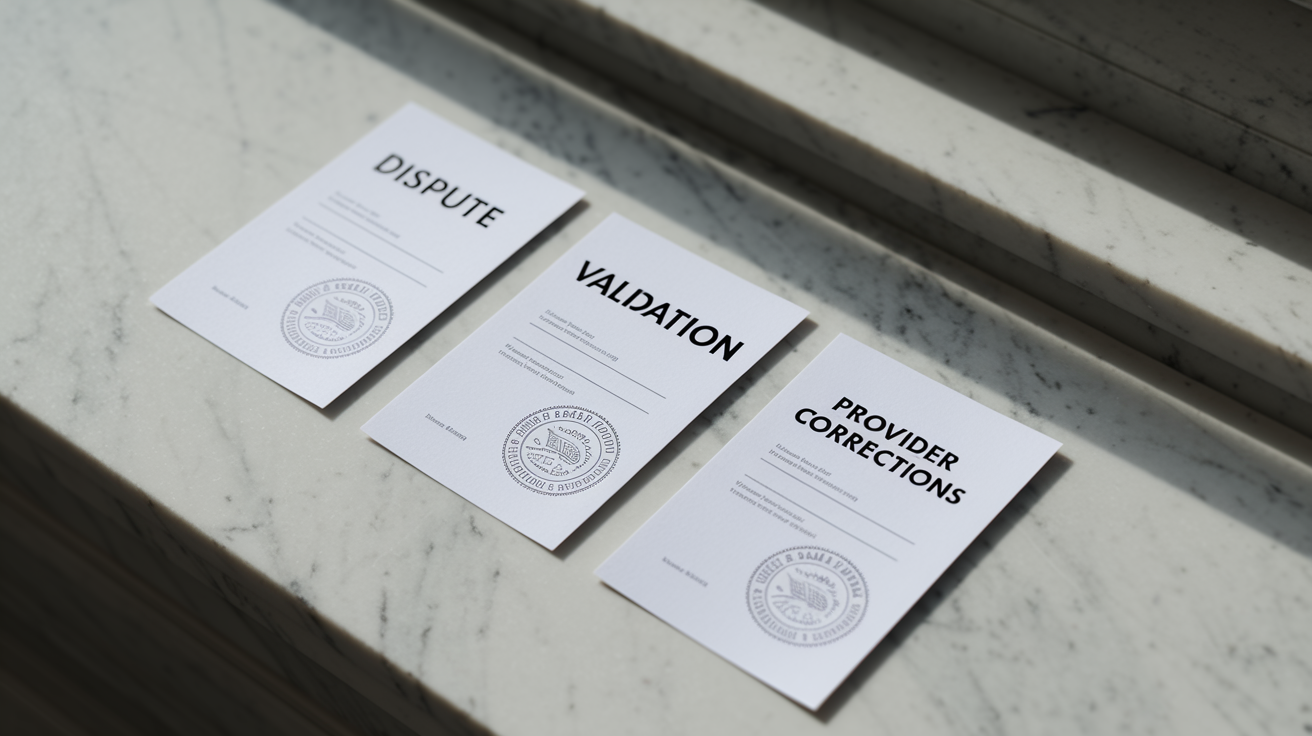
Filing a dispute under the Fair Credit Reporting Act is your primary legal tool. When you dispute an entry, the credit bureau must investigate and either verify the debt or remove it. If the bureau can’t confirm the information within 30 days, the item must come off your report. Always include your report number or consumer identification number when you dispute, along with copies of documents that prove the entry is wrong.
Debt validation is a separate right under the Fair Debt Collection Practices Act. After a collector contacts you for the first time, you’ve got 30 days to request validation. Send a letter asking for an itemized bill, the original creditor’s name, proof that the collector owns or is authorized to collect the debt, and confirmation of the amount owed. The collector must pause collection activity until they send you verification. If they can’t validate, they’re not allowed to report the debt to the credit bureaus.
Provider corrections are often the fastest route when the problem started with hospital billing. If your insurance paid the bill, ask your insurer for a letter confirming payment and send it to both the hospital and the credit bureaus. If the hospital made a billing error, ask the billing department to issue a corrected statement and notify the collection agency and the bureaus. Get reference numbers and the names of everyone you speak with.
Documentation Needed to Support a Medical Debt Dispute
You’ll need an itemized bill from the provider showing every charge, procedure code, and date of service. Request it under HIPAA if the provider won’t send it voluntarily. They must respond within 30 days. Collect your explanation of benefits statements from your insurance company, which show what the insurer paid, what they denied, and what you’re responsible for. If you paid the bill, include bank statements, canceled checks, credit card receipts, or payment confirmations from the provider’s billing portal. If the debt stems from identity theft, file a report at IdentityTheft.gov and attach a copy to your dispute. Include a copy of your ID if the bureau requests it. Always keep your original documents.
Negotiating Medical Collections: Pay-for-Delete, Goodwill Requests, and Provider Relief

Pay-for-delete means the collector or provider agrees in writing to remove the collection from your credit report after you pay. It’s legal but not guaranteed. Some collectors refuse. Some will agree only if you pay in full. Never pay first and hope they’ll delete later. Get the agreement in writing before you send money, and confirm it says the account will be deleted from all three credit bureaus, not just marked as paid.
Goodwill deletion requests work best after you’ve already paid. Write a letter to the original provider or the collection agency explaining why you fell behind. For example, a one-time medical emergency, job loss, or insurance delay. Ask them to remove the collection as a courtesy. Mention your otherwise solid payment history if that’s true. Goodwill deletions are discretionary. You might get a yes, you might get ignored. Always send your request in writing and keep a copy.
If you haven’t paid yet and the bill is large, ask the hospital billing department about financial assistance or charity care before the account goes to collections. Many hospitals have programs for low-income patients or people facing hardship. If you qualify, the hospital may forgive part or all of the bill and tell the collection agency to stop reporting. Get any settlement, payment plan, or forgiveness agreement in writing.
Use these six tactics when negotiating:
- Request a written pay-for-delete or settlement agreement before you make any payment
- Send a hardship letter with documentation like pay stubs, termination notices, or medical bills to support your case
- Ask the provider to resubmit the claim to your insurer if the bill resulted from a processing error
- Negotiate a reduced balance and specify in writing that payment satisfies the debt in full
- If the collector agrees to delete, confirm the deletion timeline and get a reference number
- Follow up 30 to 45 days after payment to verify the collection was removed from all three reports
Legal Limits, Statute of Limitations, and When Medical Debt Cannot Be Removed

The statute of limitations on medical debt is the deadline for a creditor or collector to sue you in court. It varies by state, typically ranging from 3 to 6 years, though some states allow up to 10. Once the statute expires, the collector can’t win a lawsuit. But the debt doesn’t disappear and the collection can still sit on your credit report until the 7-year reporting period ends. Statute of limitations and credit reporting timelines are separate.
If a collector sues you and wins a judgment, that judgment can appear on your credit report for 7 years from the filing date. Wage garnishment or bank levies may follow in states that allow them for medical debt. A judgment is harder to remove because it’s a public record verified by the court. You can sometimes negotiate to vacate a judgment as part of a settlement, but you’ll need the agreement in writing and a court order.
Accurate, verified medical debt that you still owe and that’s above $500 and older than one year usually can’t be removed unless you negotiate deletion or prove it’s being reported incorrectly. If the debt is legitimate, the bureaus and the collector have the right to report it. In that case, your options are to pay it and request deletion, settle for less and get deletion in writing, or wait for the 7-year clock to run out. Consult a consumer credit attorney if a collector is suing you, if wage garnishment has started, or if you believe your rights under the FCRA or FDCPA have been violated.
Avoiding Scams When Trying to Remove Medical Debt From Your Credit Report

The Credit Repair Organizations Act makes it illegal for any company to charge you before they’ve completed the services they promised. If a firm demands a large upfront fee and guarantees they’ll remove accurate negative items from your credit report, walk away. No one can legally promise to delete information that’s correct and verifiable. And you can dispute errors yourself for free.
Legitimate credit repair might help you organize disputes, draft letters, or track responses. But those tasks don’t require hundreds or thousands of dollars. Most people succeed by following the dispute process on their own, using their rights under the FCRA and FDCPA. If you do hire help, choose a licensed professional, pay only after work is done, and avoid any company that advises you to lie, create a new identity, or stop communicating with creditors.
Watch for these five red flags:
- Company demands payment before doing any work
- Guarantees removal of all negative items, even accurate collections
- Tells you to dispute everything on your report without reviewing it first
- Advises you to create a new credit identity using an Employer Identification Number
- Pressures you to sign a contract immediately or refuses to explain their process in writing
Preventing Future Medical Debt From Hitting Your Credit Report

Most medical collections happen because of insurance delays, billing errors, or out-of-network surprise bills. Not because patients refuse to pay. Follow up with your insurance company after every medical visit to confirm the claim was received and processed. If a claim is denied, ask why and appeal if the denial seems wrong. Many insurers reverse denials on appeal.
Review every medical bill for errors before you pay. Hospitals and providers make mistakes. Look for duplicate charges, services you didn’t receive, and incorrect billing codes. If something looks wrong, call the billing department, get an itemized statement, and compare it to your explanation of benefits. The No Surprises Act, effective January 2022, protects you from most surprise out-of-network bills for emergency care and certain non-emergency services. So if you get an unexpected balance bill, dispute it and cite the law.
Five practices that keep medical bills off your credit report:
- Set up payment plans directly with the provider before the account goes to collections
- Confirm your insurance claim status within 30 days of every appointment or procedure
- Ask about financial assistance or charity care programs if you can’t afford the bill
- Dispute billing errors immediately and request corrected statements in writing
- Keep copies of all EOBs, receipts, and correspondence in a dedicated file for at least 7 years
Final Words
Start by checking your credit reports. Paid medical collections and balances under $500 should already be removed. Bureaus wait one year before reporting and unpaid collections can stay up to seven years.
If an item still appears, dispute it, request validation, or ask the provider to correct it. Gather EOBs, bills, and proof of payment. Get any agreement in writing.
So, can medical debt be removed from credit report? Yes, often it can, depending on payment, amount, accuracy, and timing. Pull your reports this week and pick one medical item to dispute or fix.
FAQ
Q: How do I get medical debt off my credit report?
A: To get medical debt off your credit report, dispute inaccuracies with the bureaus, show insurance or payment proof, request debt validation, negotiate pay-for-delete or goodwill deletions, or file a CFPB/state complaint.
Q: What is the 777 rule with debt collectors?
A: The 777 rule with debt collectors is not a formal law; it’s an informal phrase people use. The real consumer right is the FDCPA’s 30 days to request debt validation after first collector contact.
Q: Does medical debt in collections ever go away?
A: Medical debt in collections can go away: paid collections must be removed, unpaid balances under $500 were removed starting April 2023, and accurate unpaid collections generally fall off after seven years from the original delinquency.
Q: Which states ban medical debt on credit reports?
A: No states fully ban medical debt from credit reports; some states and local programs limit reporting or offer stronger consumer protections—check your state attorney general or the CFPB for rules that apply where you live.