


How many points does a late payment cost your credit score?
Short answer, it depends, and the difference can be huge.
A single 30-day late can shave anywhere from about 50 to 160 points depending on your starting score, the account type, and how long you stay past due.
Higher, cleaner scores usually get hit harder.
This post breaks down the typical point drops for 30, 60, and 90-day delinquencies, why some files fall more than others, and the exact steps to limit and repair the damage.
Credit Score Point Loss From a Late Payment Explained Clearly

A single late payment reported to the bureaus usually drops your score somewhere between 50 and 120 points. But that’s a wide range, and the actual damage depends on where you started, what your overall credit looks like, and exactly how late the payment is. FICO’s published examples show what a 30-day late payment on a mortgage can do. If you’re sitting at 670, you might fall to around 520 or 530. That’s a 140 to 150 point crash. A 720 score? You’re looking at a drop to about 580 or 590, losing roughly 130 to 140 points. And if you’ve got a 780, you could sink to around 620. That’s 160 points gone.
Higher scores get hit harder. When you’ve got clean credit, a late payment breaks the pattern completely. Lower scores already carry negative marks, so one more doesn’t move the needle as much. The severity matters too. A 90-day late payment can wreck your credit almost as badly as bankruptcy. It’s one of the most destructive things that can show up on your report.
Here’s what the point drops usually look like based on FICO’s data and published research:
- Someone with a 780+ score and a first 30-day late payment often loses about 90 to 160 points, depending on what type of account it is and which scoring model gets used.
- A 720 score typically drops around 60 to 140 points after a single 30-day late.
- A 670 score might lose about 50 to 150 points following a 30-day late on something big like a mortgage.
- Scores below 600 with existing problems usually see smaller drops, often around 10 to 40 points, because the file already shows payment trouble.
- A recent late on a clean 780+ score can trigger a 90 to 150 point drop, while a second late on an already damaged file might only cause another 60 to 80 points of damage.
Late payments don’t work the same across every credit file. Severity, how recent it is, the account type, your existing history…all of that shapes the final number. The same 30-day late that destroys an excellent score barely touches a profile already loaded with delinquencies.
How Payment History and Scoring Models Influence Late Payment Damage

Payment history makes up about 35 percent of your FICO score. It’s the biggest single factor. Both FICO and VantageScore treat on-time payments as the most reliable sign you’ll pay back future debts, so even one missed payment downgrades your risk profile immediately. About 90 percent of top lenders use FICO scores when they’re evaluating loans, which means FICO’s treatment of late payments drives most credit decisions in the U.S.
Clean files take harder hits for a pretty straightforward reason. Scoring models compare each new piece of information against what’s already there. When you’ve got zero late payments on file, a single 30-day late is a statistical outlier. It signals a fundamental change in behavior. Algorithms see that outlier as increased risk and cut your score sharply to reflect the new uncertainty about whether you’ll repay future debts. When you already have a few late payments on record, one more just confirms an established pattern instead of introducing new risk. So the incremental point loss is smaller.
Account type influences the damage too. Late payments on mortgages and auto loans often cause bigger score drops than a missed credit card payment. Lenders view installment accounts as more predictive of overall financial discipline. Late payments stick around on your report for up to seven years from the date of the original delinquency. The impact fades over time, but the visible negative mark keeps shaping lender perceptions for that entire period.
Days Late Breakdown: 30, 60, and 90-Day Late Payment Credit Effects
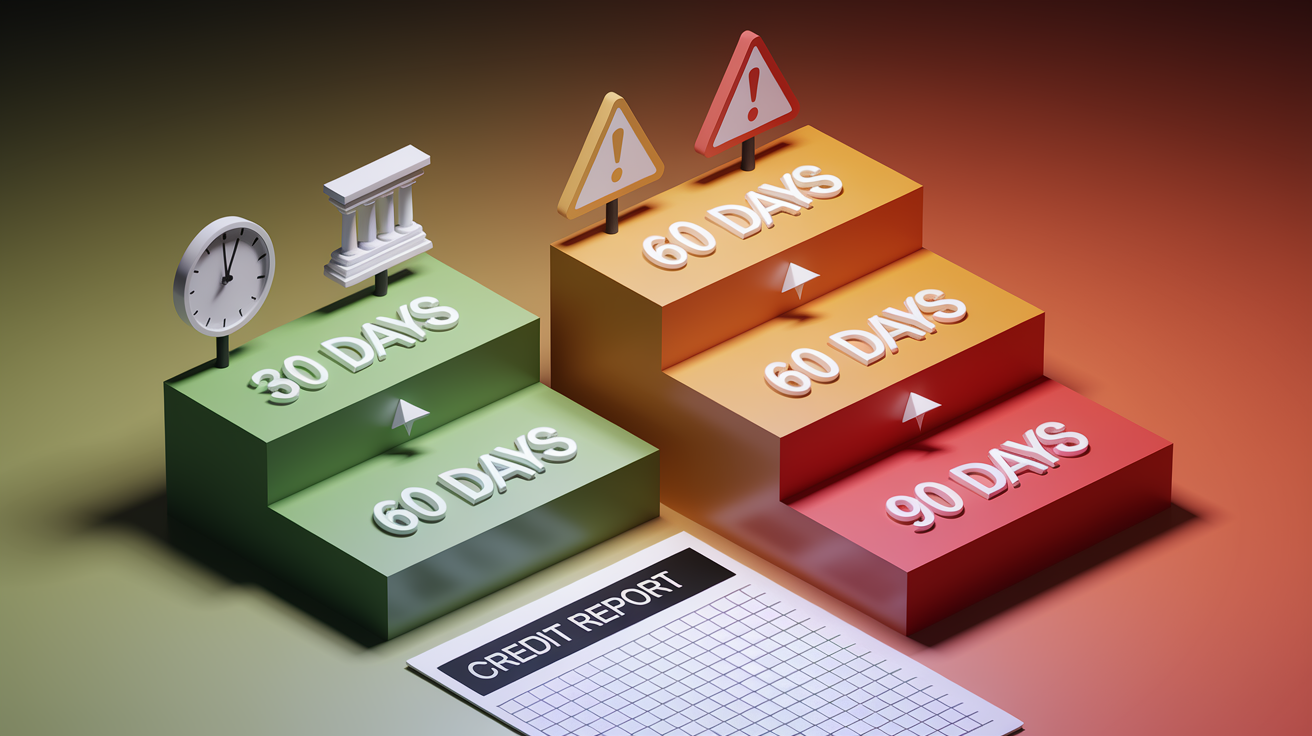
Most lenders won’t report a missed payment to the bureaus until it hits 30 days past the due date. But once it crosses that threshold, the damage starts right away. Each additional stage of delinquency cranks up the severity, not just because the number of days grows, but because the likelihood of default rises sharply as accounts age into deeper trouble.
30 Days Late
A 30-day late payment is the first level of delinquency that shows up on your report. Lenders see it as a warning sign. A single failure to meet the agreed payment schedule. The score drop at this stage is significant, commonly ranging from 50 to 160 points depending on your starting score and history. Creditors might also hit you with late fees and penalty interest rates even if you pay before the 30-day reporting threshold.
60 Days Late
A 60-day late signals worsening trouble and substantially greater risk. Scoring models treat this as evidence that the missed payment wasn’t a one-time oversight. It’s part of a pattern of financial distress. The score damage goes beyond what a 30-day late causes, and lenders start viewing your account as a higher default risk. Many creditors escalate collection efforts at this stage.
90 Days or More Late
A 90-day or longer late payment is a severe delinquency. It can cause credit damage nearly equivalent to filing for bankruptcy. At this point, lenders often write off the debt internally or transfer the account to collections. Both of those add additional negative marks to your file. The combined effect of a 90-plus-day late can reduce a high score by more than 150 points and push a borderline score deep into subprime territory. You’ll have severely limited access to new credit, and the cost of any credit you can still get shoots up.
| Days Late | Typical Impact Range | Notes |
|---|---|---|
| 30 Days | 50–160 points | First reporting threshold; significant damage, especially for high scores. |
| 60 Days | Larger than 30-day impact | Escalating risk signal; collections efforts often intensify. |
| 90+ Days | Severe, comparable to bankruptcy | May lead to charge-off or collections; long-lasting harm. |
How Long Late Payments Stay on Your Credit Report and Affect Your Score

Late payments stick around on your report for seven years from the date of the original missed payment. Doesn’t matter if you eventually bring the account current or pay the balance in full. The seven-year clock starts on the date you first missed the payment, not the date it got reported or the date you caught up. If a 30-day late escalates to 60 or 90 days, the entire delinquency series still falls off seven years after that original missed-payment date.
The damage is worst in the first one to two years after it appears. During that window, lenders view the delinquency as recent and relevant to your current financial behavior. As time passes and you make consistent on-time payments, the late payment’s weight in scoring calculations gradually shrinks. But the negative mark doesn’t disappear from your report until it ages off after seven years. Even a fading late payment still signals past risk to potential lenders who are manually reviewing your file.
Repeated late payments extend the visible negative pattern and reset the clock on how lenders see your reliability. If you’ve got a 30-day late from two years ago and then add a new 30-day late today, your profile now shows an active problem instead of a single old mistake. Scoring models and underwriters read multiple late payments as evidence of ongoing financial instability. That keeps your score down and limits access to favorable loan terms even as older delinquencies start to fade.
Why Starting Score, Credit History, and Account Type Change Point Loss

Consumers with higher starting scores lose more points from a single late payment because their credit files reflect consistently responsible behavior. The late payment is a sharp break from that established pattern. Scoring algorithms amplify the damage when an outlier appears in an otherwise clean record. It introduces new uncertainty about future payment behavior. If you start with a 780 score built on years of on-time payments, a 30-day late can drop your score by 90 to 160 points. The model recalculates your risk profile from “very low” to “moderate” in a single update.
Credit history depth shapes how much a late payment hurts. Consumers with short credit histories have fewer data points for scoring models to evaluate, so each new piece of information carries more weight. A late payment on a file with only two years of history moves the score more dramatically than the same late payment on a file with 15 years of mixed positive and negative activity. Older accounts and longer overall history create a buffer that softens the impact of isolated mistakes.
Account type matters because lenders view installment loans (mortgages, auto loans, student loans) as more predictive of overall creditworthiness than revolving credit like credit cards. A 30-day late on a mortgage often causes a larger score drop than a missed credit card payment. Mortgage payment behavior correlates more strongly with serious default risk. Scoring models weight late payments on installment accounts more heavily to reflect that increased predictive value.
The main things that determine how much a late payment will hurt your score:
- Starting score level. Higher scores lose more points because the late payment is a larger break from the existing profile.
- Length and depth of credit history. Shorter, thinner files amplify the impact of new negative information.
- Type of account. Installment loans (mortgage, auto) typically cause larger drops than revolving credit (credit cards).
- Existing negative marks. Profiles with prior late payments or derogatory marks see smaller additional damage from more late payments.
Single vs. Repeated Late Payments: How Much Worse Does It Get?
A single late payment causes immediate, measurable damage. Commonly dropping a score by 50 to 120 points depending on your starting profile. But repeated late payments create compounding harm that goes beyond simple addition of point losses. Each additional late payment reinforces the idea that you can’t or won’t meet payment obligations consistently. Scoring models interpret that as a fundamental shift in creditworthiness rather than an isolated mistake.
The first late payment on a clean file triggers the largest drop because it introduces new risk where none existed before. Subsequent late payments still reduce your score, but the additional damage is often smaller. Your profile already reflects payment problems. If your score is 620 after a first late payment dropped it from 780, a second late payment might cause another 60 to 80 point decline instead of another 160-point hit. But the cumulative effect is severe. Multiple late payments lock you into subprime credit territory, raise the cost of borrowing dramatically, and in many cases disqualify you from new credit entirely until you demonstrate months or years of consistent on-time payments.
How to Recover After a Late Payment and Rebuild Your Credit Score

Bring your past-due account current as soon as you can. The longer a payment stays unpaid, the more severe the delinquency becomes and the larger the score damage. If you can pay before the account reaches 30 days past due, many creditors won’t report the late payment to the bureaus. That prevents the score drop entirely. Even if the payment’s already been reported, catching up immediately stops the account from escalating to 60 or 90 days late. That limits further damage.
After bringing the account current, contact your creditor to request a goodwill adjustment. Some lenders will remove a single late payment from your report if you’ve got an otherwise strong payment history and can explain the circumstances that led to the missed payment. Not all creditors offer this, but a polite letter or phone call costs nothing and can sometimes get the negative mark erased. At the same time, review your credit reports from all three major bureaus to spot and dispute any errors. If a late payment got reported incorrectly or appears on your report past the seven-year limit, filing a dispute can remove it and restore lost points.
Focus on building positive payment history to offset the late payment’s impact. Scoring models give the most weight to recent activity, so making every payment on time for the next 12 to 24 months will gradually restore your score as the late payment ages and its influence fades. Keep your credit use below 30 percent of your available credit limits. Don’t close old accounts even if you don’t use them regularly. Length of credit history helps stabilize your score. If you’re struggling with multiple debts, consider working with a non-profit credit counseling agency to set up a Debt Management Plan. That can consolidate payments and sometimes reduce interest rates without the severe credit damage of debt settlement or bankruptcy.
Key steps to recover and rebuild your credit score after a late payment:
- Pay the missed amount as soon as possible to prevent the delinquency from escalating to 60 or 90 days late.
- Contact your lender to request a goodwill adjustment or ask that the late payment not be reported if you’ve got a strong history with them.
- Dispute any errors on your credit reports with the three major credit bureaus to remove inaccurate late payment marks.
- Keep credit card balances below 30 percent of your total credit limits to support score recovery.
- Keep older credit accounts open to preserve the length of your credit history, even if you don’t use them actively.
- Make every payment on time going forward. Consistent on-time payments are the most effective way to rebuild your score over months and years.
Final Words
Know this: a single late payment commonly trims a FICO score by about 50–160 points, with larger drops for 60/90+ day delinquencies and for higher starting scores.
We covered why payment history and account type matter, how late marks stay on your report for seven years, and simple recovery steps: pay past due, request goodwill, lower utilization, and keep making on-time payments.
If you’re asking how many points does a late payment affect credit score, use those ranges to plan next steps. You can rebuild this over time with consistent on-time payments.
FAQ
Q: How much will my credit score drop with a late payment?
A: A late payment will typically lower your score roughly 50–120 points; higher starting scores can fall 120–160 points. Longer delinquencies (60–90+ days) cause bigger, more lasting drops.
Q: How to raise your credit score 200 points in 30 days?
A: Raising your credit score 200 points in 30 days is unlikely. Focus instead: fix reporting errors, pay down balances heavily, bring accounts current, and ask creditors for goodwill or limit increases.
Q: Can you have a 700 credit score with missed payments?
A: You can have a 700 credit score with missed payments if those delinquencies are old or isolated. Recent 30–90 day lates or repeated misses usually push scores below 700.
Q: How rare is an 830 credit score?
A: An 830 credit score is rare. Scores above 800 belong to a small share of consumers and signal excellent credit: long clean history, low balances, and consistent on‑time payments.