


Is it smart to let HSA money sit as cash while the market climbs? It depends on when you’ll need the funds. Keep enough cash to cover your deductible plus predictable medical costs for the next 6 to 12 months so you won’t be forced to sell investments at a bad time. Invest any clear surplus for long-term tax-free growth. In short, if you expect expenses within a year keep cash. If you don’t and your balance exceeds your buffer, invest the rest.
Clear Criteria for Deciding When to Invest HSA Funds vs Keep Cash

The choice between keeping your HSA in cash or investing it comes down to one question: when do you need the money? If you’re paying for prescriptions, doctor visits, or physical therapy every month, you need cash you can spend today. If your medical expenses are low and you’re building the account for future healthcare costs, investing the balance gives you tax-free growth that cash can’t match.
Timing matters because invested funds aren’t instantly available. Selling stocks or mutual funds inside your HSA usually takes a few business days to convert back to spendable cash. That delay is fine when you’re planning years ahead, but it’s a problem if you need to pay a bill this week. Your cash buffer should cover your deductible plus any predictable medical spending over the next 6 to 12 months. If your deductible is $2,000 and you expect another $1,500 in routine care this year, keep at least $3,500 in cash and consider investing the rest.
The case for investing gets stronger as your balance grows beyond immediate needs. If you’re healthy, rarely hit your deductible, and your HSA balance sits above $5,000, the surplus is a candidate for long-term growth. Many HSA administrators require a minimum balance before you can invest, commonly $1,000 to $2,000, so small accounts should stay liquid until you cross that threshold and still retain a working cash cushion.
Decision factors that determine your cash versus investment split:
Age and time horizon. Younger account holders with decades until retirement can tolerate more market volatility and benefit from compounding.
Stability of health conditions. Chronic conditions or scheduled treatments mean you need predictable cash access.
Risk tolerance. If market swings would cause you to panic sell at a loss, keep more in cash.
Predictability of medical expenses. Recurring prescriptions and therapy sessions require steady liquidity. Sporadic care allows longer investment horizons.
Income stability. If your income is variable or at risk, a larger HSA cash reserve acts as a medical emergency buffer.
Investment time horizon. Funds you won’t need for five to ten years can ride out market downturns.
Comfort with settlement delays. If waiting three to five days for cash after selling investments feels risky given your health, prioritize liquidity.
Understanding HSA Cash vs Investment Options for Smart Decision-Making

A cash HSA holds your balance in a savings account or money market fund. You access it immediately with a debit card, checks, or online bill pay, just like a checking account. Cash HSAs earn minimal interest, typically well under 1%, and carry almost no volatility. They’re built for paying this month’s medical bills without any delay or risk of loss. An investment HSA puts some or all of your balance into stocks, bonds, mutual funds, or target date funds, similar to a 401(k). Invested accounts offer the potential for long-term growth through compounding, but they also expose you to market swings and require selling shares to free up cash, a process that can take a few business days.
Both account types share the same tax rules. Contributions are pre-tax or tax-deductible, growth is tax-free, and withdrawals for qualified medical expenses come out tax-free at any age. That triple tax advantage makes HSAs powerful whether you keep cash or invest, but investing amplifies the benefit because your returns compound without being taxed. Non-qualified withdrawals before age 65 trigger income tax plus a 20% penalty. After 65, non-medical withdrawals are taxed as ordinary income but avoid the penalty, which makes an HSA function like a traditional IRA for non-healthcare spending in retirement. The rollover feature means unused funds carry forward year after year, so HSAs work as long-term savings vehicles, not just annual spending accounts.
Key operational differences between cash and investment HSAs:
Immediate liquidity. Cash HSAs let you pay providers instantly. Investment HSAs require selling assets first.
Settlement time. Moving money from investments to spendable cash typically takes two to five business days.
Volatility. Cash balances stay stable. Investment balances fluctuate with the market and can drop in the short term.
Consolidated Cash Buffer Rules and Investment Threshold Guidelines

Most HSA custodians set a minimum balance you must keep in cash before you’re allowed to invest. Common thresholds range from $1,000 to $2,000, though some providers permit investing from dollar one and others require $5,000. Check your administrator’s rules before moving money. Once you meet the minimum, a practical cash buffer is $1,000 to $3,000 or an amount equal to your annual deductible plus expected out-of-pocket costs over the next 12 months. If your plan’s deductible is $1,500 and you anticipate $800 in routine care, keep around $2,300 in cash and invest the surplus. This buffer protects you from needing to sell investments on short notice and shields you from market timing risk when you have an urgent expense.
Small balances should stay entirely in cash. If your HSA holds less than $1,000, investment fees and custodial charges can erode gains, and you’ll likely need the money soon anyway. Accounts between $1,000 and $3,000 should cover your deductible and expected annual costs in cash first, then invest only the remainder. As your balance grows past $3,000, you can afford to invest a larger share because your cash buffer is already adequate for routine needs. Once your HSA exceeds $10,000, consider investing most of the balance while maintaining a 6 to 12 month medical expense reserve in cash. At this tier, the account functions more like a healthcare retirement fund than a checking account.
Upcoming medical procedures change the math. If you’re scheduled for surgery in three months that will cost $4,000 out of pocket, keep that $4,000 in cash even if your total balance is $15,000. The risk of a market downturn forcing you to sell at a loss right before you need the money outweighs any potential short-term gain. Similarly, if you have a chronic condition with unpredictable flare-ups, keep a larger cash cushion than someone with stable, low medical spending. Remember to maintain a separate emergency fund of 3 to 6 months of living expenses outside your HSA for non-medical emergencies like job loss or car repairs.
| Balance Range | Recommended Action | Rationale |
|---|---|---|
| Under $1,000 | Keep 100% in cash | Fees erode small balances; funds likely needed soon; may not meet custodian minimums |
| $1,000–$3,000 | Hold cash equal to deductible + 12 months expected costs; invest remainder | Covers immediate needs; begins capturing growth on surplus without excessive risk |
| $3,000–$10,000 | Maintain cash buffer for annual medical costs; invest excess | Adequate liquidity cushion; enough surplus to benefit from long-term compounding |
| Above $10,000 | Invest most; keep 6–12 month medical reserve in cash | Account transitions to long-term healthcare savings; growth outweighs need for full liquidity |
Comparing Potential Returns: Cash Savings vs Long-Term HSA Investment Growth

Cash held in an HSA earns interest like a savings account, and those rates are low. In recent years, HSA cash interest has ranged from 0.07% to 2.00% depending on your custodian and the Federal Reserve’s rate environment. On a $25,000 balance, 0.07% annual interest pays you $17.50 a year. At 2.00%, the same balance earns $500 annually. Over ten years at 2.00%, assuming the rate holds steady, you’d accumulate roughly $5,000 in interest. That’s real money, but it doesn’t keep pace with inflation or healthcare cost growth, and it leaves a lot of potential on the table.
Investing that same $25,000 inside your HSA exposes you to market risk, but it also taps into historical equity returns. The stock market has averaged around 10% annually over the long term, though any given year can swing higher or lower. If your HSA investments returned 10% per year for a decade, your $25,000 could grow to approximately $65,000. That’s more than 2.5 times your starting balance, and because it’s inside an HSA, every dollar of that growth is tax-free when used for qualified medical expenses. The difference between $5,000 in interest and $40,000 in market gains is the opportunity cost of holding cash when you don’t need immediate liquidity.
| Scenario | Annual Return | 10-Year Outcome on $25,000 |
|---|---|---|
| Low-yield HSA cash | 0.07% | ≈ $25,175 |
| High-yield HSA cash | 2.00% | ≈ $30,000 |
| Stock market investment (historical average) | 10.00% | ≈ $65,000 |
These numbers assume steady contributions or a static balance and ignore fees, which means real world results will vary. Market returns aren’t guaranteed, and you can lose money in any given year. But if your time horizon is a decade or more and you can tolerate short-term volatility, the growth potential of investing usually justifies the risk. The key is matching your investment strategy to your liquidity needs so a bad market year doesn’t force you to sell at a loss right when you need cash for care.
Implementation Steps for Investing HSA Funds the Right Way
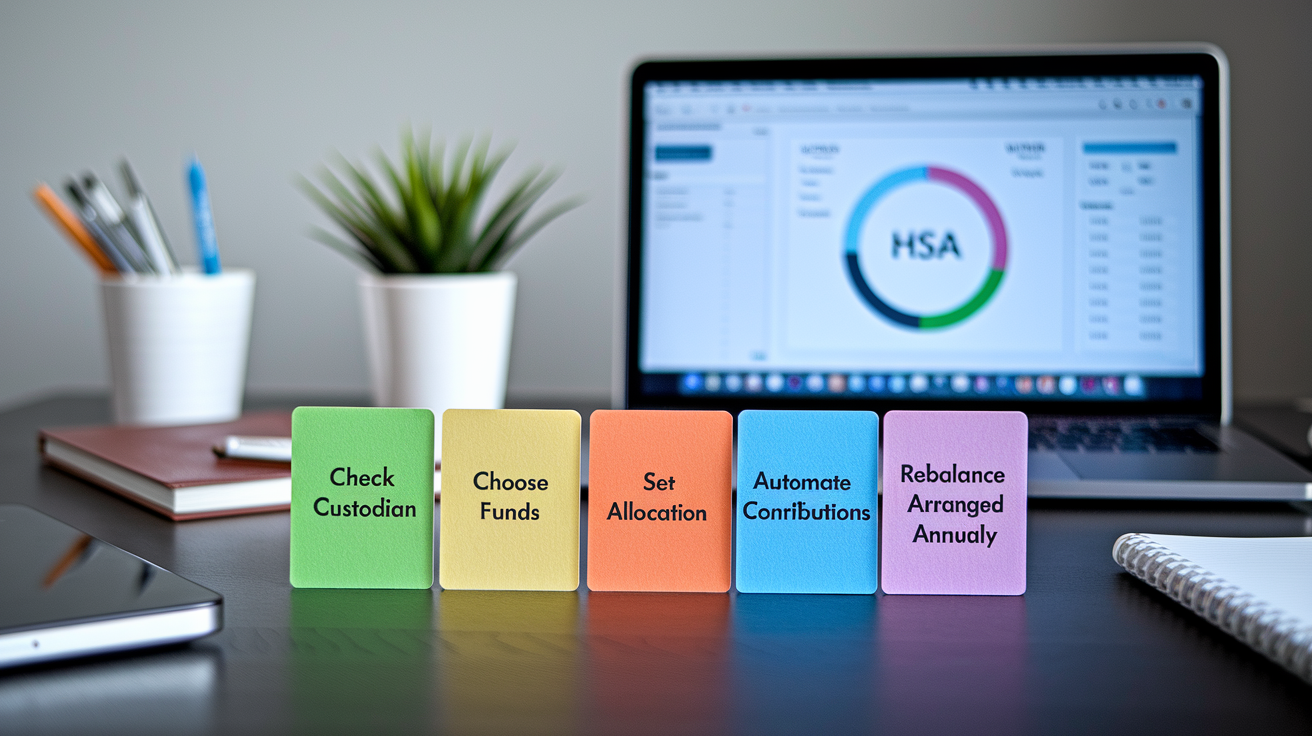
Start by confirming your HSA administrator’s investment options and requirements. Log in to your account or call customer service to find out the minimum balance required to invest, the available fund lineup, and any fees or transaction costs. Some custodians offer a handful of index funds and target date portfolios. Others provide access to a full brokerage menu. Look for low-cost index funds with expense ratios below 0.20% when possible. Higher fees eat into returns, and inside an HSA where growth compounds tax-free, keeping costs low matters even more than in a taxable account.
Your investment allocation should reflect your age, risk tolerance, and time horizon. If you’re in your 20s or 30s with decades until you’ll need the money for healthcare, a growth focused allocation of 80% to 100% stocks makes sense. You have time to ride out market downturns and benefit from long-term equity returns. If you’re approaching retirement or expect major medical expenses in the next five years, shift toward a conservative mix with more bonds and cash equivalent funds. A balanced portfolio of 50% stocks and 50% bonds reduces volatility and protects your principal when you’re close to needing the funds. Many HSA providers offer target date funds or managed portfolios that automatically adjust the allocation as you age, which simplifies the decision if you’re not comfortable picking individual funds.
Dollar cost averaging is a useful technique when you’re moving a large lump sum from cash into investments. Instead of investing $10,000 all at once, transfer $2,000 per month over five months. This spreads your entry points across different market prices and reduces the risk of buying right before a downturn. Once your allocation is set, automate future contributions so new HSA deposits flow into your chosen funds without manual intervention. Rebalance your portfolio once a year or whenever your allocation drifts more than 5 percentage points from your target to maintain your intended risk level.
Five step process to start investing your HSA:
Check custodian minimums and fees. Confirm the required cash balance, investment platform, and any transaction or maintenance charges.
Choose low-cost funds. Select index funds, ETFs, or target date portfolios with expense ratios under 0.20% if available.
Set your allocation. Match stock to bond ratio to your age, risk tolerance, and time horizon. Aggressive for long horizons, conservative for near-term needs.
Automate contributions and transfers. Direct new HSA deposits into investments and use dollar cost averaging for large initial transfers.
Rebalance annually and keep receipts. Adjust allocation once per year and save documentation for all qualified medical expenses to preserve tax-free withdrawal status.
Situational Scenarios Showing When to Keep HSA Cash vs Invest It

Young, healthy low-spend individual
If you’re 28, rarely visit the doctor, and your annual out of pocket medical costs are under $500, your HSA is a long-term savings tool more than a spending account. Keep enough cash to cover your deductible, say $1,500, and invest the rest. With a $6,000 balance, that means $1,500 stays liquid and $4,500 goes into a stock heavy allocation. You won’t touch this money for decades, so short-term market swings don’t matter. Every year you contribute the maximum and invest the surplus, you’re building a tax-free healthcare fund that can grow to six figures by retirement. If an unexpected medical expense does come up, you can pay out of pocket with your regular checking account, keep the receipt, and reimburse yourself from the HSA years later when you need the cash for something else. This strategy keeps your HSA invested and growing while you retain full flexibility.
Family with ongoing medical expenses
A family of four with two kids in braces, regular allergy shots, and a parent managing a chronic condition will spend $4,000 to $6,000 a year on healthcare. That’s predictable, recurring spending, which means liquidity is essential. Keep 12 to 18 months of expected medical costs in HSA cash, around $6,000 to $9,000, so you’re never forced to sell investments to pay for routine care. If your HSA balance is $12,000, invest only $3,000 to $6,000, the portion you won’t need in the near term. This approach gives you a cash cushion for the expected while still capturing some growth on the surplus. As your kids age out of braces and your medical spending drops, you can shift more of the balance into investments. The priority here is avoiding the stress and transaction costs of constantly moving money between cash and investments every time a bill arrives.
Near-term surgery or chronic condition scenario
If you’re scheduled for knee surgery in four months with an estimated out of pocket cost of $5,000, keep that $5,000 in cash even if your total HSA balance is $15,000. The risk of a market correction right before your surgery date isn’t worth a few months of potential gains. Once the surgery is paid and recovery is complete, reassess your cash needs and move the surplus back into investments. Similarly, if you have a condition like diabetes that requires ongoing prescriptions, regular monitoring, and occasional emergency care, keep a larger than average cash buffer, 12 to 24 months of expected costs. The unpredictability of flare-ups and emergency visits means you need reliable access to funds without worrying about settlement delays or selling at a loss during a market downturn. In these situations, the value of liquidity and peace of mind outweighs the opportunity cost of lower returns on cash.
Final Words
Decide by matching liquidity to how predictable your medical costs are. Keep cash for near-term needs. Invest surplus for long-term tax-free growth.
Use a cash buffer equal to your deductible or 1-3 months of expected care, watch custodian minimums like 500-2,000, and allow a few days for settlements. Then move excess into low-cost index funds.
A simple rule is keep cash for known short-term needs and invest the rest. That’s when to invest hsa funds vs save cash. Do one small step this week, like setting an automatic transfer, and you’ll be more in control.
FAQ
Q: Is it better to use HSA money or save it?
A: Whether it’s better to use HSA money or save it depends on expected medical costs and cash needs; use HSA cash for predictable near-term bills and save or invest excess for tax-free long-term growth.
Q: When should you invest your HSA money?
A: You should invest HSA money when you have a stable cash buffer for near-term medical costs, low current healthcare spending, meet your custodian’s minimum, and plan to hold investments for several years.
Q: What does Dave Ramsey say about HSA?
A: Dave Ramsey says HSAs are useful for tax-advantaged medical savings but he typically advises building an emergency fund and paying high-interest debt before investing HSA funds.
Q: What is the loophole for HSA investments?
A: The HSA “loophole” involves paying qualified medical expenses out of pocket, investing HSA funds, and later reimbursing yourself tax-free by keeping receipts, letting the invested money grow tax-free meanwhile.