


Think keeping your credit card balance at zero is the best move?
It’s not that simple.
A good credit utilization ratio is under 30 percent, but if you want your score to shine aim for single digits, under 10 percent.
Zero percent can actually look worse than a small reported balance because lenders want to see you use and manage credit.
In this post you’ll learn how utilization is calculated, why single digits beat 30 percent, and exact steps you can take before your statement closes to lower the number lenders see.
Defining and Identifying a Good Credit Utilization Ratio

Anything below 30 percent counts as good credit utilization. But if you really want your score to shine, go for single digits. Under 10 percent is where people with the highest credit scores tend to live. That 30 percent rule gets thrown around constantly because it’s where scoring models start paying closer attention, but lower always beats higher. A lot of experts push for something closer to 5 or 7 percent if you’re chasing top-tier scores.
Zero percent isn’t the automatic winner, though. Never using your credit cards at all means scoring models can’t see any proof you handle credit responsibly. A reported balance of 1 percent often works better than zero because it shows you’re actually using credit and managing it well. Think of utilization like a signal. You want to prove you can handle credit without depending on it too much. U.S. average overall utilization sat at 29 percent in Q3 2024, right at that recommended threshold. Staying meaningfully below that tells lenders and scoring models you’re not stretched.
Here’s how this plays out in real life. You’ve got one card with a 5,000 limit. If your reported balance is 500, that’s 10 percent utilization. Pretty solid. Drop that balance to 250, and now you’re at 5 percent, even better. Let it climb to 1,500, and you’re at 30 percent, the edge of the safe zone. Push it to 2,500, and you hit 50 percent, which scoring models really don’t like.
Understanding Credit Utilization and How It’s Calculated
Credit utilization only applies to revolving accounts. Credit cards, personal lines of credit, home equity lines. Installment loans like car loans, mortgages, student loans? Those don’t count. If you’re an authorized user on someone else’s card, that account usually shows up in your utilization calculation too. Even closed revolving accounts with outstanding balances still count until you’ve paid them off.
The formula’s simple. Add up all your revolving balances, add up all your revolving credit limits, divide the first number by the second, multiply by 100 to get a percentage. Say you’ve got two credit cards. One has a 3,000 limit and a 600 balance, the other has a 2,000 limit and a 400 balance. Total balance is 1,000, total limit is 5,000, so 1,000 divided by 5,000 equals 0.20. Times 100 gives you 20 percent utilization. Scoring models look at both your overall utilization and the utilization on each individual card. One maxed-out card can hurt your score even if your overall number looks fine.
Common mistakes when calculating:
- Using your current online balance instead of the statement balance. Issuers report the balance at the end of your statement period, not what you see when you log in today.
- Forgetting individual card utilization. One card sitting at 90 percent can drag down your score even if your other cards are barely touched.
- Not counting authorized user accounts. If you’re an authorized user, that card’s balance and limit usually appear on your credit report and mess with your ratio.
- Ignoring closed accounts with balances. A closed revolving account with a remaining balance still counts toward utilization until it’s paid off.
- Mixing up revolving and installment credit. Car loans and mortgages don’t factor into credit utilization. Only revolving accounts do.
How Good Credit Utilization Impacts Credit Scores

Credit utilization is one of the biggest factors in your credit score, making up roughly 20 to 30 percent of the total depending on which model you’re looking at. High utilization tells scoring algorithms you might be overextended or leaning too hard on borrowed money. Lower utilization suggests you’re managing credit comfortably and not living close to your limits. That’s why dropping your utilization from 50 percent to 10 percent can produce a noticeable score jump, sometimes within a single reporting cycle.
Newer scoring models like VantageScore 4.0 and FICO 10 T don’t just look at your most recent reported balances. They also consider trended data, meaning your average utilization and balance patterns over several months. If you’ve been hovering near your limits for a while, those models may weigh that history even after you pay down your balances. Still, most widely used scores rely on the most recently reported numbers, so lowering your utilization can help your score rebound relatively fast.
| Utilization Range | Score Impact | Notes |
|---|---|---|
| 0% | May be slightly worse than 1% | Scoring models prefer to see some responsible usage rather than no usage at all |
| 1–9% | Best for top-tier scores | People with the highest credit scores typically stay in this range |
| 10–29% | Good, generally safe | Still considered healthy; minor negative effect compared to single digits |
| 30–49% | Moderate negative impact | Crosses the commonly cited threshold; scores may drop noticeably |
| 50% and above | Significant negative impact | Signals high credit risk; can lower scores substantially |
Individual Card Utilization vs. Overall Utilization Differences

Scoring models don’t just look at your total utilization across all cards. They also examine how much of each card’s limit you’re using. You could have an overall utilization of 25 percent and still see a score drop if one card is maxed out. For instance, say you’ve got three cards with 5,000 limits each and you owe 5,000 on one card and nothing on the other two. Your overall utilization is about 33 percent (5,000 divided by 15,000). But that one card sitting at 100 percent sends a red flag to scoring models, even though your total number isn’t terrible.
Balancing your usage across cards works better than concentrating all your spending on one. Spread your balances so no single card climbs above 30 percent, and ideally keep each card under 10 percent if you can. That way, both your per-card and overall utilization stay in good shape.
Situations where individual card utilization matters more than overall:
- One card maxed, others barely used. Overall utilization might look fine, but the maxed card alone can hurt your score.
- Uneven balances across cards. Two cards at 50 percent utilization each can be worse than spreading the same total balance evenly across four cards.
- High limit and low limit cards mixed. A low limit card pushed to its max can drag down your score even if your high limit cards have low balances.
- Applying for new credit soon. Lenders may see a single maxed card as a warning sign of financial stress, regardless of your overall ratio.
Payment Timing, Reporting Dates, and Their Influence on Credit Utilization
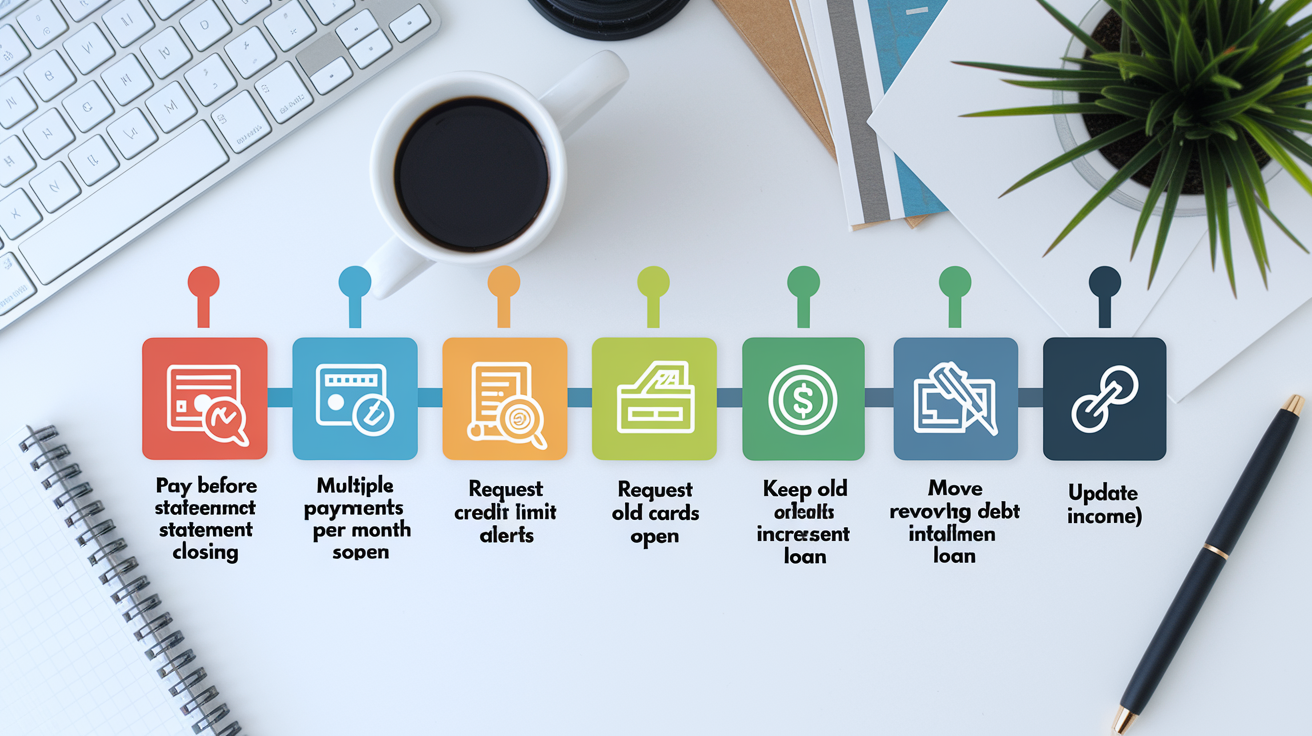
Credit card issuers typically report your balance and credit limit to the credit bureaus around the end of each statement period, not on your payment due date. That reported balance is what shows up on your credit report and what scoring models use to calculate your utilization. If your statement closes on the 15th of the month and your balance that day is 2,000, that’s the number the bureaus see. Even if you pay it off in full by the due date a few weeks later.
This timing detail gives you a way to control what gets reported. If you want a lower reported balance, make a payment before your statement closing date. Say your statement closes on the 20th and you normally carry a 1,500 balance. Pay 1,000 on the 18th, and your reported balance is only 500 instead of 1,500. That can drop your utilization significantly and give your score a quick boost. Making multiple smaller payments throughout the month can also keep your balance low when the statement closes.
High utilization can hurt your score fast, but scores can recover quickly once lower balances are reported. Most scoring models use the most recent data, so if you had 80 percent utilization last month and drop to 10 percent this month, your score may improve within one billing cycle. Trend focused models like VantageScore 4.0 and FICO 10 T do look at patterns over time, so a history of high utilization may linger a bit longer in those scores.
How Reporting Dates Can Change Your Score
Imagine you’ve got a card with a 4,000 limit and you typically spend about 3,000 each month, paying it off after the due date. If your statement closes on the 10th of the month, the issuer reports a 3,000 balance, giving you 75 percent utilization on that card. But if you pay 2,500 on the 9th, one day before the statement closes, the issuer reports only a 500 balance. Your utilization on that card drops to 12.5 percent instead of 75 percent, and your credit score sees that lower number.
Strategies to Lower Credit Utilization Quickly and Safely
Lowering your credit utilization doesn’t require waiting months or taking on new debt. The fastest method is paying down your balances, especially before your statement closing date. If you can’t pay everything off at once, focus on the cards with the highest individual utilization first. Those are likely doing the most damage to your score. Even a partial payment that brings a maxed out card below 50 percent can help.
Making multiple payments each month keeps your reported balance lower. Instead of waiting until the due date, pay weekly or every two weeks. This works especially well if you use your card for everyday spending and pay it off in full each cycle. Your balance stays small throughout the month, so when the statement closes, the reported number is much lower than it would be if you let charges pile up.
Seven ways to lower utilization:
- Pay before the statement closing date. This reduces the balance that gets reported to the bureaus.
- Make multiple payments per month. Weekly or bi-weekly payments keep your running balance low.
- Set utilization alerts. Many issuers let you set alerts when your balance reaches a certain percentage, like 30 percent of your limit.
- Request a credit limit increase. A higher limit with the same balance automatically lowers your utilization percentage. Just know this may trigger a hard inquiry with some issuers.
- Keep old cards open. Closing a card removes its credit limit from your total available credit, which can raise your utilization even if your balances stay the same.
- Move revolving debt to an installment loan. Using a personal loan or home equity loan to pay off credit cards converts revolving debt to installment debt, which doesn’t count toward credit utilization.
- Update your income with your card issuer. A higher reported income can help you qualify for credit limit increases without a hard pull.
Here’s how a credit limit increase affects your ratio. Say you’ve got one card with a 5,000 limit and a 2,000 balance, giving you 40 percent utilization. If your issuer raises your limit to 8,000 and your balance stays at 2,000, your utilization drops to 25 percent instantly. You didn’t pay off a single dollar, but your ratio improved.
How Closing Cards, Opening Cards, and Credit Line Changes Affect Utilization

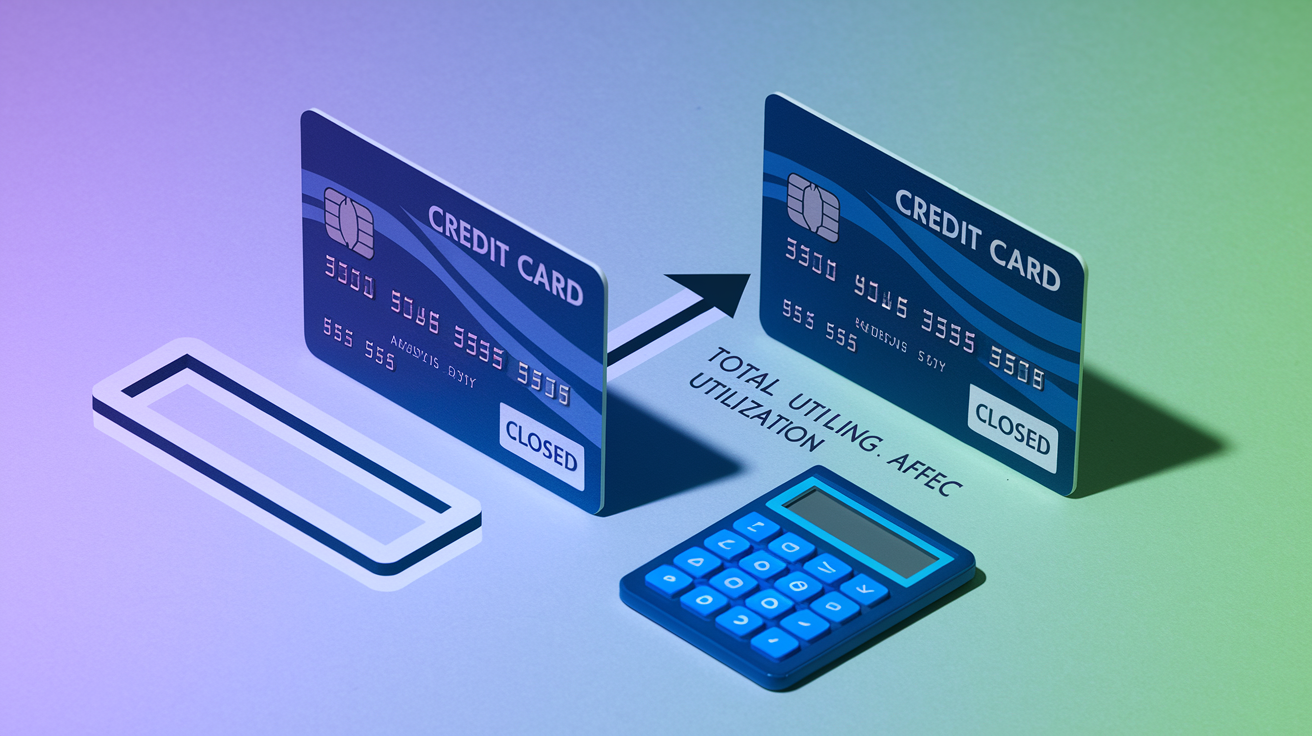
Closing a credit card might seem smart if you’re not using it, but it shrinks your total available credit and can push your utilization ratio higher. If you’ve got two cards with 5,000 limits each and balances of 1,000 on one and zero on the other, your total limit is 10,000 and your utilization is 10 percent. Close the unused card, and your total limit drops to 5,000 while your balance stays at 1,000. Now you’re at 20 percent utilization. Your score may drop even though you didn’t add any new debt.
Opening a new credit card increases your total available credit, which can lower your utilization if your balances stay the same. But be cautious. Opening accounts just to manipulate your utilization can backfire if you’re not careful with spending, and the hard inquiry from the application may ding your score temporarily. Some issuers offer soft pull credit limit increases, meaning they check your credit without a hard inquiry. Those are ideal because you get the benefit of a higher limit without the temporary score hit. Hard pull increases may lower your score slightly for a few months, but the utilization improvement can offset that if the increase is large enough.
Effects of different account changes on utilization:
- Closing a card: Reduces total available credit; raises utilization if balances stay the same; may hurt your score.
- Opening a new card: Increases total available credit; lowers utilization if balances don’t increase; triggers a hard inquiry that may temporarily lower your score.
- Soft pull credit limit increase: Raises your limit without a hard inquiry; immediately lowers utilization with no score penalty.
- Hard pull credit limit increase: Raises your limit but may trigger a temporary score drop from the inquiry; utilization benefit can outweigh the inquiry impact if the increase is significant.
Tools and Monitoring Methods to Track Credit Utilization
(((alt-img8)))
Tracking your credit utilization regularly keeps you ahead of potential score drops and helps you spot problems before they show up on your credit report. Many online calculators let you enter your balances and limits for multiple cards to see both per-card and overall utilization. Some accept up to three cards at once, which covers most people’s active accounts. Plug in your numbers once a month, or whenever you’re planning a big purchase, to see where you stand.
Credit monitoring apps and services often include utilization tracking and can send alerts when your balance approaches a threshold you set, like 30 percent of your limit. Some card issuers also show your current utilization percentage on their dashboards or mobile apps, though remember that the number you see online may not match what gets reported to the bureaus if your statement hasn’t closed yet.
Five types of tools to monitor utilization:
- Credit utilization calculators: Free online tools that compute per-card and overall utilization when you input balances and limits.
- Credit monitoring apps: Services like Credit Karma or those offered by your bank that track utilization and send alerts.
- Card issuer dashboards: Many issuers display your current utilization percentage in your account overview or app.
- Credit bureau reports: Pull your reports from Equifax, Experian, or TransUnion to see the balances and limits currently on file.
- Financial planning tools: Apps like Mint or YNAB that aggregate all your accounts and calculate utilization as part of broader budget tracking.
Final Words
Keep overall credit use under 30%, and aim for single-digit use under 10% when you can—those moves help scores most.
Use the formula (total balance ÷ total limit × 100), watch per-card balances, and pay before the statement closing date. Make multiple small payments, ask for limit increases cautiously, and avoid closing old cards.
Use apps or simple calculators to track. If you do one thing this week—pay down reported balances—you’ll make real progress toward what is a good credit utilization ratio and see your score improve.
FAQ
Q: Is 10% credit utilization better than 30%?
A: The 10% credit utilization is better than 30% because lower utilization usually boosts credit scores; top-tier scores often sit under 10%. Pay before your statement closes or lower balances to aim for single digits.
Q: Will 50% credit utilization hurt me?
A: A 50% credit utilization will hurt your credit score because scoring models view that as high risk; expect a noticeable drop. Lower balances, pay before statement close, or request a limit increase to reduce it.
Q: What is the credit card limit for $70,000 salary?
A: A $70,000 salary doesn’t guarantee a specific credit card limit; issuers consider income, credit history, debts, and existing limits. Typical limits vary widely—improve your score, update income, or ask issuers for an increase.
Q: What happens if I use 90% of my credit card?
A: Using 90% of your credit card means reported utilization hits 90%, which can sharply lower your score and signal high risk. Pay down balances now, make payments before the statement, or transfer debt to lower utilization.