


Think settling debt will save your credit score? Not usually.
Debt settlement often drops your score 65 to 125 points.
But most of that damage comes from the missed payments, charge-offs, and collections that happened before you agreed to a deal.
How hard your score falls depends on your starting score, how many accounts you settle, and whether the accounts were charged off or sold to collectors.
This post explains why settlements hit your score, gives real point-range examples, and ends with simple next steps to limit the damage and start rebuilding.
Credit Score Impact After Debt Settlement

Debt settlement usually drops your credit score somewhere between 65 and 125 points. But that’s not a guarantee. Your actual damage depends on where you started, how many accounts you settle, and what your credit report already looked like before you picked up the phone to negotiate. Someone with a 720 score who settles a single charged-off card might land anywhere from 595 to 655. Start at 640 and you’re looking at maybe 40 to 80 points gone. The settlement gets recorded as a negative event, sure. But most of the real damage comes from the missed payments and delinquencies that happen before you ever agree to a deal.
Why does your score tank? Most creditors won’t negotiate until you’ve already fallen behind. You’ll rack up 30-day marks, 60-day marks, maybe 90-day marks before they’re willing to accept less than what you owe. Payment history is the biggest single piece of your credit score, so every missed payment takes a bite. By the time you reach settlement, your account might be charged off or sitting with a collection agency. That’s another layer of damage. Then the settlement itself shows up with labels like “settled,” “paid–settled,” or “settled for less than full balance.” Scoring models treat those as derogatory marks.
Five things that control how hard you get hit:
- Starting credit score. Higher scores drop harder because there’s more room to fall and fewer existing problems to cushion the blow.
- Number and timing of missed payments. If you’ve already blown six months of payments before settling, a lot of the damage happened before the settlement entry even appears.
- Charge-off or collections status. Accounts that get charged off or sent to collections before settlement do their own damage first. The settlement mark just piles on.
- Credit utilization when you settle. High balances across multiple cards make everything worse because utilization is the second biggest scoring factor.
- How many accounts you’re settling. Settling three accounts at once hurts more than settling one. Each account adds its own negative entry and potentially multiple late payments.
Real-World Score Examples
Picture a borrower with a 720 FICO who settles one $8,000 credit card after missing four months of payments and watching the account get charged off. The combo of late marks, charge-off, and settlement often produces a drop of 80 to 120 points. Final score lands somewhere between 600 and 640. The exact number depends on what else is open, total credit limits, and whether any other bad marks exist.
Now look at someone starting at 640 who settles two collection accounts totaling $12,000. The accounts were already in collections and had already done damage, so the settlement itself might only knock off another 40 to 80 points. Lower starting score means less room to fall. Final scores might hit 560 to 600, but recovery can start as soon as this person establishes on-time payments somewhere else.
Different scoring models give slightly different results. FICO and VantageScore use similar inputs (payment history, utilization, length of history, new credit, credit mix), but they weigh them differently and treat settled accounts with small variations. Both penalize settlements. The exact point drop can vary by 10 to 30 points depending on which version a lender pulls.
How Settled Debts Are Reported and How Long They Remain
When you settle, the creditor reports it to the three major bureaus with a status label that tells everyone you paid less than what you originally owed. Common labels include “settled,” “paid–settled,” “settlement accepted,” or “settled for less than full balance.” Not the same as “paid in full” or “paid as agreed.” Lenders who review your report read settled accounts as a sign you couldn’t or wouldn’t repay the original debt. That makes you a higher risk for future loans. A “paid in full” label says you met your agreement. A “settled” label says you negotiated out of part of it.
The seven-year clock starts on the date of first delinquency (the first missed payment that led to the account never getting current). Miss your May 2023 payment, settle in November 2024, and the account stays on your report until May 2030. If the account was never late before you settled (rare, since most creditors need delinquency before they’ll negotiate), the seven years run from the settlement date. Either way, the negative entry can stay visible for up to seven years. There’s no way to remove it early unless the creditor agrees to delete it or reports it wrong.
| Status Label | Lender Interpretation |
|---|---|
| Paid as Agreed | Borrower met original terms; no increased risk. |
| Paid in Full | Account closed with full balance paid; neutral to positive. |
| Settled / Paid–Settled | Borrower negotiated out of part of the debt; significant credit risk. |
| Charge-Off | Creditor wrote off the debt as a loss; severe negative mark. |
Debt Settlement vs Bankruptcy vs Ongoing Non-Payment
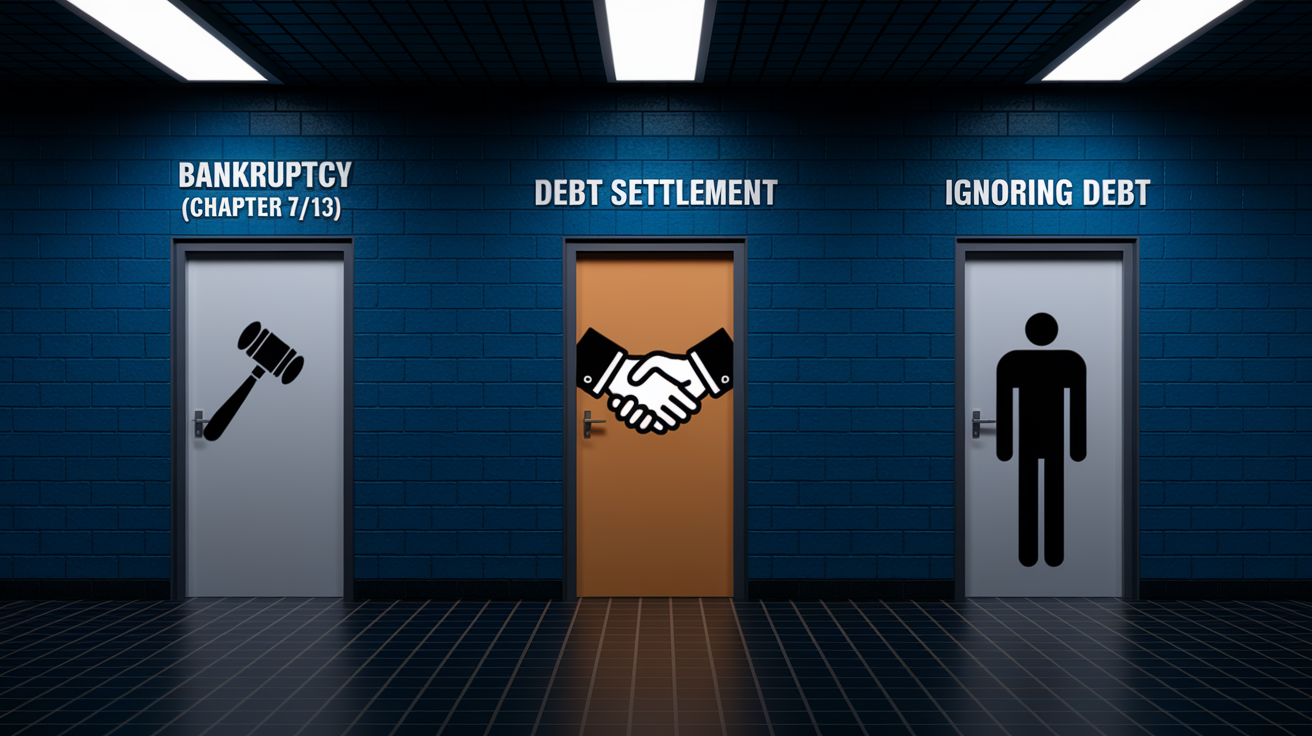
Bankruptcy stays on your credit report longer than debt settlement in most cases. Chapter 7 stays up to 10 years from the filing date. Chapter 13 stays 7 years. Settlement entries last 7 years from the first delinquency date. Bankruptcy generally hits your credit harder in the short term, but it can wipe out qualifying debts entirely. You walk away owing nothing, while settlement still requires you to pay a portion and may trigger tax consequences on the forgiven amount. If your total debts are massive, your income is low, and you don’t have much to protect, Chapter 7 might offer faster relief despite the longer reporting period. Settlement makes more sense when you can negotiate big reductions, want to avoid the public record of bankruptcy, and can manage lump-sum or short payment plans.
Ignoring debt entirely is usually the worst call. Stop paying and take no action, and creditors will charge off your accounts, send them to collections, and maybe file lawsuits to get judgments. A judgment allows wage garnishment, bank account levies, and liens on property in many states. Collection accounts appear on your credit report for seven years. Public judgments (where still reported) can kill your ability to rent, get utilities without deposits, or qualify for any credit. Active collections and lawsuits also add legal fees and court costs to your debt balance.
Debt consolidation and debt management plans (DMPs) can be middle-ground options. Consolidation uses a new personal loan or home-equity loan to pay off high-interest accounts. Your credit report shows those old accounts as “paid in full,” and you’re left with a single fixed payment. This works only if you can qualify for the loan and avoid running up the paid-off cards again. A DMP, arranged through a nonprofit credit counseling agency, negotiates lower interest rates with creditors and consolidates payments without a new loan. Creditors may require you to close participating accounts, but the accounts are often reported as “paying under a management plan” rather than “settled,” which is less damaging. DMPs typically last three to five years and charge modest monthly fees.
| Option | Credit Impact | Duration on Report | Key Risk |
|---|---|---|---|
| Debt Settlement | Significant negative; 65–125 point drop typical | 7 years from first delinquency | Tax on forgiven debt; fees; creditor may refuse |
| Chapter 7 Bankruptcy | Severe; larger initial drop | 10 years | Public record; asset liquidation possible |
| Ignoring Debt | Ongoing damage; collections, charge-offs, judgments | 7 years per derogatory item | Lawsuits, wage garnishment, liens |
| Debt Management Plan | Moderate; may show “management plan” status | Accounts closed; 7 years if any late marks | Requires creditor enrollment; 3–5 year commitment |
Additional Factors That Influence How Severe the Credit Impact Is
If your settled account was already sent to collections before you negotiated, the collections entry itself caused a separate score drop. Settling the debt doesn’t remove the collection mark. It updates the status to “settled” or “paid,” but the derogatory entry remains for seven years. Multiple collection accounts from the same original debt can appear if the debt got sold to different agencies. That compounds the damage. Creditors may also close your account when they accept a settlement, which reduces your total available credit and can raise your utilization ratio on remaining accounts. A closed account with a settled status is worse for your score than an open account in good standing.
Existing bad marks sometimes limit how much more damage a settlement can do. If you already have two charge-offs and three collection accounts on your report, your score is already low. Settling one more account may only cause a small incremental drop. The flip side? A borrower with an otherwise clean file will see a sharper decline because the settlement is a new and major negative event in an otherwise positive history.
Four variables that really matter:
- Collections activity and whether the debt got sold multiple times
- Whether the creditor closed the account at settlement, cutting your total available credit
- The age of your credit file and whether you have other positive accounts to offset the damage
- Your total number of open accounts and overall utilization before settlement
Rebuilding Credit After a Debt Settlement

Recovery doesn’t take seven years. Scores can start improving within six to twelve months if you stop missing payments immediately, reduce your credit utilization, and add new positive payment history. The settled account stays on your report as a negative mark, but its impact fades over time, especially as you stack months of on-time payments and show you can use credit responsibly. Lenders care most about recent behavior. Consistent performance over one to three years can make you eligible for new credit even while the settlement is still visible.
Secured credit cards and credit-builder loans are two of the fastest rebuilding tools. A secured card needs a cash deposit (often $200 to $500) that becomes your credit limit. You use the card for small purchases and pay the balance in full each month. The issuer reports your on-time payments to the bureaus, which helps rebuild payment history. Credit-builder loans work in reverse. The lender holds the loan amount in a savings account while you make monthly payments. When the loan term ends, you get the funds. Both products are designed for people with damaged credit and typically have high approval rates. Adding one or both within three months of settling gives you fresh positive accounts that begin to offset the settlement’s weight.
Review your credit reports every few months to confirm that settled accounts are reported accurately. Creditors sometimes make errors (reporting an account as unpaid when it was settled, listing the wrong settlement date, failing to update the balance to zero). Dispute inaccuracies with the bureaus in writing and keep copies of your settlement agreement and proof of payment. If a creditor reports a settled account as “charged off” without noting the settlement, request a correction. Accurate reporting won’t remove the negative mark, but it makes sure lenders see the most current status and that the seven-year clock is calculated correctly.
Five steps for fast rebuilding:
- Make every payment on time across all remaining accounts starting immediately. Set up autopay to avoid mistakes.
- Reduce revolving credit utilization to below 30 percent, ideally below 10 percent, within three to six months.
- Open one secured credit card or credit-builder loan within 90 days of settlement and use it responsibly.
- Avoid applying for new credit unnecessarily. Limit hard inquiries to essential needs only.
- Pull your credit reports quarterly and dispute any errors related to settled accounts, balances, or dates.
Tax, Legal, and Fee Consequences Related to Debt Settlement
When a creditor forgives $600 or more of your debt, the IRS may treat that forgiven amount as taxable income. The creditor will send you Form 1099-C, and you must report it on your tax return unless you qualify for an exclusion. The most common exclusion is insolvency. If your total debts exceeded your total assets immediately before the settlement, you may exclude some or all of the forgiven debt from income. You’ll need to file IRS Form 982 and calculate your insolvency amount, which can get complex. Plan for a potential tax bill when you settle, or talk to a tax professional to figure out whether you qualify for relief.
Settlement doesn’t stop creditors from suing you before you finalize an agreement. Many creditors will negotiate while a lawsuit is pending, but some will pursue a judgment if they think they can collect more through wage garnishment or asset seizure. Settlement companies typically tell you to stop making payments while they negotiate, which extends the period of delinquency and increases the risk of legal action. If you use a settlement company, expect to pay fees ranging from 15 to 25 percent of your enrolled debt or the amount forgiven. Those fees come on top of the settlement payment itself. A $10,000 debt settled for $5,000 might cost you $5,000 plus $1,250 in company fees.
Four key cautions:
- Forgiven debt above $600 may generate a 1099-C and taxable income unless you qualify for insolvency exclusion.
- Creditors can file lawsuits during negotiation. Settlement doesn’t guarantee immunity from legal action.
- Third-party settlement companies charge 15–25 percent fees. DIY negotiation avoids those costs but requires direct creditor contact.
- Interest and fees continue to accrue on your debt while you save for a lump-sum settlement, potentially increasing the total owed.
DIY Debt Settlement vs Using a Settlement Company

Negotiating directly with creditors eliminates third-party fees and gives you full control over timing and offer amounts. Start by reviewing your budget to figure out how much you can realistically pay in a lump sum or over a short payment plan (three to six months is common). Contact the creditor’s collections or hardship department, explain your financial situation, and propose a settlement offer. Begin lower than your maximum (for example, offer 30 percent of the balance if you can afford 50 percent) to leave room for negotiation. Get any agreement in writing before you send payment. Confirm that the creditor will report the account as “settled” and update the balance to zero. DIY works best when you have a lump sum available, can handle phone negotiations calmly, and want to avoid fees.
Settlement companies handle the negotiation process for you. You stop paying creditors and instead deposit money into a dedicated account each month. Once enough funds pile up, the company contacts creditors and negotiates settlements on your behalf. This spreads payments over time, which can be easier on your budget, but it also extends the period of missed payments and delinquency. Most companies charge a percentage of the enrolled debt or the debt reduction they achieve. Some require you to enroll multiple accounts to participate. You lose direct control over which debts are settled first and in what order. There’s no guarantee every creditor will agree.
Scam Red Flags
- Demands upfront fees before negotiating or settling any debt. This violates Federal Trade Commission rules.
- Claims to work with a “new government program” that eliminates debt quickly or guarantees results.
- Tells you to stop all communication with creditors without explaining that missed payments will damage your credit and invite lawsuits.
- Promises to settle all your debts for “pennies on the dollar” or guarantees specific outcomes.
- Refuses to provide written contracts, fee schedules, or disclosure of risks before you enroll.
Using a company may make sense if you’re overwhelmed, lack confidence negotiating, or have multiple debts and need a structured plan to accumulate settlement funds. Choose a company with a solid reputation, transparent fee structure, and accreditation from organizations like the American Fair Credit Council. Confirm they’ll provide written settlement agreements before you authorize any payments and that they disclose all tax, legal, and credit consequences up front.
Practical Timeline: Credit Score Recovery After Debt Settlement

In the first zero to six months after settlement, your score will likely hit its lowest point. The settled account posts to your credit report with a derogatory label, and any late payments leading up to settlement continue to weigh on your payment history. During this period, focus on stopping further damage. Make every payment on time for your remaining accounts, avoid new credit applications unless absolutely necessary, and start reducing revolving balances. Even small improvements in utilization (dropping from 80 percent to 50 percent, for example) can produce modest score gains within a few months.
Between six and 24 months, real recovery becomes possible if you’ve established consistent on-time payments and added new positive accounts. A secured credit card or credit-builder loan that reports monthly will begin to dilute the impact of the settled account. Lenders start to see recent positive behavior, and scoring models give more weight to the last 12 to 24 months of activity. Many borrowers see improvements of 50 to 100 points during this window, depending on how much utilization they’ve reduced and how many new positive accounts they’ve opened. Your score won’t return to pre-settlement levels yet, but you may qualify for some mainstream credit products with higher interest rates and lower limits.
From two to five years, the settled account ages and its negative weight continues to fade. If you’ve maintained clean payment history and kept utilization low, your score can rebound significantly. Often you’ll reach levels that allow approval for car loans, mortgages (with higher rates), and unsecured credit cards. At the seven-year mark, the settled account falls off your credit report entirely, which can produce a noticeable score jump. The exact size of that jump depends on what else is on your report at that time. If you’ve built a strong positive file over seven years, the removal of the old settlement may only add 20 to 40 points. But it removes a visible red flag that some lenders use as an automatic decline reason.
Four stages with time ranges:
- 0–6 months: Score at lowest point. Focus on stopping new damage and stabilizing payments.
- 6–24 months: Early recovery phase. New positive accounts and lower utilization can produce 50–100 point gains.
- 2–5 years: Medium-term rebuilding. Consistent behavior restores access to mainstream credit with improving terms.
- 7+ years: Settled account removed. Final score improvement and full restoration of creditworthiness for most lenders.
Final Words
You saw the immediate effect: debt settlement commonly knocks 65–125 points off a score and is reported as “settled” or “paid-settled,” which stays on file for up to seven years.
We covered why scores drop (missed payments, charge-offs), compared settlement with bankruptcy and non-payment, and flagged tax, legal, and fee risks.
If you do one thing now, lower your utilization, make every payment on time, and add a secured card or credit-builder loan.
If you’re asking what happens to credit score after debt settlement, steady rebuilding usually brings meaningful gains within 1–3 years.
FAQ
Q: Will my credit score go up if I settle a debt?
A: Settling a debt usually won’t raise your credit score immediately. Settlement often causes a 65–125 point drop, but consistent on-time payments and lower credit utilization can rebuild your score over months to years.
Q: How low will my credit score drop after debt settlement?
A: The credit score can drop about 65–125 points after settlement. Higher starting scores usually fall more; the size depends on missed payments, charge-offs, utilization, and how many accounts were settled.
Q: How long does it take for your credit score to improve after debt settlement?
A: After debt settlement, your score often begins improving in 6–24 months, with noticeable gains in 1–3 years. Speed depends on adding on-time payments, lowering utilization, and fixing reporting errors.
Q: Why did my credit score drop 40 points after paying off debt?
A: A 40-point drop after paying off debt likely happened because the account was reported as settled or closed, or because earlier missed payments and reduced available credit raised your utilization temporarily.