


Debt relief sounds like a bailout, and debt consolidation sounds like neat simplification, but they work very differently.
One reduces what you owe by negotiating settlements.
The other restructures multiple balances into one loan or card so you keep paying the full amount.
If you have steady income and decent credit, consolidation often lowers interest and helps rebuild your score.
If you’re already behind and can’t pay the full balance, relief can cut principal but will damage credit and may create a tax bill.
This post gives a simple rule and the first steps to take next.
Clear Comparison Overview of Debt Relief vs Debt Consolidation

Debt consolidation reorganizes multiple debts into one payment without cutting what you owe. You’re looking at personal loans (APR usually 6% to 36%), balance-transfer credit cards (0% intro APR for 12 to 21 months), or home-equity loans and HELOCs (typically 4% to 8%). The whole point is simpler payments and less interest. Debt relief reduces the actual balance through negotiation. Creditors accept settlements at 40% to 50% of what you originally owed, though the range runs anywhere from 30% to 60% depending on your account status and how much leverage you have. Settlement timelines usually run 12 to 48 months.
The core difference? Restructure versus reduce. Consolidation keeps your full debt intact and focuses on a lower rate, easier payments, and a fixed timeline. You pay back everything you borrowed, just under better terms. Relief negotiates the principal down and wipes out part of what you owe, but you’re getting credit damage, possible tax bills on forgiven amounts, and you need to show financial hardship or already be behind.
Each option fits different situations:
Choose consolidation if you’ve got stable income, decent credit (often 600 or higher), and want to rebuild while paying everything back at a lower rate.
Choose relief if you’re seriously behind, can’t realistically pay the full balance, and can accept short-term credit harm in exchange for principal reduction.
Consolidation works best when you qualify for an APR at least 5 to 10 percentage points lower than your current weighted average and you can commit to no new debt.
Relief makes sense when accounts are already 120-plus days delinquent, collections have started, and your monthly cash flow can’t support even a consolidated payment plan.
Debt Consolidation Methods and How They Work
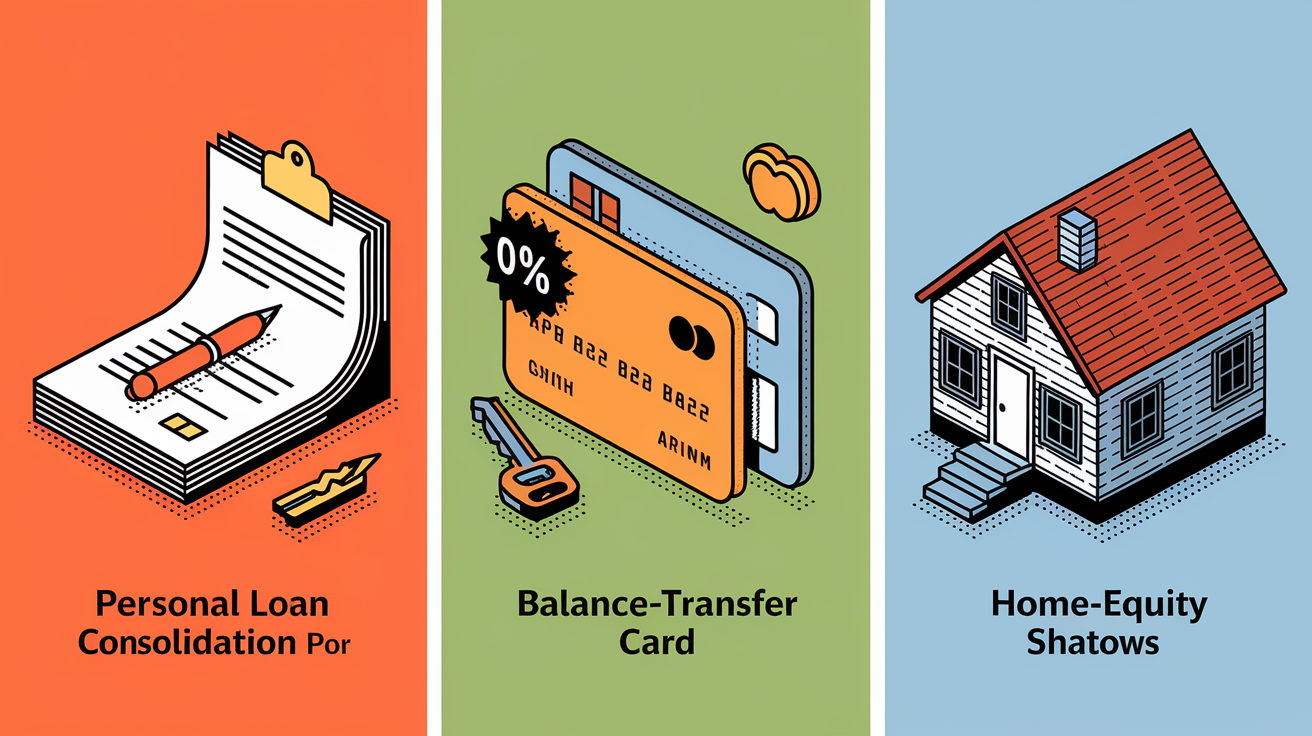
Consolidation combines multiple debts into a single monthly payment, usually through a new loan or credit product that pays off your existing balances. You still owe the full principal. The new terms just simplify your life and often cut your interest rate.
Personal Loan Consolidation
A personal loan for consolidation is an unsecured installment loan that pays off your credit cards, medical bills, or other debts. Lenders offer APRs from 6% to 36%, depending on your credit score and income. Most want credit scores of 600 or higher, and the best rates (below 10%) usually go to borrowers with scores around 680 to 740 or above. Origination fees run 1% to 6% of the loan amount, charged up front or rolled into the balance. Loan terms commonly range from 24 to 84 months. If you have a score of 680 and qualify for a 10% APR on a $20,000 loan over 60 months, your monthly payment is about $413 and you’ll pay roughly $4,800 in interest.
Balance-Transfer Card Consolidation
A balance-transfer credit card lets you move existing credit-card balances onto one card, often with a promotional 0% APR for 12 to 21 months. Issuers charge a one-time transfer fee of 3% to 5% of the amount transferred. Transfer $10,000 with a 3% fee and you pay $300 up front. The strategy works if you can pay off the balance before the intro period ends and the standard APR (often 18% to 25%) kicks in. You’ll need fair to good credit to get approved, typically a score in the mid 600s or higher. The risk is falling back into debt if you keep using the card for new purchases instead of paying down the transferred balance.
Home-Equity Based Consolidation
A home-equity loan or HELOC uses the equity in your home as collateral. Because the loan is secured, APRs are lower, typically 4% to 8%, and you can borrow larger amounts. Lenders require sufficient equity and acceptable loan-to-value ratios (often 80% to 85% maximum). Here’s the key risk: your house. If you default, the lender can foreclose. This option converts unsecured debt (credit cards) into secured debt backed by your home. Closing costs and appraisal fees can add hundreds or thousands to the upfront expense. Use this method only if your income is stable and you’re confident you can make every payment.
| Method | Typical APR | Key Risk |
|---|---|---|
| Personal Loan | 6% to 36% | High APR if credit is weak; origination fees 1% to 6% |
| Balance-Transfer Card | 0% intro (12–21 months), then 18%–25% | Balance not paid before promo ends accrues high APR; 3%–5% transfer fee |
| Home-Equity Loan/HELOC | 4% to 8% | Home is collateral; foreclosure risk if you default |
How Debt Relief and Negotiated Settlement Operate

Debt relief works by negotiating with creditors to accept less than the full balance you owe. You (or a professional negotiator) propose a lump-sum or structured settlement payment, and the creditor agrees to cancel the remaining debt. To build leverage, most settlement programs require you to stop making monthly payments and instead deposit money into a dedicated settlement fund. Missing payments pushes accounts into delinquency or collections, which motivates creditors to negotiate. Once the fund has enough cash, the negotiator offers a settlement, typically 30% to 60% of the original balance. The most common outcome is around 40% to 50% of what you owe.
Professional debt-settlement firms charge fees of 15% to 25% of the enrolled or settled debt, depending on the fee structure and state regulations. Settle $20,000 in debt for $10,000 and the firm’s fee is 20% of the enrolled amount? You’ll pay $4,000 in fees on top of the $10,000 settlement. Some firms charge based on settled amounts, others on enrolled balances. Settlement timelines range from 12 to 48 months. During that period, creditors continue collection calls, report delinquencies, or file lawsuits. Not every creditor will settle. There’s no guarantee of acceptance.
The process carries risks. Your credit score drops as accounts go delinquent, late payments appear on your credit report, and accounts get charged off or sent to collections. Creditors can sue and win judgments that allow wage garnishment in some states. Forgiven debt over $600 typically triggers IRS Form 1099-C, making the cancelled amount taxable income unless you qualify for an insolvency exception.
Common debts eligible for relief:
Credit card balances, medical bills (varies by creditor), unsecured personal loans, private student loans (federal student loans are generally ineligible), certain payday loans (restrictions apply).
Credit Score Impact of Relief vs Consolidation
Consolidation causes a small short-term dip when the lender runs a hard credit inquiry and opens a new account. Use a personal loan to pay off credit cards and keep those card accounts open with zero balances? Your credit-utilization ratio drops, which often improves your score within 6 to 24 months. On-time payments on the new loan build positive payment history. If your credit was fair before consolidation and you make every payment on schedule, you can see measurable score gains over 12 to 36 months.
Debt settlement hits harder. Stopping payments to fund a settlement account triggers delinquencies, and accounts reported as “settled for less than full” or “paid settled” appear less favorable than “paid as agreed.” Late and missed payments stay on your credit report for up to 7 years. Settled accounts can remain for the same period. Typical score drops range from 50 to 160 points, depending on your starting score and overall credit mix. If accounts were already delinquent or in collections before you enrolled in settlement, the additional damage is smaller than if you had a clean payment history. Recovery takes time, sometimes several years of on-time payments on any remaining accounts.
Steps to rebuild credit after either option:
Make every payment on time on any remaining debts, utilities, or new credit accounts to build positive history.
Keep credit-card balances low relative to limits. Aim for utilization below 30%, ideally below 10%.
Monitor your credit reports every few months through the free annual reports and dispute any errors promptly.
Avoid opening multiple new accounts quickly, which can trigger hard inquiries and lower the average age of your credit.
Cost, Fee, and Tax Differences Between Debt Relief and Debt Consolidation

Consolidation costs come from interest and fees on the new loan or card. Personal loans charge origination fees of 1% to 6% of the loan amount, so a $15,000 loan with a 3% fee adds $450 up front. Balance-transfer cards charge 3% to 5% of the transferred balance. Home-equity products carry closing costs, appraisal fees, and other charges similar to a mortgage refinance. The main cost driver is the interest rate. Consolidate $20,000 at 10% APR over 60 months and you’ll pay roughly $4,800 in interest. If your old cards averaged 20% APR, you would have paid about $11,800 in interest over the same period making minimum payments. That’s a savings of about $7,000 in interest.
Debt relief costs include professional fees and potential taxes. Settlement firms typically charge 15% to 25% of enrolled or settled debt. Enroll $25,000 and the firm charges 20% of enrolled debt? That’s $5,000 in fees. On top of that, forgiven debt over $600 triggers IRS Form 1099-C, which reports the cancelled amount as taxable income. A creditor forgives $10,000 and you’re in the 22% marginal tax bracket? You owe $2,200 in federal taxes unless you qualify for the insolvency exception. Insolvency means your total liabilities exceeded your total assets immediately before the settlement. You’ll need to file IRS Form 982 and calculate the insolvency amount. The tax exposure can be significant, so consult a tax professional before settling.
Interest is a major cost difference. Consolidation continues to accrue interest on the full principal, but at a lower rate. Settlement stops interest on forgiven portions, but you pay taxes on the forgiven amount and fees to the settlement company. Total cost depends on your situation. Run the numbers on interest, fees, and taxes before choosing.
| Option | Typical Fees | Tax Exposure | Cost Drivers |
|---|---|---|---|
| Consolidation Loan | Origination 1%–6%; transfer fees 3%–5% | None | Interest rate, loan term, origination fee |
| Balance-Transfer Card | 3%–5% transfer fee | None | Transfer fee, APR after intro period if balance remains |
| Home Equity | Closing costs, appraisal fees | None | Interest rate, closing costs, risk of foreclosure |
| Debt Settlement | 15%–25% of enrolled/settled debt | Tax on forgiven amounts unless insolvent | Settlement percentage, firm fees, tax liability, credit damage |
Eligibility Requirements for Consolidation vs Relief
Consolidation requires qualifying for a new loan or credit product. Lenders want a credit score of at least 600, and the best rates go to borrowers with scores around 680 to 740 or higher. Lenders also review your debt-to-income ratio (DTI), which compares your monthly debt payments to your gross monthly income. Most lenders prefer DTI below 40% to 50%. You’ll need proof of steady income, acceptable employment history, and sometimes collateral if using a home-equity product. If your credit is weak or income is unstable, you won’t qualify for a rate low enough to make consolidation worthwhile.
Debt-settlement programs generally require a minimum amount of unsecured debt, often $7,500 to $10,000 or more. You need to demonstrate financial hardship or an inability to pay the full balances. Many programs expect you to be behind on payments or willing to stop paying to build a settlement fund. If your accounts are current and your credit is strong, creditors have little incentive to settle. Settlement works best for unsecured debt like credit cards, medical bills, and some personal loans. Secured debts (mortgages, auto loans) and federal student loans aren’t eligible.
Lenders and counselors often request the following:
Recent pay stubs or proof of income (last 2 to 3 months), tax returns from the past 1 to 2 years, government-issued photo ID, list of current debts with balances, interest rates, and creditor names, bank statements showing account balances and cash flow.
Numeric Examples Showing the Difference Between Debt Relief and Debt Consolidation

You owe $20,000 across multiple credit cards at an average APR of 20%. Make monthly payments of $531 (covering interest and principal), and it’ll take about 60 months to pay off the debt. You’ll pay roughly $11,800 in interest over that period. Total cash out of pocket: about $31,800.
Consolidate that $20,000 with a personal loan at 10% APR over 60 months and your monthly payment drops to about $413. Total interest over the life of the loan is roughly $4,800, so you pay about $24,800 in total. You save about $7,000 in interest and lower your monthly obligation by around $118. The trade-off is the origination fee, say 3% on $20,000, or $600. That’s still a net savings of roughly $6,400 over five years.
Pursue debt settlement and negotiate a 50% reduction? You’d aim to pay $10,000 total over 24 months, or about $417 per month into a settlement fund. Once the fund is large enough, the settlement company negotiates with creditors. Assuming a 20% fee on the $20,000 enrolled debt, you’d pay $4,000 in fees. Your total cash outlay is $10,000 (settlement) plus $4,000 (fees), or $14,000. If the $10,000 forgiven amount is taxable and you’re in the 22% bracket, add roughly $2,200 in taxes, bringing your total to about $16,200. You save about $15,600 compared to paying the full $31,800, but your credit takes a significant hit and the forgiven amount is taxable income.
| Option | Total Paid | Time | Risks |
|---|---|---|---|
| Minimum Payments (20% APR) | ~$31,800 | ~60 months | High interest cost; long repayment; risk of missing payments |
| Consolidation Loan (10% APR) | ~$24,800 (plus ~$600 origination) | 60 months | Must qualify; risk of re-accumulating card debt; full principal still owed |
| Settlement (50% reduction) | ~$10,000 settlement + $4,000 fees + ~$2,200 tax = ~$16,200 | 24 months to settle | Credit damage; tax liability; collections/lawsuits; no guarantee of acceptance |
Pros and Cons Comparison Covering Both Options
Consolidation and relief each have clear benefits and drawbacks. Here’s a side-by-side look.
Debt Consolidation Pros:
Combines multiple payments into one monthly bill, simplifying budgeting. Can lower your interest rate and reduce total interest paid. Fixed monthly payment and clear payoff date. It can improve credit score over time if payments are on time and utilization drops. No reduction in principal owed, so no tax consequences on forgiven debt.
Debt Consolidation Cons:
Doesn’t reduce the total amount you owe, only restructures it. Extending the loan term can increase total interest paid despite a lower rate. Origination fees, transfer fees, or closing costs add upfront expense. Requires qualifying for a new loan, which is difficult with poor credit. Risk of re-accumulating credit-card debt if spending habits don’t change.
Debt Relief Pros:
Reduces the principal balance you owe, potentially by 40% to 60%. Monthly contributions to settlement fund are lower than combined minimums. Can resolve debt faster than minimum-payment plans (often 12 to 48 months). Stops interest accrual on forgiven portions once settled. Professional negotiators reduce collection activity once agreements are in place.
Debt Relief Cons:
Damages credit score significantly. Settled accounts appear on reports for up to 7 years. Forgiven debt over $600 is taxable income unless you qualify for insolvency. Professional settlement firms charge fees of 15% to 25% of enrolled or settled debt. Creditors aren’t obligated to settle and can sue or pursue wage garnishment. Stopping payments to build a settlement fund increases collection calls and legal risk.
Choosing Between Debt Relief and Debt Consolidation Based on Your Situation

The right choice depends on your income, credit score, debt amount, and ability to repay. Consolidation makes sense when you can secure a lower APR (at least 5 to 10 percentage points below your current weighted average) and your monthly budget supports the new payment. Relief is the option when accounts are already 120-plus days delinquent, full repayment is unrealistic, and you can accept the credit and tax trade-offs.
Decision Checklist
Check your credit score and DTI. If your score is 600 or higher and DTI is below 40%, you likely qualify for consolidation.
Compare APRs. If a consolidation loan or balance-transfer card offers at least 5 to 10 points lower APR than your current debts, consolidation saves money.
Run the numbers on total cost. Calculate interest, fees, and taxes for both options. Include settlement firm fees and potential 1099-C tax liability for relief.
Assess your payment capacity. If your monthly income covers a realistic consolidation payment, choose that. If you can’t meet minimums and accounts are already delinquent, relief is the only path short of bankruptcy.
Review eligible debts. Consolidation works for most debts. Relief applies mainly to unsecured credit cards, medical bills, and some personal loans.
Evaluate credit impact and recovery time. If preserving or rebuilding credit is a priority, consolidation is safer. If you’re already deep in collections, the additional damage from settlement is manageable.
You have a steady job, a 680 credit score, and $15,000 in credit-card debt at 22% APR? Consolidating to a 9% personal loan saves thousands in interest and keeps your credit on track. You lost your job, your score is already 580, accounts are 150 days past due, and you owe $25,000 with no realistic way to pay it all? Settlement might cut your total obligation in half despite the credit hit and possible tax bill.
Final Words
You saw the side-by-side: consolidation keeps your balance but simplifies payments and can lower APR (personal loans 6–36%). Debt relief negotiates a smaller payoff, often settling for about 40–50% over 12–48 months.
Main difference: restructure versus reduce. If you can qualify for a lower APR and stay current, consolidation usually wins. If accounts are seriously delinquent and full repayment isn’t realistic, settlement may be the better option.
Next: check your credit score, compare total costs, and get quotes. Understanding the difference between debt relief and debt consolidation gives you a clear next move.
FAQ
Q: How much is the payment on a $50,000 consolidation loan?
A: The payment on a $50,000 consolidation loan depends on APR and term; for example, at 10% APR over 60 months it’s about $1,064/month, and at 8% APR over 120 months about $607/month.
Q: What two debts cannot be erased?
A: The two debts that cannot be erased are most student loans and court-ordered obligations like child support or alimony, which generally survive settlement or bankruptcy.
Q: What are the disadvantages of debt relief?
A: The disadvantages of debt relief include major credit-score damage, fees (often 15–25%), possible tax on forgiven amounts, continued collections or lawsuit risk, and longer timelines (12–48 months).
Q: How to pay off $30,000 in debt in 1 year?
A: To pay off $30,000 in one year, pay about $2,500/month and combine spending cuts, extra income, balance-transfer or consolidation at lower APR, and one-time windfalls to hit the target.